

Hungary opens Communist-era secret police files: judges, bishops and politicians appear in the records

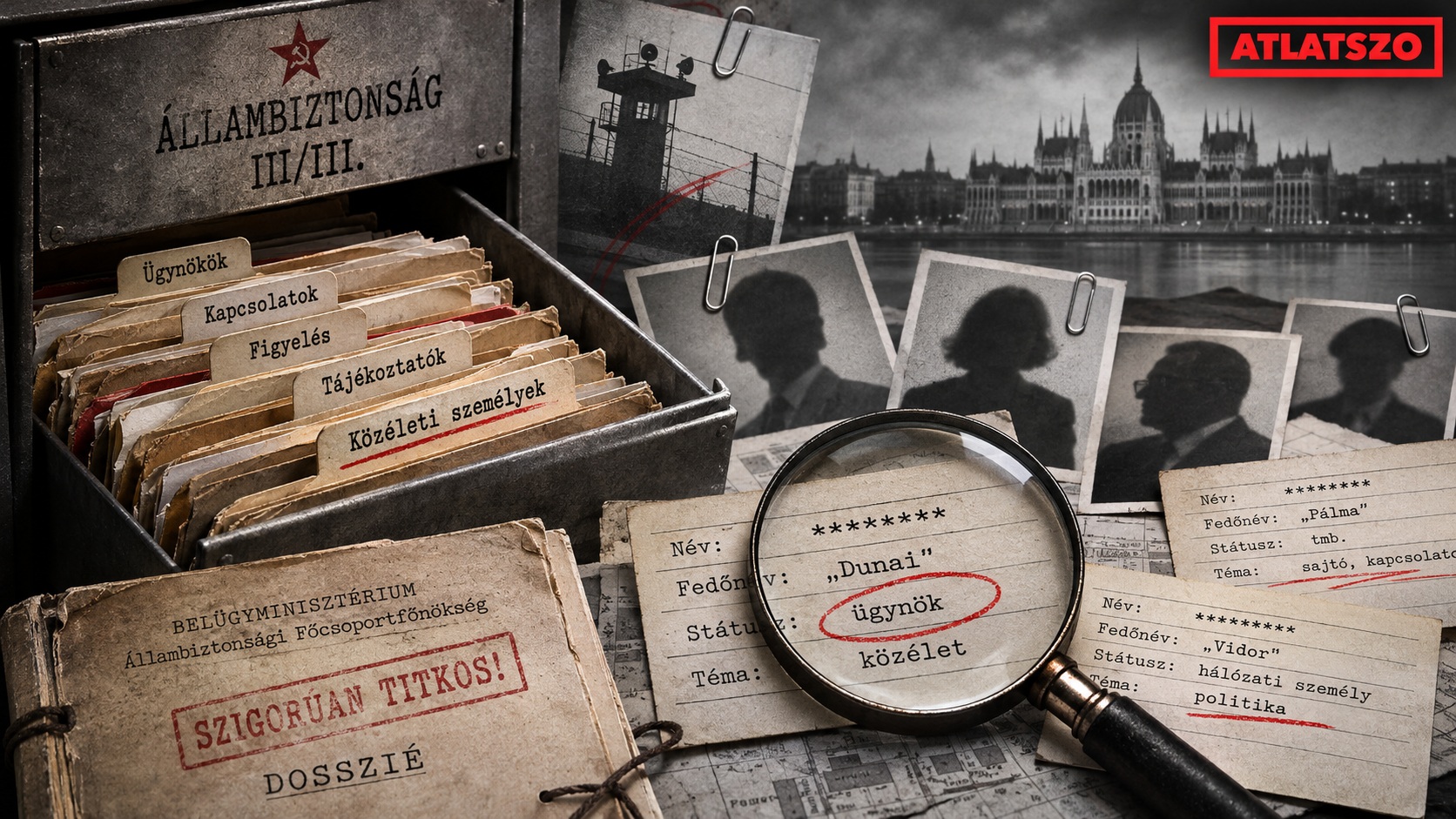
Thirty-six years after the fall of Communism, Hungary has opened a searchable database containing the names of tens of thousands of people registered by the former regime’s secret police. By comparing the newly released records with its own archive, Atlatszo identified around 50 public figures whose personal details match those in the database, including a Constitutional Court judge, former government officials, bishops and university leaders. However, historians warn that appearing in the records does not necessarily prove active collaboration.
On November 4, 2026, the 70th anniversary of the Soviet suppression of the Hungarian Revolution of 1956, the Historical Archives of the Hungarian State Security Services (ÁBTL) launched nyitottaktak.hu, making previously restricted Communist-era state security records publicly searchable.
The release marks a major step towards confronting one of Hungary’s most controversial historical legacies. While several other former Communist countries opened their secret police archives decades ago, Hungary’s attempts to uncover the activities of informants and collaborators remained politically contentious long after the democratic transition of 1989–1990.
The newly available material includes recruitment records, identification cards and information preserved on magnetic tapes. One database contains approximately 55,000 individuals. More detailed recruitment dossiers are scheduled for publication by February 25, 2027.
Atlatszo identifies dozens of public figures in the database
Atlatszo compared the newly released state security records with a database containing nearly 20,000 personal names extracted from its previous investigations.
The initial comparison produced more than 2,000 name matches, most of which could not establish identity. Further checks narrowed the results to approximately 50 public figures whose names and birth details corresponded to the historical records. These individuals had appeared in 268 Atlatszo articles covering political influence, public spending, church investments, universities and institutional controversies.
One of the most prominent names is Károly Szita, the long-serving mayor of Kaposvár, who appears under the codename “Péter Krakus”. His connections to Communist-era counterintelligence have been publicly discussed for years. Atlatszo first investigated his political and business networks in 2013.
Szita subsequently remained an influential local politician. His role in the city’s defence industry was also examined in our 2022 English-language investigation into Hungarian-Turkish military cooperation.
Another notable entry concerns András Patyi, a member of Hungary’s Constitutional Court and former rector of the National University of Public Service. A registration card identifies him under the codename “Márton Kocsis”, with a recruitment date of August 5, 1988, linked to the Communist political police’s domestic surveillance division.
The Constitutional Court has acknowledged the significance of the document but stated that it would assess the circumstances before reaching a substantive conclusion.
Former Foreign Ministry state secretary Iván Bába also appears in the records under the codename “Gyula”. Bába previously denied collaborating with the Communist secret services, citing a 1998 official screening decision. The newly published records do not establish whether he actually carried out intelligence-related activities.
László Borhy, who served as rector of Eötvös Loránd University between 2017 and 2025, is another prominent academic appearing in the records.
Church leaders and other prominent figures
The released files also contain the names of several senior Hungarian church officials.
László Kiss-Rigó, the Roman Catholic Bishop of Szeged-Csanád, appears under the codename “Lawrence”. His diocese has rejected suggestions that the registration card proves active collaboration, pointing to a final court ruling from 2009 that found allegations of actual recruitment unproven.
Atlatszo has previously investigated the bishop’s extensive state-funded investments, including a football stadium and other construction projects. His diocese also featured in our English-language report on the HUF 30 billion Hungarikum Park development.
Other religious figures appearing in the database include former Reformed Church leader Gusztáv Bölcskei, retired Catholic Bishop Miklós Beer and the late Cardinal László Paskai.
Beer has stated that he was unaware of being recruited. According to his account, unidentified men approached him for conversations on several occasions, but he was never informed that he was expected to perform intelligence tasks.
The records also include historian and publisher János Gyurgyák, who acknowledged that he had been recruited while a university student. He maintains that he never submitted reports and deliberately avoided cooperating. The records indicate that he was removed from the network in 1978.
Nobel Prize-winning scientist Katalin Karikó also appears in the database. She had already disclosed in 2021 that she signed a recruitment document after being threatened over her father’s involvement in the 1956 revolution. Karikó has consistently maintained that she never informed on anyone or caused harm to others.
A name in the files is not proof of collaboration
The revelations have revived a debate that has continued for more than three decades: how should Hungarian society distinguish between those who voluntarily informed on others, those recruited through intimidation, and those who were registered without meaningful cooperation?
The Communist state security apparatus relied on a wide range of relationships, not all of which involved formally recruited agents. Some individuals provided information as unofficial contacts, while others were pressured or blackmailed into signing documents.
Historian Krisztián Ungváry examined these distinctions in a 2019 investigation published by Atlatszo, concerning Endre Marinovich, who later became chief of staff to Hungary’s first post-Communist prime minister, József Antall. Marinovich disputed Ungváry’s interpretation of the documents and denied being a formally recruited agent.
The case illustrates why a simple list of names cannot fully explain the workings of a dictatorship’s surveillance system.
Historical records are also incomplete. Documents were destroyed or disappeared around the time of the democratic transition, while some surviving records reflect the subjective assessments or administrative practices of secret police officers.
The wider struggle for access to Hungary’s secret files
The opening of the Communist-era archives forms part of a broader debate about transparency and the preservation of historically significant state documents.
In an investigation published in October 2026, Atlatszo revealed that important files concerning Hungary’s organised crime scandals of the 1990s had disappeared, been destroyed or remained classified decades after the events.
The investigation found that some documents examined by a parliamentary committee had been destroyed after declassification, while two surviving dossiers remain secret until 2029 and 2042.
Although these records concern a different historical period, their fate demonstrates the lasting importance of preserving state documents and ensuring meaningful public access.
Atlatszo has also reported on alleged political surveillance during the more recent Orbán era. In a May 2026 investigation, a former employee of pro-government media described the alleged use of covert surveillance and intelligence-style dossiers against political opponents.
These investigations underline why transparency surrounding state security institutions remains relevant far beyond the Communist period.
A historic opening, but many questions remain
For the first time, Hungarian citizens can directly search extensive records documenting the Communist dictatorship’s informant networks.
The release may help historians reconstruct how the authorities monitored society, how individuals were recruited and how some former contacts of the security services subsequently pursued careers in democratic Hungary.
Nevertheless, the newly published registration cards cannot by themselves establish guilt, responsibility or even conscious participation in the surveillance network.
Further documents, testimony and historical research will be needed to distinguish genuine collaboration from attempted recruitment, coercion and administrative registration.
The opening of the archives is therefore not the end of Hungary’s long-running debate over its Communist past, but an opportunity to examine it with greater access to evidence than ever before.
The original Hungarian articles were published by Atlatszo on November 3, 2026 and November 5, 2026. This English summary was prepared with the assistance of artificial intelligence.
Share:
Your support matters. Your donation helps us to uncover the truth.
- PayPal
- Bank transfer
- Patreon
- Benevity
Support our work with a PayPal donation to the Átlátszónet Foundation! Thank you.
Support our work by bank transfer to the account of the Átlátszónet Foundation. Please add in the comments: “Donation”
Beneficiary: Átlátszónet Alapítvány, bank name and address: Raiffeisen Bank, H-1054 Budapest, Akadémia utca 6.
EUR: IBAN HU36 1201 1265 0142 5189 0040 0002
USD: IBAN HU36 1201 1265 0142 5189 0050 0009
HUF: IBAN HU78 1201 1265 0142 5189 0030 0005
SWIFT: UBRTHUHB
Be a follower on Patreon
Support us on Benevity!
