

Classified, destroyed, or missing: a decade-long quest to uncover files of organised crime
More than a quarter of a century after Hungary’s notorious 1990s oil scandals, crucial documents that could shed light on links between organized crime, the police and state institutions remain inaccessible. Some files have disappeared, others were destroyed after being declassified, while two surviving dossiers are still classified until 2029 and 2042. Journalist László Tamás Papp has spent years trying to reconstruct what happened to the records examined by a parliamentary inquiry into the oil mafia – and why so much of the story remains hidden.
Péter Magyar’s new government pledged to declassify documents ranging from the minutes of government meetings to files of the Communist-era secret police. However, there is one notable omission: documents related to the illegal oil trade of the 1990s, involving organized crime, police officers, and corruption reaching the highest echelons of the state remain unavailable.
In 2000, the Hungarian parliament established a committee to investigate crimes connected with so-called “oil bleaching”. In the early 1990s, diesel fuel used by motorists and household heating oil were subject to very different tax rates. Heating oil was therefore much cheaper and was dyed to distinguish it from diesel. Criminal groups chemically removed the coloring and sold the fuel as higher-priced diesel, pocketing the difference.
From tax fraud to murder
What started as small-scale fraud soon developed into one of post-Communist Hungary’s most lucrative criminal industry. Contemporary estimates put the losses to the Hungarian state budget at hundreds of billions of forints. A report by the Prosecutor General’s Office said that between 1991 and 1999 authorities identified some 4,300 crimes related to petroleum products, including forgery, smuggling and customs offences, and prosecuted 340 defendants.
The 2000 parliamentary inquiry was not limited to tax fraud. It investigated whether organized criminals had developed connections with state officials, police officers and customs personnel;
whether legislation and law enforcement practices had facilitated massive losses to the state;
and the deaths of five police officers in Békés County.
One particularly troubling case was that of police lieutenant colonel Mihály Kuzma, head of the Békés County police unit fighting organized crime. Kuzma shot himself in a police office in February 1998. His farewell letter referred to deliberate attempts to discredit him. Earlier investigations found irregularities in police actions against him, including the alteration of data relating to a traffic case and a major police operation directed at members of his family shortly before his death.
Despite the scale of these crimes, the major figures behind the business largely avoided serious convictions. The best-known company associated with the oil business was
Energol, whose circle included Tamás Portik, later convicted in connection with several murders.
However, criminal proceedings against Energol executives eventually collapsed. Contemporary reporting quoted the trial judge as sharply criticizing the prosecution: important circumstances had been omitted from the indictment, preventing the court from considering the full range of facts that had emerged during the case.
Classified for a lifetime
The parliamentary committee requested numerous classified files from state institutions. Atlatszo journalist László Tamás Papp has attempted to trace several of the most important documents. During the previous government, repeated questions to then interior minister Sándor Pintér produced no substantive answers. After the change of government in 2026, the new Interior Ministry headed by Gábor Pósfai provided the first detailed response:
of four Interior Ministry-related files being sought, three could no longer be found and a fourth had been destroyed.
One missing document is particularly mysterious: investigation file No. 405, referred to as the “Ukrainian investigation material”, which the parliamentary committee requested directly from Pintér in 2000. The committee’s own register noted at the time that no response had arrived.
According to Károly Tóth, a former Socialist member of the committee, the Interior Ministry provided several cabinets’ worth of files, but one highly sensitive dossier was subsequently taken back on the grounds that it had been sent by mistake. Tóth said this file had been classified for 85 years. According to information obtained by Atlatszo, committee members may briefly have been able to inspect the dossier in the Interior Ministry building before access was withdrawn.
We have asked the current Interior Ministry whether this dossier remains classified, who ordered its withdrawal, whether the decision was lawful, and whether an investigation was ever conducted into its supposedly accidental disclosure.
Missing evidence about police connections
The committee had also wanted to create an “oil map” identifying the owners and personal networks behind companies involved in the trade. Its final report complained that information supplied by prosecutors did not contain the ownership data essential to this work.
Despite the inquiry’s focus on possible police corruption, the 2000 report by the Prosecutor General’s Office said that
only one police officer had been charged with bribery in an oil-related case.
Our sources maintain that corruption was considerably more widespread, although such accounts are difficult to verify decades later.
Another missing classified document could have been important in establishing the extent of the problem. A report entitled Summary Reports, 1992–1999, submitted to the committee by the Interior Ministry’s internal security service, can no longer be located.
We have also investigated a potential link between the police and Energol. József Szabó, who chaired Energol’s supervisory board, was described during a 1997 police interrogation as someone who had allegedly served on the National Police Headquarters’ advisory body. The Interior Ministry told us that under the relevant regulation all members of that advisory body belonged to the police personnel but added that virtually no documentation concerning the body’s activities during the relevant period can now be found in the police archives. According to several sources, Szabó had previously worked for the police. Szabó could not be reached for comment.
We also sought to ask Portik about these connections, but a prison interview request submitted in August 2026 was rejected. This follows earlier restrictions on the newspaper’s attempts to interview people convicted in cases connected to organized crime: one interview with Portik was interrupted and subsequently banned from publication, while in another prison interview journalists were prevented from asking questions about alleged police connections.
A reform that could have stopped the fraud was removed
The parliamentary inquiry uncovered another unresolved question: why a proposed reform that could have eliminated the economic basis of oil bleaching was abandoned in 1993.
During the Antall government, officials recognized that abuses involving petroleum products were increasing rapidly. An expert body was established to examine, among other things, equalizing the tax treatment of diesel and household heating oil. An action plan originally contained a provision requiring experts to develop such a system – which, according to the parliamentary committee, could have eliminated the opportunity for fraud created by the dual pricing system.
However, the provision was deleted “at a special request”.
The surviving documentation examined by the committee did not establish whose request this was. The price and tax difference remained in place for more than another year and a half and was only abolished on May 1, 1995.
We repeatedly requested the government records that might identify who intervened. During the previous government, four information requests went unanswered. Under the new government, the Prime Minister’s Office rejected the request on the grounds that it was not the data owner of the records.
The missing Ukrainian investigation file is also important because of the international connections of Hungary’s oil mafia. The parliamentary committee concluded that violent crimes related to the oil trade were probably connected not only to major Hungarian criminal groups but also to Russian, Slovak, Ukrainian and Albanian criminal organizations. Investigative journalist András Dezső has documented connections between figures around Energol and Semion Mogilevich, a major post-Soviet organized crime figure.
Declassified – and then destroyed
Some records did not disappear: they were deliberately destroyed.
One was a classified report submitted to the committee by then national police chief Péter Orbán. Its classification was reviewed and lifted in 2014. Instead of being transferred to an archive where historians and journalists could eventually study it, however, the document was destroyed on November 2, 2015.
The National Police Headquarters told us that it had
no record of anybody applying to research the document between its declassification and destruction.
Police said the destruction protocol had been sent to the Hungarian National Archives, which approved the disposal.
Former senior archivist György Majtényi told us that this does not necessarily mean archivists examined the actual contents of the document. State bodies produce enormous quantities of material, and archives often have to decide whether records should be retained on the basis of their administrative classification rather than a detailed examination of every individual document.
Majtényi said that reports prepared by interior or defence ministers, national police chiefs and security agencies for governments or parliamentary committees on politically significant matters should normally be considered records of permanent historical value. Such documents should therefore not be destroyed, although errors in classification can make this possible in practice.
Military records examined by the oil committee met a similar fate. An eleven-page top-secret document submitted in 2000 by then defence minister János Szabó was classified until March 2010. Defence Ministry records show that it was subsequently selected for destruction and shredded in March 2011. The ministry found no evidence that anyone had applied to research it and, strikingly, no trace that the relevant archive had been consulted before its destruction.
Another Defence Ministry document requested by the parliamentary committee in October 2000 has simply disappeared. The ministry told us that it could not be found in its archives.
Two files survive but remain secret
Not every document has vanished. Two classified oil-related dossiers are still held by Parliament.
We submitted a public information request asking for their classification to be reviewed. The Constitutional Protection Office and the National Police Headquarters examined the files but decided that their secrecy should remain in force.
One document is classified until December 31, 2029; the other until December 31, 2042.
The fate of these records illustrates the broader problem surrounding Hungary’s oil scandals. Twenty-five years after Parliament investigated possible connections between organized crime, public officials and law enforcement agencies, some potentially crucial evidence has disappeared, some has been destroyed, and some remains secret.
The surviving records may eventually provide answers, but only if they reach the archives intact. The author of this article now plans to contact the Hungarian National Archives before the first dossier is declassified in 2029, to ensure that it is preserved rather than meeting the fate of other documents that disappeared or were shredded before the public could examine them.
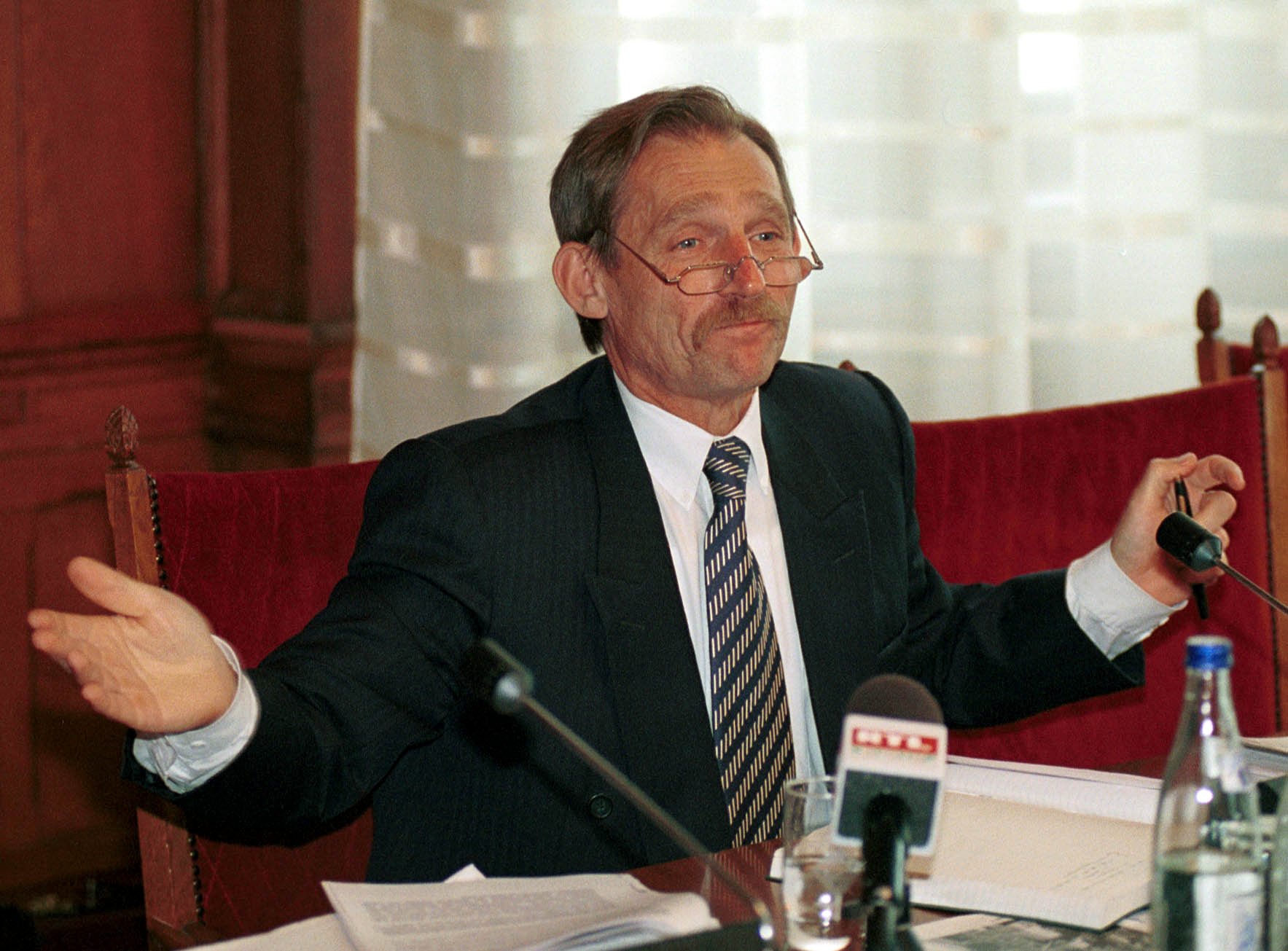
Written by László Tamás Papp. The english summary was prepared with the assistance of artificial intelligence. The original Hungarian version of the story can be found here. Cover image: Interior Minister and former national police chief Sándor Pintér testifying in front of the National Assembly’s investigative committee established to look into oil-related matters in 2000. Source:MTI / Szilárd Koszticsák.
Share:
Your support matters. Your donation helps us to uncover the truth.
- PayPal
- Bank transfer
- Patreon
- Benevity
Support our work with a PayPal donation to the Átlátszónet Foundation! Thank you.
Support our work by bank transfer to the account of the Átlátszónet Foundation. Please add in the comments: “Donation”
Beneficiary: Átlátszónet Alapítvány, bank name and address: Raiffeisen Bank, H-1054 Budapest, Akadémia utca 6.
EUR: IBAN HU36 1201 1265 0142 5189 0040 0002
USD: IBAN HU36 1201 1265 0142 5189 0050 0009
HUF: IBAN HU78 1201 1265 0142 5189 0030 0005
SWIFT: UBRTHUHB
Be a follower on Patreon
Support us on Benevity!
