

After Orbán’s defeat, Washington may fill in to fund the European far-right

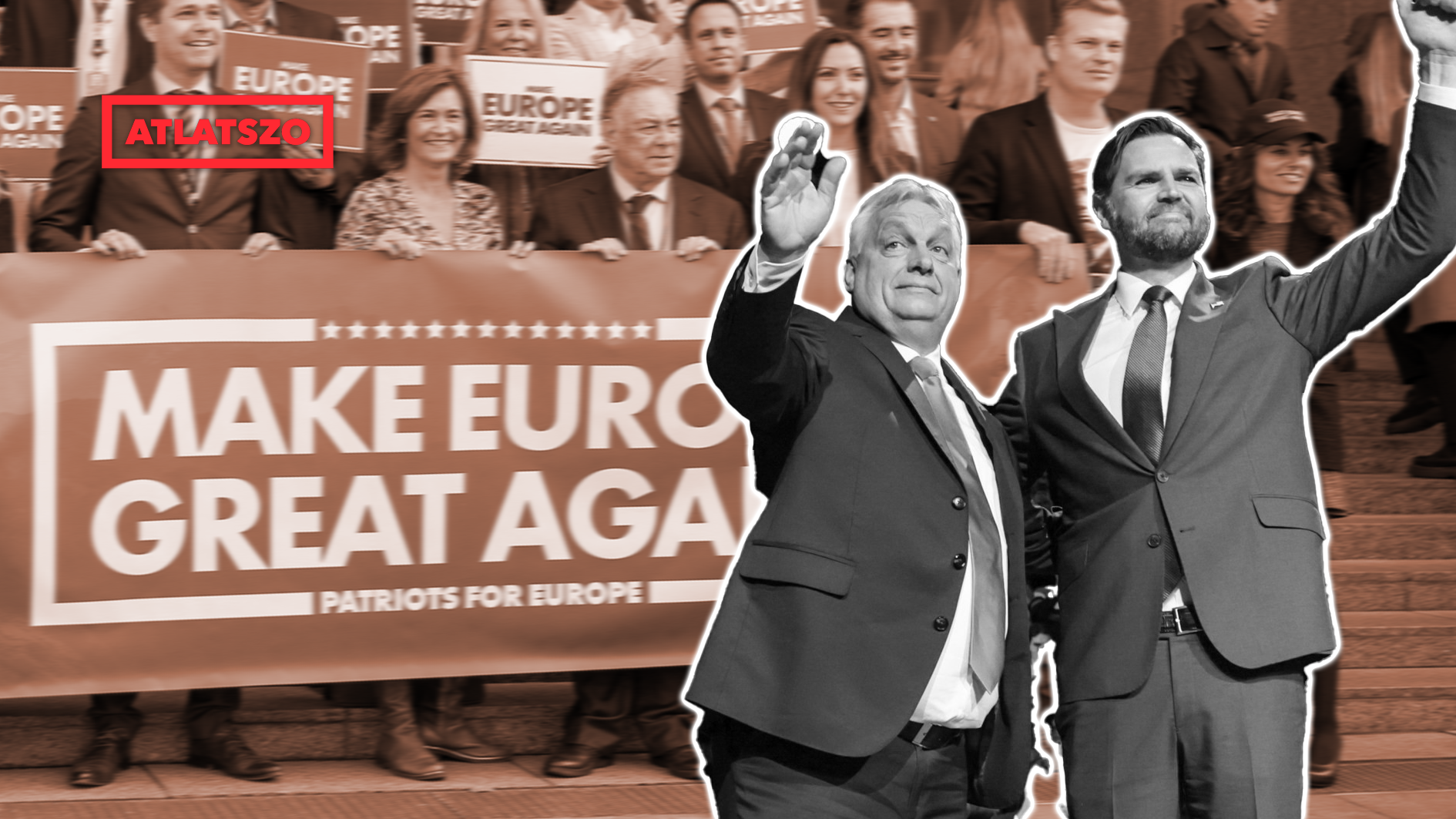
Just as Viktor Orbán departed to the United States, presumably to watch the World Cup finale, a new US State Department funding program was launched that has raised concerns that the Trump administration could seek to influence European politics by supporting organizations aligned with its anti-immigration, anti-big tech regulation, and “sovereignist” agenda.
On July 21 the Washington Examiner reported that during his US trip, former Hungarian Prime Minister Viktor Orrbán visited both the White House and the State Department in addition to attending World Cup matches. The newspaper could not confirm whom Orbán met what was discussed, but according to them, the trip suggested that the Trump administration had not abandoned one of its closest former European allies.
On July 13, the same day Orbán left for the United States, the US State Department announced a grant program, entitled “Advancing Civilizational Bonds, Democratic Resilience, and the Rule of Law in Europe”. The program appears to be designed to fund a network right-wing think tanks and influence groups in Europe – a network that previously the Orbán governments have spent a fortune to cultivate.
During Orbán’s years in power, Hungary became an important center of the European populist right.
A network of publicly funded foundations, think tanks and political organisations invested heavily in relationships with nationalist movements across Europe as well as the United States.
This network helped establish the Patriots group in the European Parliament, opened a Brussels office for Mathias Corvinus Collegium, and organized the CPAC Hungary conferences together with the American Conservative Union. Orbán’s allies went as far as to fund foreign politicians directly: Marine Le Pen, for example, received a loan from the oligarch Lőrinc Mészáros’s MKB Bank.
Since this network was largely fueled by public money, Orbán’s defeat in the 2026 April elections mean the end of a crucial revenue stream. However recent developments indicate that Washington could take over some of Budapest’s role in coordinating and supporting an international alliance of nationalist and anti-immigration forces.
The new State Department program offers almost $5 million for European projects promoting democratic resilience, freedom of expression, press freedom, human rights and the rule of law.
Eligible activities include research, conferences, cultural initiatives and civil society projects. The department expects to award two or three grants, each worth between $1 million and $3 million.
Although the program uses the language of democracy and human rights, its political priorities are clearly stated. The announcement claims that European governments are moving away from democratic principles because supranational bureaucracy is expanding and power is being concentrated in technocratic institutions.
It calls for greater respect for national sovereignty and responses to challenges including mass migration and violations of free speech. The language closely resembles arguments made by Vice-President JD Vance, Secretary of State Marco Rubio and other leading figures in the Trump administration.
From “America First” to civilizational mission
Trump’s first presidency was associated with the slogan “America First,” implying that the United States should focus primarily on its own interests. His second administration, however, has increasingly promoted the idea that
the MAGA movement has a wider mission across Western civilization.
According to this worldview, Europe is experiencing cultural and political decline. The European Union and national governments are accused of encouraging mass migration, restricting speech and abandoning traditional Western values. American conservatives therefore have a duty to save Europe – seen as the civilizational cradle of the US – by supporting like-minded European political movements, even when those movements oppose existing governments.
Vance expressed this position at the 2025 Munich Security Conference. He argued that Europe’s greatest danger did not come from Russia or China but from within. He accused European leaders and EU institutions of restricting free expression, supporting mass migration and turning away from fundamental values.
The same ideas appeared in the United States’ national security strategy, published last December. The document warned of Europe’s possible “civilizational erasure” while presenting the growing influence of “patriotic parties” as a positive development. This was widely interpreted as a reference to nationalist and far-right groups such as Germany’s Alternative for Germany, or AfD.
Elon Musk addressed an AfD event last year, while Vance met the party’s chancellor candidate, Alice Weidel, during the Munich conference.
Trump and Vance also openly supported Orbán during Hungary’s election campaign, with Vance personally appearing alongside Fidesz in April.
In July German Chancellor Friedrich Merz has warned that the new State Department program could be used to interfere in European elections. “We do not interfere in American elections,” Merz said, adding that he did not want the US government or government-linked institutions interfering in German elections.
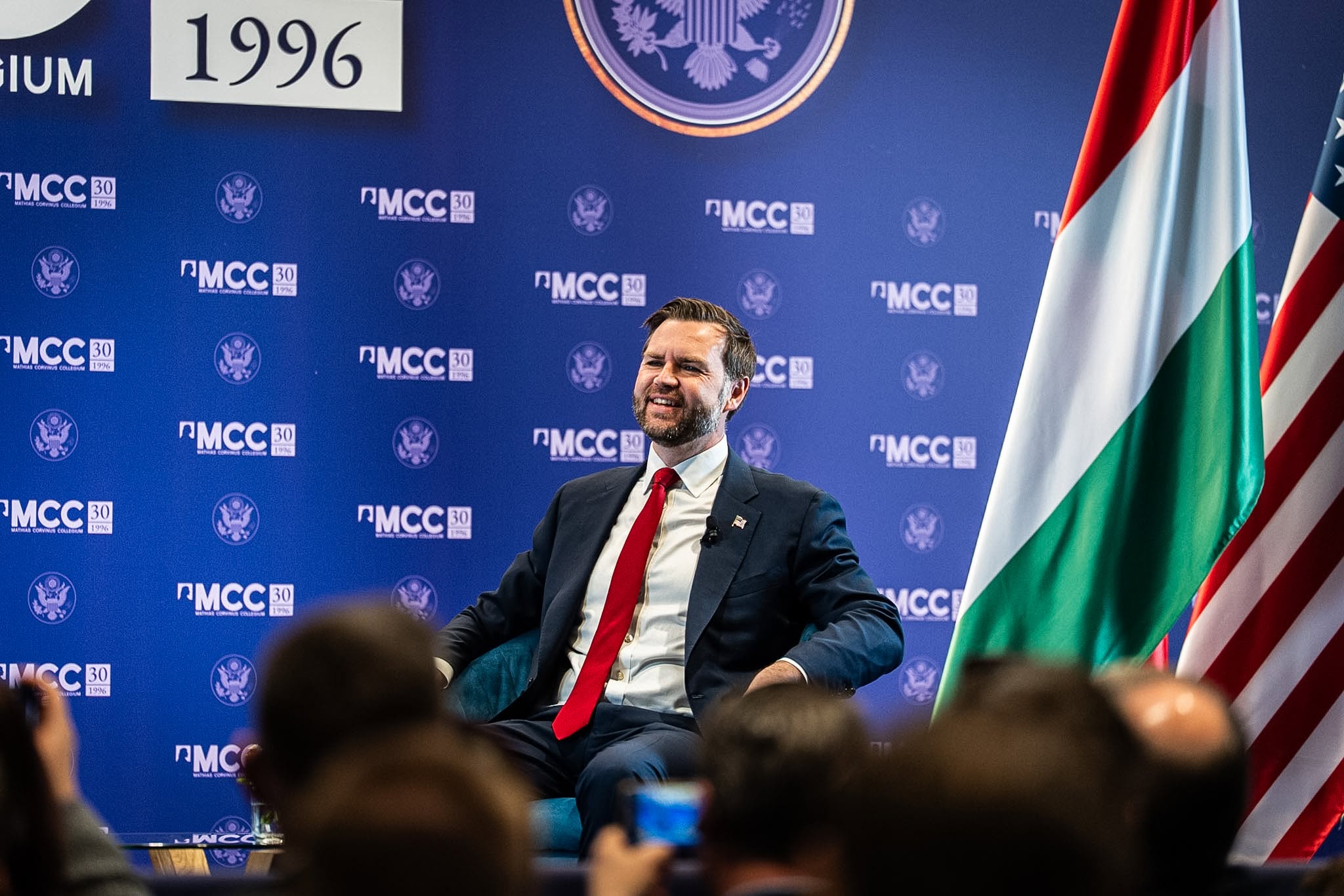
JD Vance at the MCC event in April 2026. Source: Facebook/Balázs Orbán
German law prohibits parties from receiving foreign funding, and US law also bans the use of federal money to finance foreign political parties directly. Political influence, however, can be exercised through think tanks, advocacy organizations, media initiatives, research projects and cultural groups.
The new program has broad eligibility rules. Non-profit organizations, companies, government institutions and private individuals may all apply.
Laying the groundwork
The funding initiative appears to have been preceded by discussions between State Department officials and conservative organizations across Europe.
In February, the Financial Times reported that State Department official Sarah Rogers travelled to Britain in December, where she met representatives of right-wing think tanks and Nigel Farage’s Reform UK party. The discussions reportedly concerned possible American support for British and European groups compatible with the MAGA movement.
Politico later reported that US officials had also met the French think tank Western Arc and Britain’s Free Speech Union. Both organizations were reportedly recommended by the Heritage Foundation, an influential American conservative institute that had compiled a list of ideologically aligned European groups and public figures.
The Heritage Foundation has close relationships with the Hungarian think-tank network established under Orbán. It is an official partner of the Danube Institute, which operates within the publicly financed Batthyány Lajos Foundation.
Western Arc founder Nicolas Conquer confirmed that his organization met US officials, including Samuel Samson of the State Department’s Bureau of Democracy, Human Rights and Labor (DRL).
Samson had previously attracted attention after reportedly suggesting that American public money could support Marine Le Pen’s campaign. Although that proposal was not implemented, French judge Magali Lafourcade later alleged that Samson and another American official travelled to France and lobbied on Le Pen’s behalf while she was on trial over the alleged misuse of European Parliament funds.
Lafourcade said the officials attempted to persuade her to circulate information they believed could assist Le Pen’s defense. She refused. Le Pen ultimately lost the case, although she avoided a lengthy ban from standing in elections.
Samson also visited Hungary in December, meeting Levente Magyar, then a state secretary at the Foreign Ministry, and speaking at the Hungarian Institute of International Affairs.
Rogers appeared in Budapest in February at the institute’s Budapest Global Dialogue 2026, alongside Viktor Orbán’s political director and the head of MCC, Balázs Orbán. The institute promoted her presentation under the title “Restoring Civilizational Confidence: Which Values Will Secure Our Future?”
In an interview with Mandiner a pro-government magazine published by the MCC, Rogers described the Orbán government as Washington’s closest ally within the alliance and criticised the European Union’s Digital Services Act.
Free speech and big tech interest
The program focus on freedom of expression is connected to a wider conflict between the Trump administration and the European Union over technology regulation.
American officials have repeatedly described European hate-speech laws and platform regulations as censorship.
However, the dispute also involves the commercial interests of large US technology companies.
The EU’s Digital Services Act places special obligations on major online platforms and search engines. Most of the companies affected are American businesses, including social media networks, online marketplaces, hosting providers and application platforms.
The legislation contains rules on data protection, content shown to children, illegal material, disinformation and hate speech. The Trump administration has increasingly presented these regulations as restrictions on free expression and unfair burdens on American companies.
Last year, the State Department reportedly instructed US diplomats to lobby against the law. The American government later imposed travel restrictions on several European officials involved in its implementation.
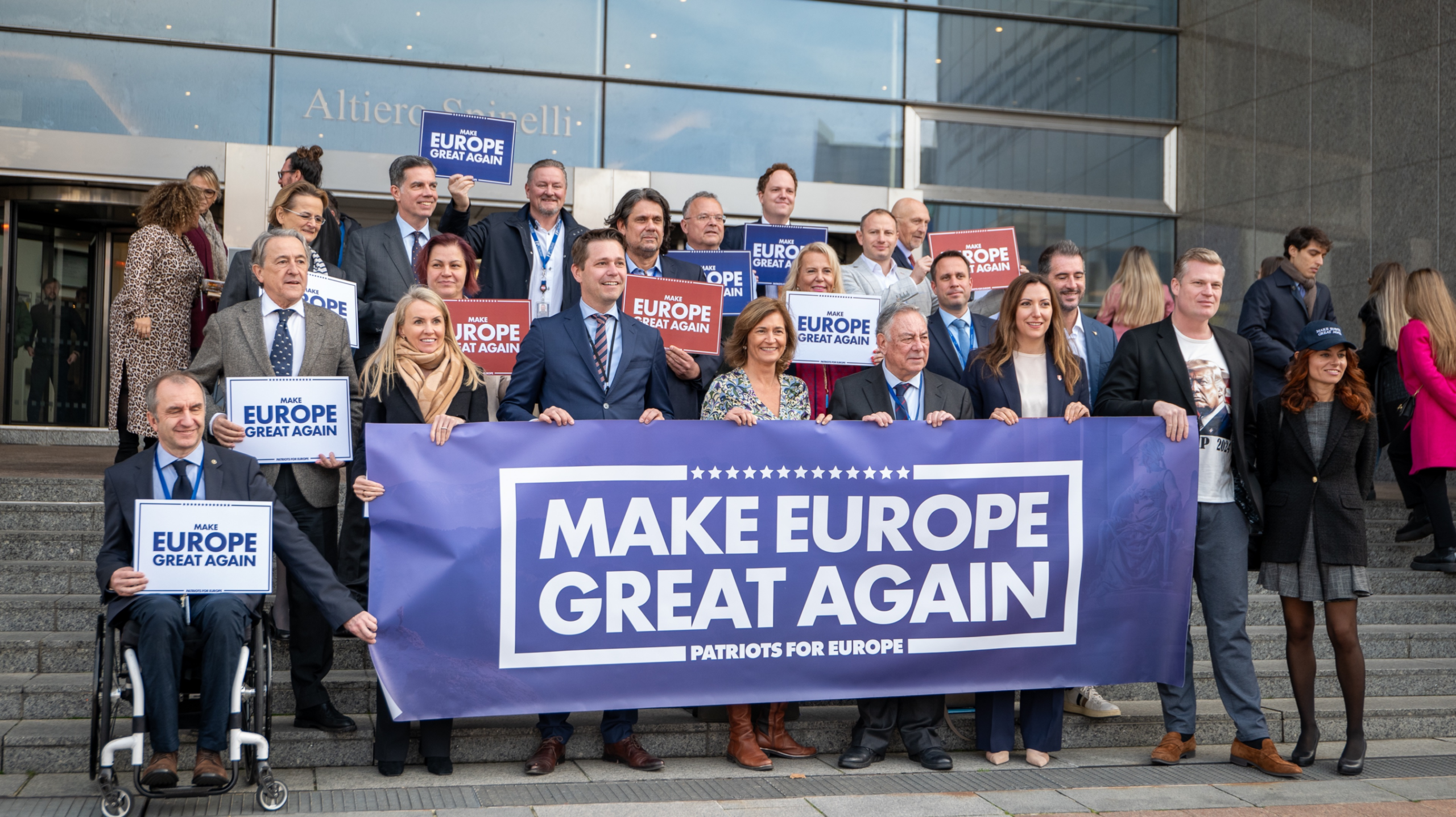
Members of the “Patriots for Europe” European Parliament group, founded by Fidesz, with a slogan borrowed from the Trump campaign. Source: X.com/Patriots for Europe
At the same time, major technology companies have moved closer to Trump and the Republican Party. Meta, Amazon and Google each donated $1 million to Trump’s presidential inaugural committee. The defence of free speech can therefore serve two purposes: supporting conservative political movements in Europe and challenging EU regulations affecting powerful American corporations.
Pro-Fidesz organization remain silent on possible application
Several Hungarian organizations previously funded with public money and closely connected to Fidesz could potentially apply for the US grants. These include the Center for Fundamental Rights, Századvég, the Nézőpont Institute, the Civil Összefogás Fórum (CÖF).
The Center for Fundamental Rights has particularly strong American connections and organized the CPAC Hungary conferences with the American Conservative Union. Other organizations played major roles in the Orbán government’s political, intellectual and campaign infrastructure.
Most did not answer questions about whether they intended to seek US funding. Only the Nézőpont Institute responded, saying it did not plan to apply. The State Department’s Bureau of Democracy, Human Rights and Labor also failed to respond before publication.
For years, Orbán’s Hungary provided money, institutions and political connections for nationalist movements across Europe. That system may now be weakened, but the Trump administration’s program suggests that the wider network will not necessarily disappear. Its financial and organizational center may simply move from Budapest to Washington.
Written and translated by Zalán Zubor, the Hungaran version of the story is here. Cover image: Patriots for Europe/Getty Images/Átlátszó montage.
Share:
Your support matters. Your donation helps us to uncover the truth.
- PayPal
- Bank transfer
- Patreon
- Benevity
Support our work with a PayPal donation to the Átlátszónet Foundation! Thank you.
Support our work by bank transfer to the account of the Átlátszónet Foundation. Please add in the comments: “Donation”
Beneficiary: Átlátszónet Alapítvány, bank name and address: Raiffeisen Bank, H-1054 Budapest, Akadémia utca 6.
EUR: IBAN HU36 1201 1265 0142 5189 0040 0002
USD: IBAN HU36 1201 1265 0142 5189 0050 0009
HUF: IBAN HU78 1201 1265 0142 5189 0030 0005
SWIFT: UBRTHUHB
Be a follower on Patreon
Support us on Benevity!
