

Grants from hijacked culture fund an auxiliary financing leg to Orbán’s international influence network

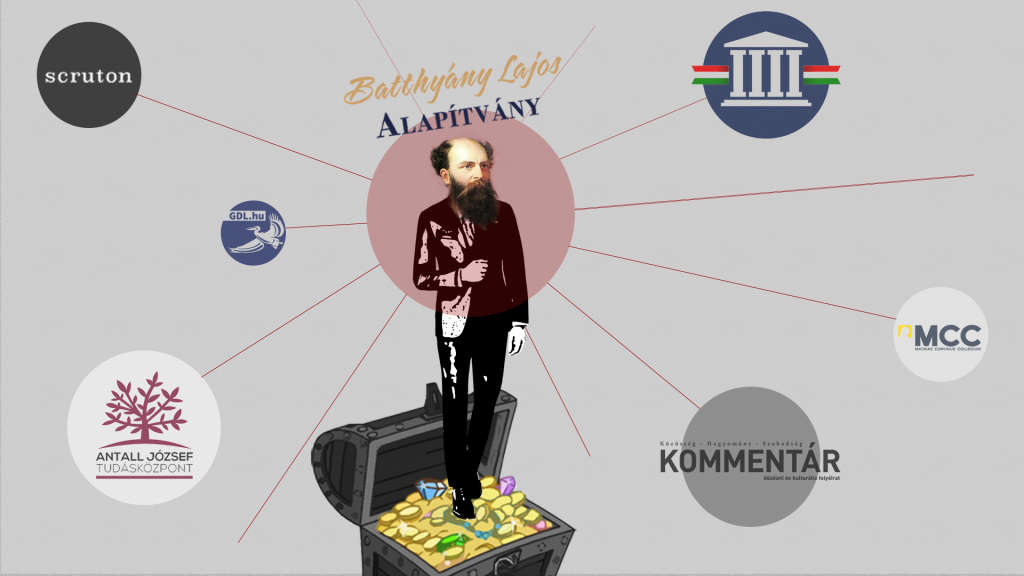
Entities in the orbit of BLA, MCC – known financiers of the Orbán government’s influence machinery – revealed to have received funding from Hungarian culture fund’s scandalous recent grants.
Several organisations in outgoing prime minister Viktor Orbán’s international influence network were recently revealed as recipients of grants from a government culture fund (NKA) typically writing checks for elite institutions like national theatres and orchestras.
While the primary recipients of the NKA’s extraordinary” largesse appear to be Fidesz-allied artists and grassroots groups, a distinct strand of funding has been diverted to the cornerstones of the influence ecosystem Orbán has built with state funds over the last decade.
According to grant data obtained by Atlatszo,
the NKA is now bankrolling entities already heavily subsidised by the quasi-state Batthyány Lajos Foundation (BLA).
Funding for films
The Batthány Lajos foundation (BLA) is a primary financier of the Orbán-aligned network. According to data compiled by Atlatszo’s journalist through several freedom of information requests, the BLA distributed more than HUF 47 billion (EUR 129m) in the years leading up to mid-2025. Now, the NKA is topping up those accounts.
The most prominent recipient is European Conservative Nkft., which received HUF 105 million (EUR 288,000) from the NKA to produce a documentary titled The Threat Nearby, focused on Ukraine. The company publishes The European Conservative, an English-language outlet aiming to coordinate an international pro-Orbán coalition.
It has already pocketed HUF 2.37 billion (EUR 6.5m) from the BLA in under five years.
Apriori Cultura Nzrt. collected HUF 115 million (EUR 315,000) from the NKA for a documentary on the life of István Nemeskürty, a former president of the Hungarian public broadcaster. The entity is best known for operating the Scruton café chain, which received HUF 4.587 billion (EUR 12.6m) from the BLA through mid-2025.
Rubicon Intézet Nkft., received an HUF 315 million (EUR 863,000) grant for a documentary on the battle of Mohács in 1526. Rubicon is a think tank associated with a popular history magazin. It has pocketed HUF 1.4 billion (EUR 3.8m) from the BLA altogether.
Férfiak Klubja Nkft. (”Men’s Club”), a manosphere organisation that formerly received a minor BLA subsidy has also collected a HUF 15 million (EUR 41,000) NKA grant to support its 2025 year-end party.
Auxiliary financing
The NKA has now joined the small circle of entities providing large-scale financing to Orbán-aligned media, think tanks, and intellectuals.
But grants made by the culture fund are dwarfed by the size of BLA subsidies. Additionally, while these NKA grants specifically fund the creation of specific cultural products, BLA subsidies usually come with less constraints: their aim is usually to simply fund the “operating costs” of the grantee.
If anything, the NKA funding serves to illustrate what critics say is an intellectually sub-par cadre of Hungarian and international academics and professionals who have positioned themselves strategically close to the Hungarian government-funded money fountain.
The price of a film
The Threat Nearby, the NKA-funded documentary released shortly before the April elections, is a case in point. Essentially anti-Ukrainian propaganda masquerading as a documentary,
the film’s only non-Hungarian-speaking voice is Konstantin Bondarenko, a Ukrainian ex-politician sanctioned by Kyiv for spreading Kremlin-aligned propaganda.
But to reach Bondarenko, viewers must endure a 12-minute Hungarian-language lecture on the origins of the Slavs and the Grand Duchy of Lithuania, presented by a coterie of Fidesz-aligned academics. And even in its remaining runtime, The Threat Nearby stays up there with the most uninspiring processions of talking heads in recent memory.
While some independent films released during the same period—such as The Price of a Vote—garnered millions of views, The Threat Nearby sank without a trace. At the time of writing, it has just 45,340 views on the channel of its publicity partner, Mandiner, and a paltry 519 views on the European Conservative’s own channel.
Notably, Mandiner’s publisher also received an HUF 40 million (EUR 110,000) NKA grant for its own documentary series.
Control consolidated
Since late 2024, MCC Média Holding Zrt.– controlled by the quasi-state entity Mathias Corvinus Collegium (MCC) –has taken full ownership of the publishers of Mandiner and The European Conservative.
As these ventures are not commercially viable, the MCC is effectively acting as a lifeboat. This consolidation suggests that while other loss-making outlets in the government-aligned Mediaworks media empire might be sacrificed, Orbán’s circle views these specific brands as “family jewels” to be preserved.
This move has further consolidated the influence of MCC director-general Zoltán Szalai. Szalai has edited Mandiner for years, founded the entity behind the Scruton cafés, and maintains full control over the Rubicon think tank.
Scandalous subsidies
The NKA’s distribution of HUF 17 billion (approx. EUR 46.6m) in the run-up to the election has left the Hungarian cultural sector in an uproar. Critics allege
the funds were used to reward Fidesz-friendly artists and subsidise campaign events under the guise of “culture.”
The nature of the grants – ranging from support for eating contests to HUF 150 million (EUR 375,000) payments to popular musicians – has triggered a crisis within the NKA.
The top decisionmaking authority at the NKA is its committee, which is presided over by outgoing minister for culture and innovation Balázs Hankó. Grant decisions now under scrutiny have been made not by this board but by a secretive sub-committee stacked with Hankó loyalists.
Several members of the top committee, including Fidesz loyalists, have stepped down from their positions in reaction to what they described to Hungarian news site Telex as “severely lacking” and “misleading” informing that was formerly presented to the board regarding the grants in question.
Written and translated by Márton Sarkadi Nagy. The Hungarian version of this story is here. Cover image: montage by Átlátszó
Share:
Your support matters. Your donation helps us to uncover the truth.
- PayPal
- Bank transfer
- Patreon
- Benevity
Support our work with a PayPal donation to the Átlátszónet Foundation! Thank you.
Support our work by bank transfer to the account of the Átlátszónet Foundation. Please add in the comments: “Donation”
Beneficiary: Átlátszónet Alapítvány, bank name and address: Raiffeisen Bank, H-1054 Budapest, Akadémia utca 6.
EUR: IBAN HU36 1201 1265 0142 5189 0040 0002
USD: IBAN HU36 1201 1265 0142 5189 0050 0009
HUF: IBAN HU78 1201 1265 0142 5189 0030 0005
SWIFT: UBRTHUHB
Be a follower on Patreon
Support us on Benevity!
