

A new Orbán-era cultural headquarters was established in Jerusalem, but he was no longer able to inaugurate it


While the Orbán government has been visibly building closer political and diplomatic ties with Israel for years, it quietly established a new Hungarian institution in Jerusalem just six months before the elections. The Hungarian Academy in Jerusalem (HAJJ) operates in one of the city’s most expensive neighbourhoods, yet no one is willing to reveal exactly how much money it runs on, who finances it, or why. Its director, Vatican-honoured archaeologist Győző Vörös, who has been appointed until 2030, previously found himself in trouble over an Egyptian tomb.
The Hungarian Academy in Jerusalem opened its doors in December 2025 in an upscale district of the Holy City, launched its own journal, and its director — whose career has long been controversial within Hungarian academic circles — refers to himself as having been appointed for five years, until 2030. The institution describes itself as the flagship of Hungarian cultural diplomacy. Despite this, we were unable to trace the founding charter of HAJJ, which communicates itself through a strongly religious, cultural and scholarly narrative, nor a government decree establishing it, nor any information about its budget.

According to our sources familiar with the matter,
Viktor Orbán’s plan may have been that following an electoral victory, his first foreign trip would lead to Jerusalem, with the ceremonial inauguration of the academy serving as one of the highlights of the visit.
According to our information, the institution’s annual budget may even have exceeded the entire budget of the Hungarian Embassy in Tel Aviv, while a medium-sized European diplomatic mission is estimated to amount to several million euros.
The Guardian of The Tomb
One of the few concrete traces of the institute is a report aired by pro-Orbán television channel, HírTV on 1 April and an interview with its director, egyptologist Győző Vörös, who first became nationally known in the late 1990s after presenting a rock cavity as a long-lost tomb of an Egyptian pharaoh. Based on this, the decision to establish the academy must have been taken during the first half of 2025, while the institution itself opened its doors last December.
The academy’s website reveals little more than the fact that it presumably operates under the auspices of the Ministry of Culture and Innovation or the Ministry of Foreign Affairs and Trade — and that it publishes its own English-language scholarly journal entitled Hungarian Academy in Jerusalem Journal, for which we likewise found no information regarding funding.
What seems almost certain is that the Hungarian Academy in Jerusalem operates in Jerusalem’s prestigious Talbiyeh neighbourhood, at 6 George Washington Street, immediately next to the YMCA building and close to the Czech and Slovak diplomatic compounds. The first photographs of the institution were published not by the Hungarian but by the Israeli press: Times of Israel reported on the opening day that Hungary had “raised its flag over a new Jerusalem ‘embassy branch’.”
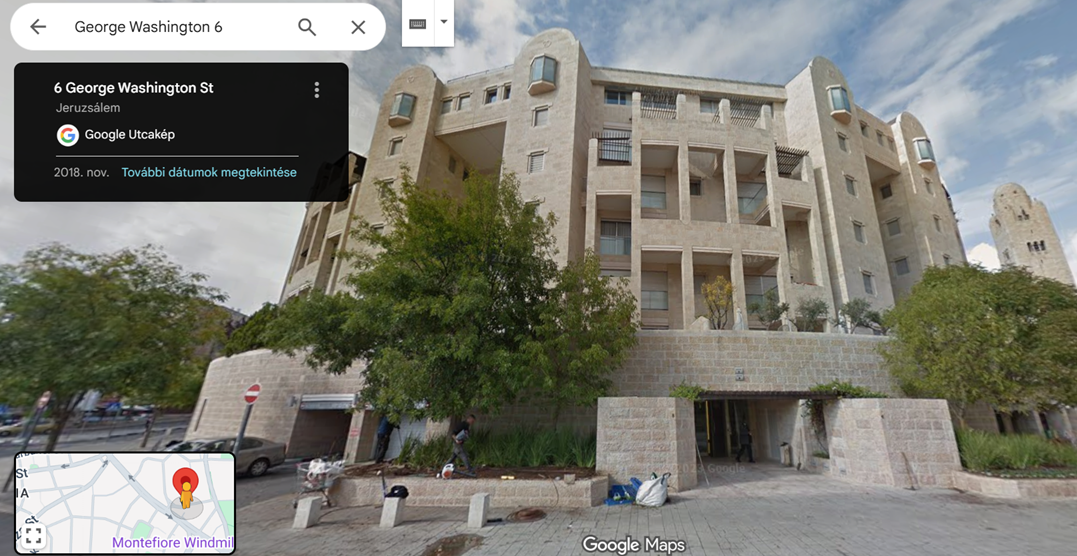
Source: Google Street View
The Israeli newspaper describes the institution not simply as a cultural centre but as an “embassy branch,” that is, an extension of the embassy itself. This may explain why the academy’s name does not appear in Israeli nonprofit or company registries either.
Public Funds Gone Missing
We attempted to uncover the background of the academy, which is presumably financed from public funds: we searched for a founding charter, ministerial resolution, government decision, entry in the official gazette, organisational and operational regulations and budgetary documents — all in vain. It is unknown how many employees work at the institution, how much money it operates on, who finances it and from what sources, or under what arrangement it uses a valuable Jerusalem property that serves as its home. The institution’s website is practically empty: its posts are outdated, there is no imprint, and according to the events calendar,
not a single event has been organised there since its opening.
There is currently no publicly identifiable trace of the academy’s financing: no budget appropriation, grant agreement or financial report is available among the public documents of either the Ministry of Culture and Innovation or the Ministry of Foreign Affairs and Trade.
This is particularly unusual because the academy has already published its own scholarly journal: the first issue of Jerusalem HAJJ includes contributions from authors such as László Veszprémy, who until 2021 headed the Institute and Museum of Military History under the Ministry of Defence.
An additional detail is that although the institution opened in December last year, its Facebook page was only launched on 1 April this year — as if the academy’s online presence had begun to be built up retrospectively, six months later.

Source: Facebook
The Hungarian Miracle in Jerusalem
The Israeli press repeatedly refers to the institute as a “diplomatic mission” and a “foreign mission,” suggesting that Orbán’s government intended the Hungarian Academy in Jerusalem to be not merely a cultural institution but also a foreign policy and ideological project.
The initiative also has a clear precedent: in 2019, Israeli Prime Minister Benjamin Netanyahu and Hungarian Foreign Minister Péter Szijjártó jointly inaugurated Hungary’s trade representation office in Jerusalem, located in the City Tower at 34 Ben Yehuda Street. At the event, Netanyahu said that this was the first European diplomatic mission established in the city in many decades, and praised Hungary’s role in changing Europe’s attitude towards Israel.
The Hungarian Academy in Jerusalem appears to be an even more ambitious undertaking. In an interview about the institution, Vörös — who has since also received a Vatican honour — stated that the Orbán government had “re-established” the thousand-year-old Hungarian presence in Jerusalem. According to his own account, he was asked to become director because he has lived in Jerusalem for eighteen years and possesses an extensive scholarly network.
Return and Crusade
The notion of “return” is a key element of the institution’s self-representation. Vörös traces the “Hungarian presence” all the way back to the era of Saint Stephen, emphasising the role of Andrew II, leader of the Fifth Crusade, as well as the brief history of the Hungarian Institute in Jerusalem, which operated between 1946 and 1948. The creation of an appearance of historical continuity was therefore clearly one of the objectives.
For the time being, HAJJ seems less like a traditional cultural institute and more like a government-backed grand project following diplomatic logic while being endowed with a cultural-political mission. While its director speaks of a historical mission and a thousand-year Hungarian presence, even the most basic information of public interest concerning this state-funded institution remains unavailable.
In order to find out under what legal form the Hungarian Academy in Jerusalem operates, what its budget is, who its employees are, on the basis of what decision it was established and who finances its operation, we submitted requests to Győző Vörös, the Ministry of Culture and Innovation, the Ministry of Foreign Affairs, the Hungarian National Asset Management and the Hungarian State Treasury. No replies have yet been received.
Written and translated by Hanna Solti, the Hungaran version of the story is here. Cover photo: Israeli Prime Minister Benjamin Netanyahu (R) greets Prime Minister Viktor Orbán in Jerusalem on 19 July 2018. Photo: MTI/Szilárd Koszticsák
Share:
Your support matters. Your donation helps us to uncover the truth.
- PayPal
- Bank transfer
- Patreon
- Benevity
Support our work with a PayPal donation to the Átlátszónet Foundation! Thank you.
Support our work by bank transfer to the account of the Átlátszónet Foundation. Please add in the comments: “Donation”
Beneficiary: Átlátszónet Alapítvány, bank name and address: Raiffeisen Bank, H-1054 Budapest, Akadémia utca 6.
EUR: IBAN HU36 1201 1265 0142 5189 0040 0002
USD: IBAN HU36 1201 1265 0142 5189 0050 0009
HUF: IBAN HU78 1201 1265 0142 5189 0030 0005
SWIFT: UBRTHUHB
Be a follower on Patreon
Support us on Benevity!
