

Hungary Votes for Change – Despite a System Built to Benefit Orbán

Hungary’s 2026 election brought historic political change, with the opposition overcoming a system tilted in favor of the ruling party. Átlátszó documented a wide range of electoral manipulations and abuses during both the campaign period and on election day – all of which appeared to benefit Orbán.
Hungary’s 2026 parliamentary election was widely framed as a test of whether Viktor Orbán’s 16-year rule could be ended through democratic means. While the opposition’s victory marked a historic turning point, the campaign and voting process were shaped by deep structural inequalities and widespread irregularities. Our investigations reveal a pattern of abuses ranging from data misuse to on-site vote-buying.
The fall of Viktor Orbán’s long-standing political system was one of the most anticipated moments in recent Hungarian history. His main challenger emerged in the form of the Tisza Party (Respect and Liberty, also referring to one of the main rivers in Central Europe flowing through Hungary) led by Péter Magyar, a businessman formerly associated with Fidesz, who ultimately secured a two-thirds victory with record-high voter turnout, marking a long-awaited shift in Hungary’s political landscape.
International observers, including the Organization for Security and Co-operation in Europe, described the election as competitive but fundamentally unequal. Their assessment highlighted a campaign environment shaped by Orbán’s extensive use of state resources, overlapping government and campaign communication, and a media landscape that – while formally pluralistic – functioned with strong pro-government bias. Public broadcasting in particular was found to favor Orbán’s Fidesz, while campaign finance regulations were deemed insufficient to ensure a level playing field. Despite these concerns, candidates were generally able to campaign freely, and the technical administration of election day proceeded without major disruptions.
However, our investigations suggest otherwise. The structural imbalance identified by observers was accompanied by a wide array of concrete abuses throughout the electoral process – ranging from the nomination phase to election day itself.
Stolen Identities
One of the most striking patterns emerged during the signature collection period required for candidate nomination. Dozens of readers reported to us that their names and personal data appeared on recommendation sheets without their knowledge. In several cases, individuals were listed as supporting multiple candidates across different parties simultaneously, including politically opposing ones. Some even encountered the signatures of deceased relatives.
By the time of publication, Hungarian authorities had launched around eighty criminal investigations related to forged private documents, misuse of personal data and election fraud.
The scale and consistency of these cases point to systematic data misuse. Sensitive identifiers – such as personal ID numbers that are not publicly accessible – regularly appeared on falsified forms. Two main explanations have been raised: either the data originated from leaks within official or municipal databases, or it is being circulated informally between political actors. This is by no means unprecedented: since the 2013 reform of the electoral system, such cases have occurred by the dozens in every election.
Our reporting uncovered local schemes in which individuals were offered negligible 13 euros in exchange for copies of their identification documents – including those of minors between 14 and 16 – suggesting that personal data collection itself may be feeding into a broader infrastructure of electoral manipulation.
Open to Abuse
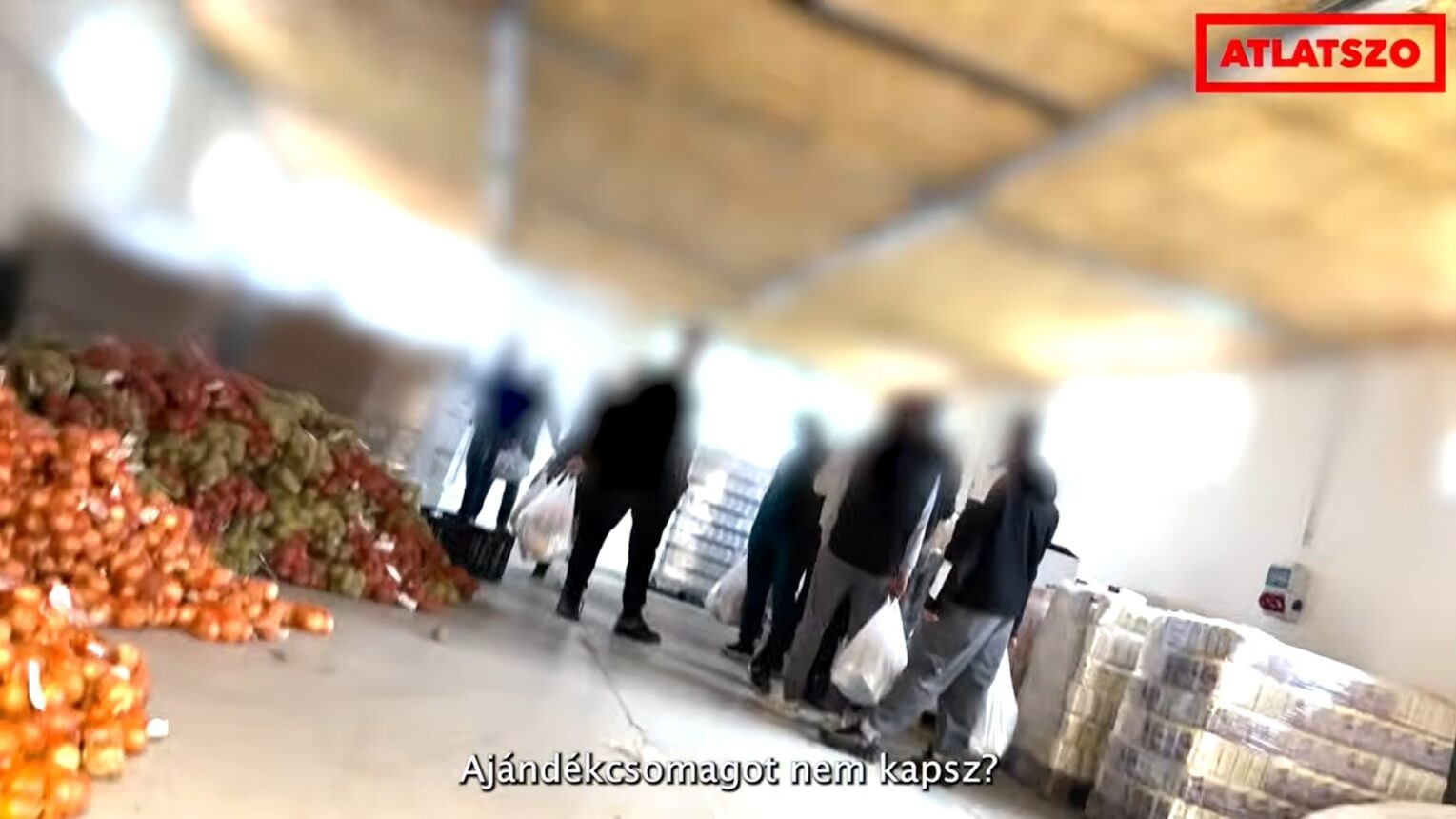
Beyond the nomination phase, our reporting documented targeted distribution of goods in the final days of the campaign. In our undercover footage, individuals linked to Fidesz’s networks and associated organizations were seen distributing more than eleven tonnes of food across selected constituencies, particularly in Békés and Tolna counties. These actions were often coordinated through local intermediaries, including organizations connected to Roma communities, and focused on economically vulnerable populations.
While framed as aid, the timing and targeting strongly suggested an attempt to influence voting behavior through material incentives.
Another less visible vulnerability lies in the system of mobile ballot voting. Intended to ensure participation for voters unable to attend polling stations, this mechanism has long been criticized for its lack of transparency. Our investigation uncovered a new form of abuse: dozens of fraudulent mobile ballot requests were submitted without the knowledge of the voters. In multiple cases, individuals received official confirmation that such a request had been registered in their name, despite never having applied. Local election offices acknowledged that similar complaints were arriving in large numbers.
In at least one instance, numerous applications were traced back to a single email address, [email protected] (meaning „mobile ballot box” in Hungarian), raising concerns about coordinated activity.
The issue is particularly serious because submitting a mobile ballot request requires detailed personal data. Combined with earlier findings on data misuse, this suggests that unauthorized access to voter information may be enabling direct intervention in the voting process itself. Once approved, mobile voting further reduces oversight: typically, two members of a counting committee deliver the ballot box to voters’ homes, leaving minimal institutional control and creating conditions in which influence or coercion can occur outside the scrutiny of polling stations.
Votes for Sale
Election day brought additional concerns. In the Nyírség region of eastern Hungary, located near the Romanian border, turnout was notably high in most precincts – except the ones located near segregated settlements. According to Antal Máté, the socialist mayor of a local town called Nyírbátor, voters in this area may not have been acting of their own free will.
The community has long been considered vulnerable to electoral abuses, with recurring accounts of vote-buying and organized mobilization. Some residents treat their votes as negotiable commodities, with informal bidding practices emerging around election time – as they often wait for the highest offer in exchange for their votes on the day of the election.
In these districts, Orbán’s party has once again secured victory, as it has consistently done in the past. According to the mayor and local volunteers, their aim was in fact to keep turnout low in the area, as votes are cast under various forms of pressure or inducement.
In the northwestern city of Tatabánya, an unusual grassroots presence appeared outside two polling stations that had previously delivered strikingly high results for Fidesz. Around forty volunteers – many mobilized by a widely viewed documentary on vote-buying – stationed themselves near the sites, quietly monitoring traffic and noting suspicious patterns. Their method was simple: counting cars and flagging those that repeatedly circled or appeared to transport voters. The aim was not confrontation, but deterrence – and by several accounts, it worked.
The atmosphere, however, was far from calm. Local figures, including representatives of the Roma minority government maintained a visible presence, at times observing the volunteers as closely as they were being observed themselves. Tensions flared with accusations of intimidation, and even counter-allegations of vote-buying directed at the activists.
Here Fidesz’s sitting candidate still secured a decisive victory, but his margin dropped noticeably – raising the possibility that civic vigilance, rather than any formal intervention, may have reshaped the dynamics on the ground.
Parallel Realities at the Ballot Box
These findings paint a complex picture of Hungary’s 2026 election, appearing to operate on two parallel levels: one that meets formal democratic criteria, and another in which informal practices, structural imbalances, and outright abuses continue to shape outcomes in less visible but deeply consequential ways. While international observers emphasized systemic inequalities – particularly in media access, campaign financing and the use of state resources – our reporting indicates that more direct, often localized forms of manipulation continue to play a significant role.
The remarkable result – a victory for the opposition led by Magyar – demonstrates that political change remains possible within the system.
Written by Hanna Solti, cover image from our reader.
Share:
Your support matters. Your donation helps us to uncover the truth.
- PayPal
- Bank transfer
- Patreon
- Benevity
Support our work with a PayPal donation to the Átlátszónet Foundation! Thank you.
Support our work by bank transfer to the account of the Átlátszónet Foundation. Please add in the comments: “Donation”
Beneficiary: Átlátszónet Alapítvány, bank name and address: Raiffeisen Bank, H-1054 Budapest, Akadémia utca 6.
EUR: IBAN HU36 1201 1265 0142 5189 0040 0002
USD: IBAN HU36 1201 1265 0142 5189 0050 0009
HUF: IBAN HU78 1201 1265 0142 5189 0030 0005
SWIFT: UBRTHUHB
Be a follower on Patreon
Support us on Benevity!
