

Editor-in-chief of Russian propaganda website relocated to Budapest is named Mária Schmidt
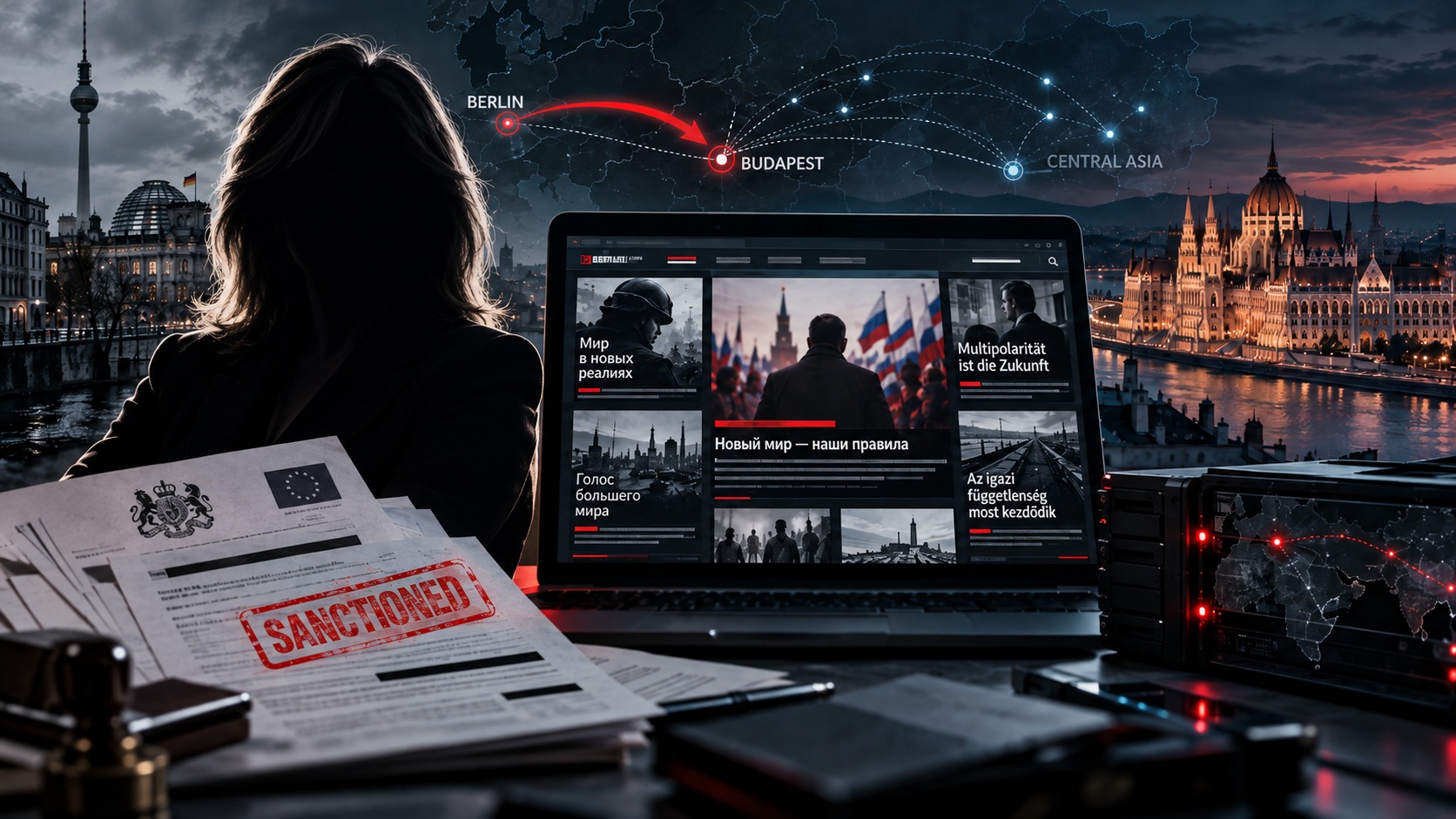
Govorit Europa, a multilingual pro-Russian media platform previously listing an address in Berlin, announced that it had relocated its editorial office to Budapest in 2026, while moving its servers to Kazakhstan. The website, which presents itself as an independent European media project, publishes content promoting Kremlin narratives and attacking Ukraine and Western governments. The organisation was sanctioned by the United Kingdom in May 2026. Its editor-in-chief is listed as Mária Schmidt, the namesake of a prominent Hungarian historian and former director-general of Budapest’s House of Terror Museum.
However, the historian denied any connection to the website when contacted by Átlátszó. We visited the address listed by Govorit in central Budapest but found no trace of its editorial office.
Operating under the slogan “Europe Speaks – Truth Unites!”, Govorit Europa publishes political commentary, interviews and videos in approximately 40 languages, including Hungarian, English, German, French, Romanian and Ukrainian. Its content frequently criticises Ukrainian President Volodymyr Zelensky, questions Ukraine’s political independence and portrays European policies towards Russia as a threat to the continent’s security.
The Hungarian edition of Govorit looks much like any other international news website, featuring political analysis, interviews, videos and opinion pieces. According to the website’s own description, its mission is to encourage dialogue between European societies and provide a platform for diverse opinions.
However, British government documents and investigations by journalists reveal a very different picture of the network behind the website.
Govorit previously operated under the govorit.eu domain and published a Berlin postal address. In 2026, it moved to govorit.tv and replaced its German contact address with one in Budapest.
According to Govorit’s own announcement, European authorities had pressured the project over content challenging Ukraine’s territorial integrity. The website characterised these measures as restrictions on freedom of speech.
Govorit subsequently moved its servers outside the European Union, to Kazakhstan, while announcing that its editorial team and leading journalists would relocate to Budapest.
Sanctioned by the United Kingdom
On 11 May 2026, the British government officially imposed sanctions on Govorit and another media platform, Euroview.
According to the British government’s explanation, these organisations were involved in Russian-linked foreign information manipulation and interference activities aimed at destabilising Ukraine.
The sanctions identify Govorit’s former domain, govorit.eu, and include asset freezes and restrictions on internet services.
It is important to distinguish between British and European Union sanctions. While Govorit itself was directly sanctioned by the United Kingdom, the documents identified by Átlátszó do not establish that Govorit is separately subject to equivalent EU sanctions. However, other organisations within the wider network also appear in EU sanctions documents.
Govorit’s history is closely connected to two earlier media platforms, Golos and Euromore. According to the British government, these websites presented themselves as independent media outlets while distributing content serving the interests of the Russian state.
British authorities also reported that leaked documents suggested the platforms had received financial support through Pravfond, a Russian organisation officially established to protect the rights of Russian citizens living abroad.
Estonian authorities have identified Pravfond as a front organisation linked to Russia’s military intelligence service, the GRU.
The United Kingdom sanctioned Golos and Euromore in December 2025. After their regular operations ceased, new websites emerged to continue their activities.
The British government explicitly identified Govorit as the successor to Golos and Euroview as the successor to Euromore. Both successor platforms were sanctioned in May 2026.
The European Union also took action against Euromore on 21 April 2026, identifying it under the alternative names Euroview and Euroview Media.
According to the EU Council’s decision, the platform systematically challenged the legitimacy of European institutions, justified Russia’s war against Ukraine and redistributed content from Russian state-controlled outlets RT and Sputnik.
A technical network connecting around 100 websites
In September 2026, the Romanian investigative outlet Public Record published a detailed investigation into the network behind Govorit and Euroview.
Journalists Matei Vrabie and Anca Mihai established that the two platforms belong to a broader media ecosystem connecting websites targeting different countries, former propaganda outlets and content distribution platforms.
One of their most significant findings was that Golos, Euromore and several related websites shared the same Google advertising publisher identifier.
Using the BuiltWith technology database, the Romanian journalists identified connections between approximately 100 domains and subdomains.
Although shared advertising identifiers do not necessarily establish common ownership, they provide evidence of technical connections between websites that present themselves as separate media organisations.
The network included the SMI.Today news aggregator, Golos, Euromore and other websites operating in different countries.
The investigation also identified redirects to Govorit’s current domain from several older addresses, including govorit.eu, golospravdy.eu, golospravdy.com, dzhangirov.su, sbu-inside.su and partyofregions.org.
The Romanian journalists also found that Govorit and Euroview used servers located in Kazakhstan and IP addresses associated with the same network infrastructure.
Taken together, these findings suggest that the websites are not entirely independent news organisations, but part of a network sharing technical infrastructure and elements of a common content distribution system.
When contacted by Public Record, Govorit described itself as a volunteer-run media project but declined to answer detailed questions.
The Romanian investigation also highlighted several controversial public figures appearing in Govorit’s content.
One was Andriy Derkach, a former Ukrainian member of parliament sanctioned by the United States. According to the US Treasury Department, Derkach acted as an active Russian agent for more than a decade and attempted to interfere in the 2020 US presidential election.
Another was Viktor Medvedchuk, a former Ukrainian politician and businessman known for his close relationship with Russian President Vladimir Putin. Medvedchuk has also been sanctioned by the European Union for activities supporting Russian influence and propaganda.
The third was Vasily Prozorov, a former officer of Ukraine’s security service who later became involved in pro-Russian information activities. Previous research by the Digital Forensic Research Lab connected Prozorov to a multilingual network of media channels amplifying each other’s content.
These examples illustrate how Govorit provides a platform not only for its own editorial material, but also for figures whose messages regularly circulate across pro-Russian information networks.
An editor-in-chief named Mária Schmidt
One of Govorit’s most notable characteristics is its multilingual operation. According to Public Record’s September investigation, Govorit and Euroview each published content in approximately 40 languages.
By operating country-specific language subdomains, the websites can reach audiences across Europe and appear in local-language search engine results.
The articles can also become accessible to AI-powered search engines and chatbots, which may reproduce content originating from political influence operations as apparently legitimate news sources.
This is particularly problematic because such websites do not necessarily resemble traditional Russian state media. Instead, they present themselves as independent, diverse and European-oriented journalism projects.
However, the precise nature of Govorit’s Hungarian presence remains unclear. We could not establish which legal entity operates its Budapest office, who finances its activities in Hungary, how many employees actually work there or what relationship they maintain with the website’s previous operators.
According to Govorit’s contact page, its editor-in-chief is Mária Schmidt, whose responsibilities include overseeing content strategy and maintaining relations with contributors and partners.
The name is identical to that of Mária Schmidt, a prominent Hungarian historian, former director-general of Budapest’s House of Terror Museum and a longstanding intellectual and political ally of Viktor Orbán.
Átlátszó contacted the historian to establish whether she had any connection to the Russian propaganda website.
She categorically denied being its editor-in-chief:
“I am not the editor-in-chief of the newspaper. I did not even know until now that such a publication existed.”
It therefore appears to be a case of two people sharing the same name, although the possibility that the website uses a pseudonym cannot be ruled out.
We also attempted to contact the editor-in-chief listed by Govorit. However, when we visited the address provided on the website, on Paulay Ede Street in central Budapest, we found no trace of either an editorial office or a publishing company operating there.
The identity of Govorit’s editor-in-chief and the precise nature of its Budapest operations therefore remain unresolved.
The case raises broader questions about how Russian-linked information networks continue operating across Europe despite international sanctions, and how multilingual websites can distribute Kremlin-aligned narratives while presenting themselves as independent media organisations.
Govorit’s declared relocation to Budapest is particularly noteworthy because its technical infrastructure has been moved outside the European Union, while its editorial operation officially remains within the bloc.
Written by Tamás Bodoky, with contributions from Katalin Erdélyi. Cover image and source research were produced with the assistance of artificial intelligence. Originally published in Hungarian by Átlátszó on 14 October 2026.
Share:
Your support matters. Your donation helps us to uncover the truth.
- PayPal
- Bank transfer
- Patreon
- Benevity
Support our work with a PayPal donation to the Átlátszónet Foundation! Thank you.
Support our work by bank transfer to the account of the Átlátszónet Foundation. Please add in the comments: “Donation”
Beneficiary: Átlátszónet Alapítvány, bank name and address: Raiffeisen Bank, H-1054 Budapest, Akadémia utca 6.
EUR: IBAN HU36 1201 1265 0142 5189 0040 0002
USD: IBAN HU36 1201 1265 0142 5189 0050 0009
HUF: IBAN HU78 1201 1265 0142 5189 0030 0005
SWIFT: UBRTHUHB
Be a follower on Patreon
Support us on Benevity!
