

Tisza beat Fidesz on its home turf, causing a massive political shift in rural Hungary


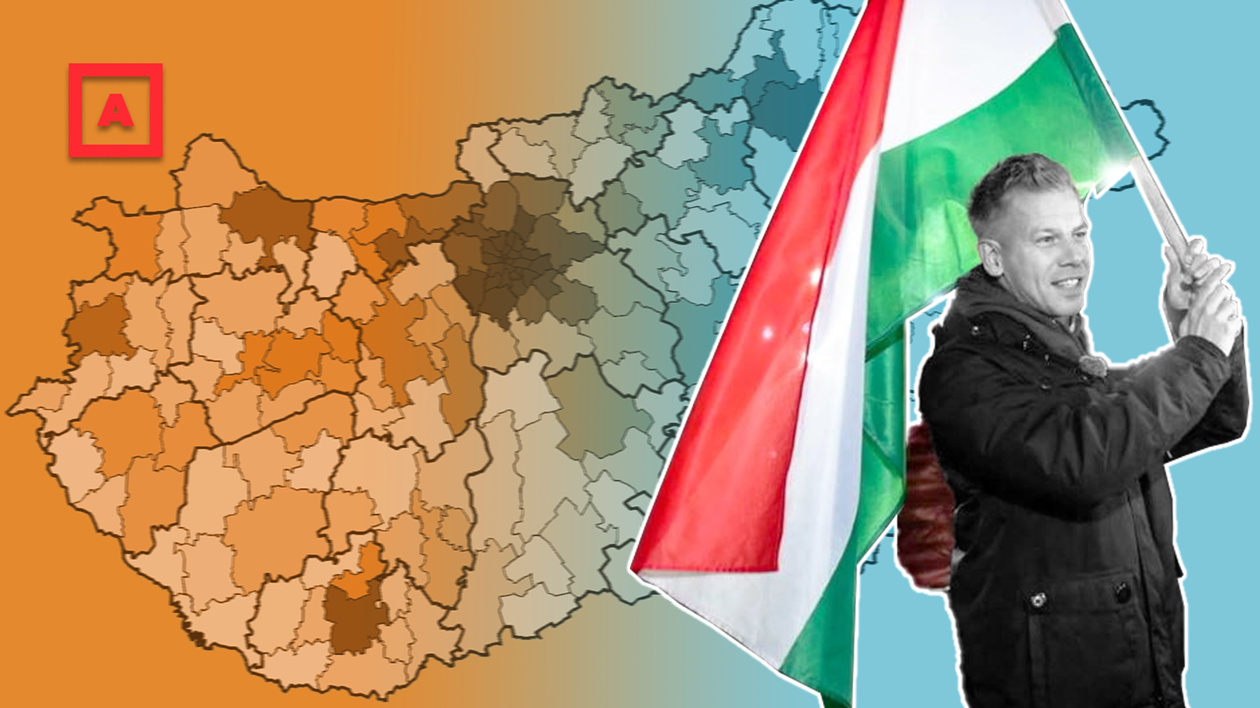
Conventional wisdom held that Fidesz has an iron grip on Hungary’s rural regions, impenetrable for opposition parties. However, the election results show that Viktor Orbán’s party has lost over 200 thousand voters in rural communities. At the same time, Péter Magyar’s Tisza received almost 500 thousand more votes compared to the 2022 opposition coalition. This has resulted in Fidesz suffering their heaviest losses in their strongest constituencies.
Viktor Orbán loss at the Hungarian parliamentary election has rightly been described as a political landslide. After 16 years of uncontested rule by Fidesz, the 2026 election saw the largest turnout of voters in Hungary’s electoral history, resulting in a 17-percentage point victory for the newly formed opposition Tisza Party.

Péter Magyar’s party is set to gain over 136 seats in parliament, well over the 2/3 majority required to amend the constitution, a larger mandate than what Orbán’s party received in past elections.
The map of the 2026 election
Looking closer at the electoral map, this landslide is a result of massive shifts in voting patterns.
At both electoral districts and types of settlements, decades-long trends have reversed.
Fidesz has lost hundreds of thousands of voters since 2022, with the biggest losses occurring in its strongest constituencies and regions.
This article is based on data collected and visualized on Átlátszó’s interactive election database from 2022 and 2026
“Countryside cities” and the Budapest bubble
Hungary has often been described as having just one “real” city, Budapest, while other regional population centers are still considered part of “the countryside”. The term “vidéki nagyváros”, meaning “countryside city” is a common way to refer to large settlements outside the capital, including county seats.
This has been reflected in electoral results since 2010: the opposition (especially parties from the left of Fidesz) only had strong results in Budapest and in a handful of traditionally liberal large cities (Pécs, Szeged).
Meanwhile, Fidesz had its own strongholds in county seats, such as Debrecen, Győr, and Sopron.
Fast forward to the 2026 election, Fidesz no longer has majorities in any “countryside cities”. County seats, which are Hungary’s largest population centers outside Budapest have now voted similarly. In many cases, results in such cities resembled Budapest more than other parts of “the countryside”. For example, in Debrecen, where Fidesz received more than 52% of the vote in 2022, it now garnered only 34%.
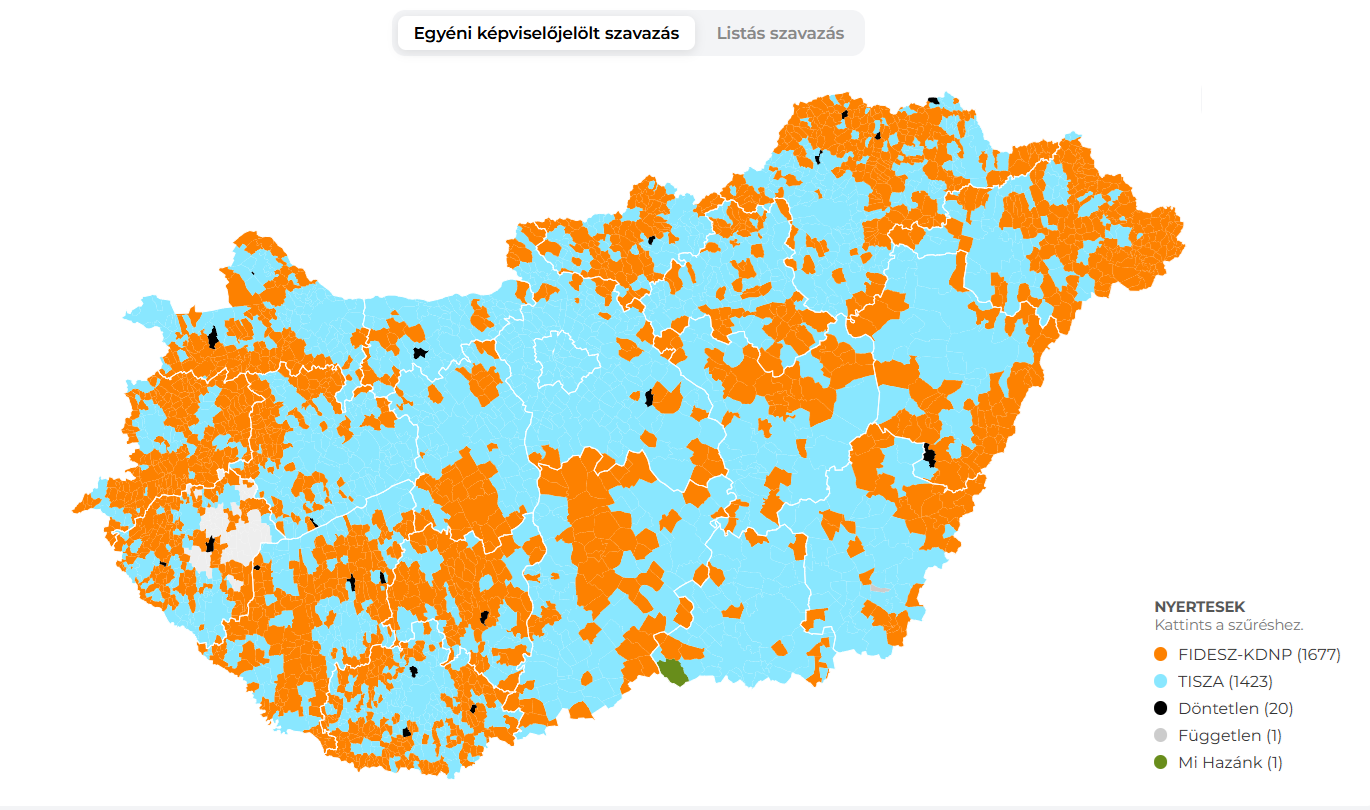
Results of the 2026 election by settlement.
This is not the result of a US-style shift, where urban areas have been slowly shifting to the left, while rural areas shifted right.
In most county seats, the number and percentage of Fidesz voters increased from election to election
in the past decade. The number of Fidesz voters in county seats continued to grow between the last two elections, at similar rates as in rural areas. Although a common stereotype, it is not true that Fidesz’s repeated supermajorities were achieved solely by dominating the country’s impoverished, isolated rural regions.
In contrast, the current election marks a massive shift in trends: Fidesz support, which had previously been rising and creeping to and above 50%, plummeted to 35–37% in cities such as Debrecen, Sopron, and Győr. We can also see a similar pattern in medium-sized cities (e.g., Siófok, Hajdúböszörmény, Szentes, Cegléd).
Half a million new opposition voters in rural areas
Losing large cities and towns alone would not have been enough for Tisza to secure a supermajority. However,
in many small towns and villages, we see an even more significant shift away from Fidesz.
For example, in Kapuvár, a small town in Western Hungary, support for the Fidesz MP candidate fell by more than 22 percentage points compared to the previous election.
While pre-election analysis often focused on Fidesz’s decline in county seats, the results in these cities were not so dramatic for Orbán’s party. Except for Debrecen, Fidesz’s losses in county seats were in line with the national average (e.g., Kaposvár) or below it (e.g., Miskolc, Szombathely).
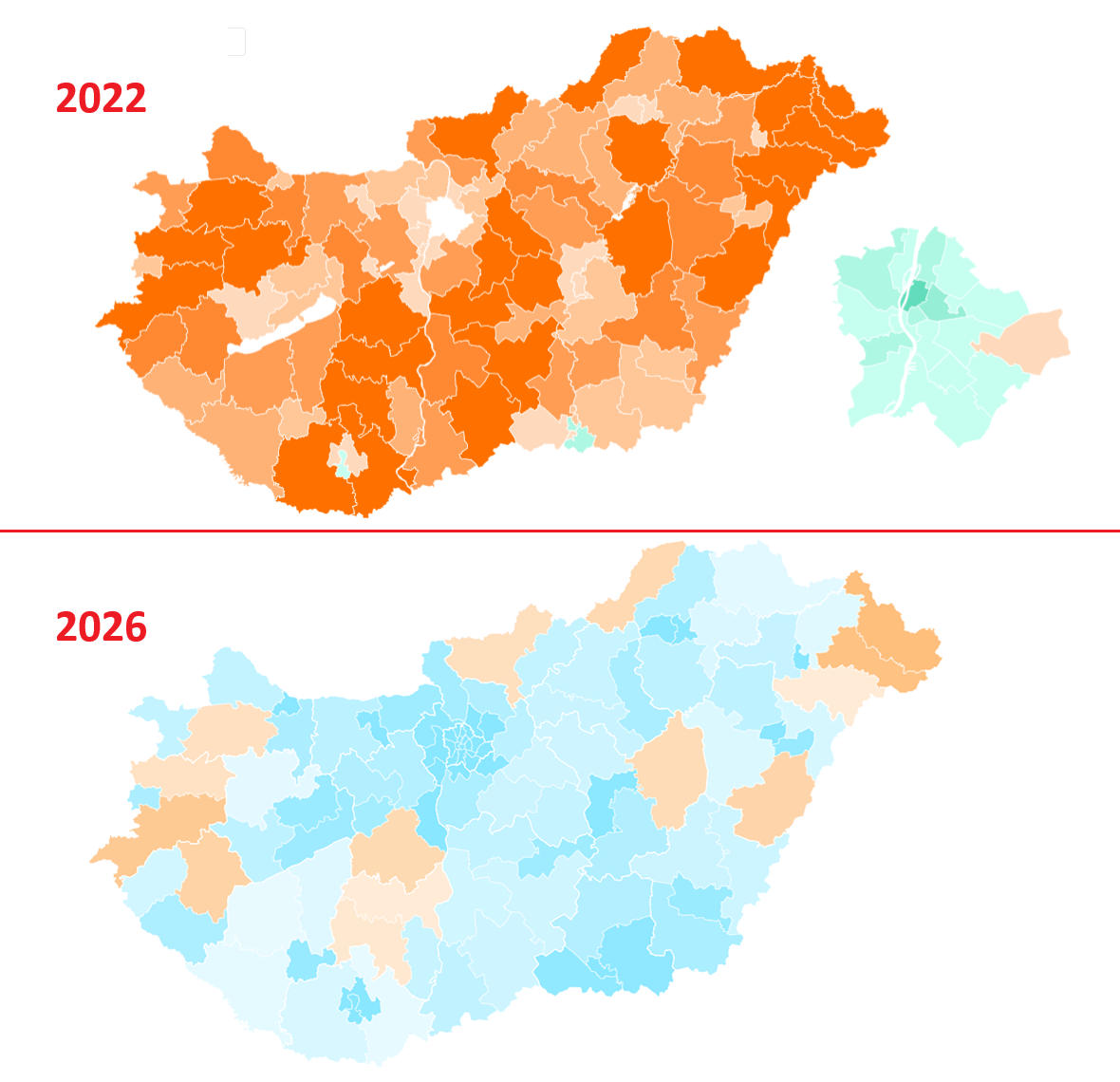
Comparison of the 2022 and 2026 election map. source: https://atlo.team/valasztas2022-eredmenyek/ , https://valasztas2026.atlatszo.hu/#/eredmenyek
Decline was much greater in constituencies comprising many smaller towns and villages. Compare, for example, the results in the constituencies Komárom-Esztergom 1, comprising of the county seat Tatabánya, and nearby, heavily rural Győr-Moson-Sopron 03. In the former, Fidesz has lost about 6,000 voters, why in the latter, nearly 10,000.
While Győr-Moson-Sopron 03 was still narrowly won by the Fidesz candidate, the swing was dramatic. In 2022, the Fidesz MP won 71.22% of the vote. Four years later, he barely won his district with 48.18%.
Although national-level figures shows that Fidesz continued to receive the highest proportion of votes in the smallest (places with under 5000 inhabitants), it is also visible that
the party lost more than 200,000 rural voters
– more than in other types of settlement.
Meanwhile, Tisza Party has gained about half a million rural voters compared to the opposition alliance (a coalition of parties ranging from the old Socialist party and post-far-right Jobbik), again, a larger gain than in other settlement types.
This fact is evident on our municipality-level election map: Tisza won a majority in some of the smallest villages in Hungary, for example, in the Borsod (Northeast Hungary) and Baranya (Southwest Hungary) regions, which include small hamlets with less than 200 voters, which in previous elections turned out strongly for Fidesz.
In February, Péter Magyar said in an interview that “the Hungarian countryside has risen up against the vile, corrupt regime.”
His remark seems to have been vindicated by the election results. It remains to be seen to what extent Tisza’s rural growth is due to the party’s efforts (such as local community building by the party, or Péter Magyar’s nationwide tour, which reached even the smallest settlements), and to a shift in national mood brought forth by mounting economic woes.
Written and translated by Zalán Zubor, data visualization by Krisztián Szabó. The Hungarian version of this story is here. The cover image: montage by Átlátszó
Share:
Your support matters. Your donation helps us to uncover the truth.
- PayPal
- Bank transfer
- Patreon
- Benevity
Support our work with a PayPal donation to the Átlátszónet Foundation! Thank you.
Support our work by bank transfer to the account of the Átlátszónet Foundation. Please add in the comments: “Donation”
Beneficiary: Átlátszónet Alapítvány, bank name and address: Raiffeisen Bank, H-1054 Budapest, Akadémia utca 6.
EUR: IBAN HU36 1201 1265 0142 5189 0040 0002
USD: IBAN HU36 1201 1265 0142 5189 0050 0009
HUF: IBAN HU78 1201 1265 0142 5189 0030 0005
SWIFT: UBRTHUHB
Be a follower on Patreon
Support us on Benevity!
