

The Russian state media’s reporter spotted at campaign event held by Hungarian transportation minister

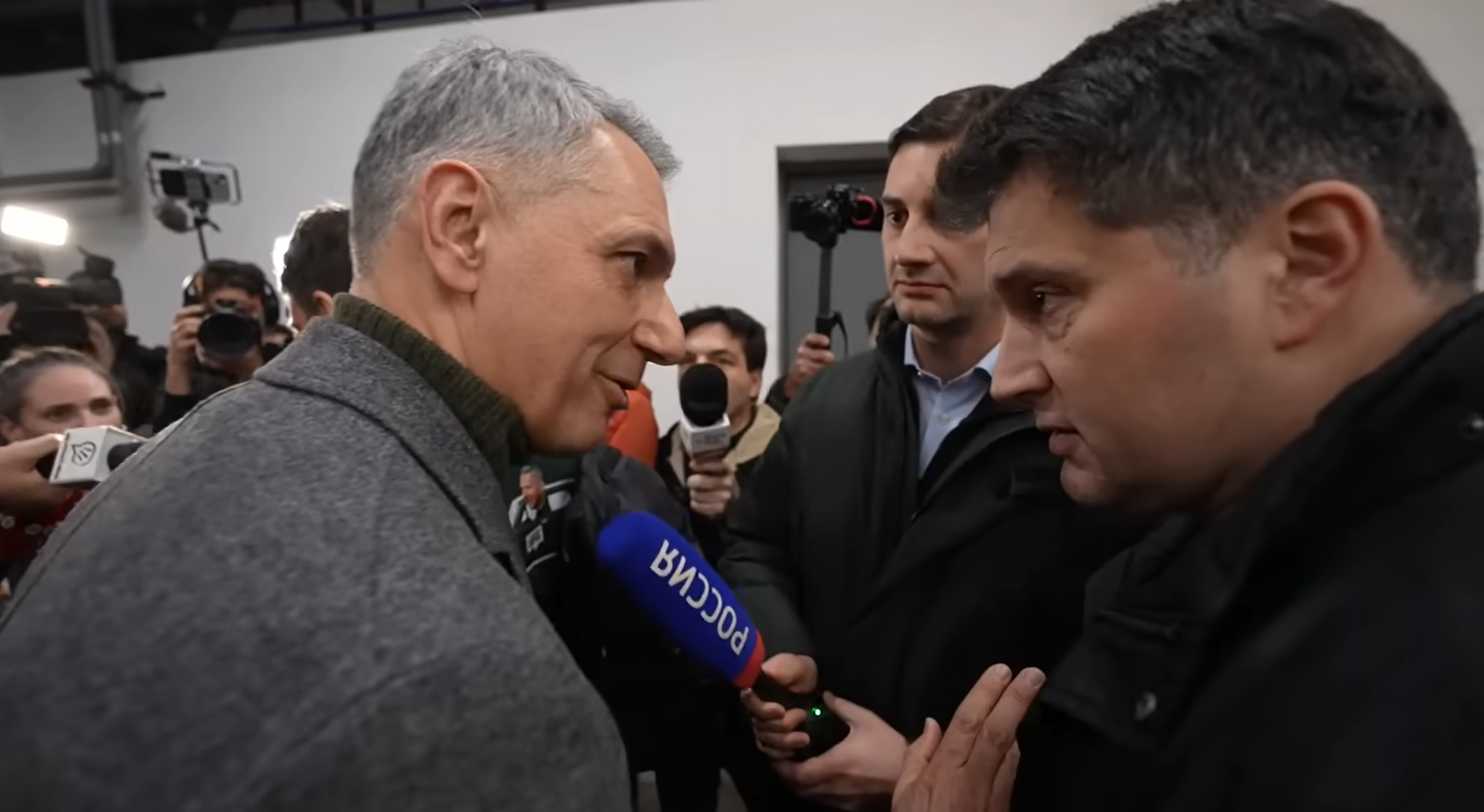
A reporter of the Russian state tv Rossiya was spotted at the campaign visit by Hungarian minister of transportation János Lázár. The Rossiya crew appears behind Lázár in his own recording and in other videos made at the forum. Compared to Hungarian journalists, the minister was very cordial with the Russian crew.
János Lázár, whom Viktor Orbán recently described as one of the three leaders of Fidesz’s election campaign, has held one of his routine public forums in the village Pusztaszabolcs on February 3. At the time, the event did not attract much national attention; however, over a week later, internet users spotted an unusual microphone in the press corps: that of the Russian state media Rossiya.
The Rossiya crew appears behind Lázár in the video the politician posted about the event, as well as other videos made at the forum. While he gets into a heated argument with representatives of the Hungarian press, the minister is clearly on better terms with the Russian crew.
Covering pro-Russian figures throughout Europe
The Russian state television microphone is held by a journalist who bears a striking resemblance to Denis Davidov, who has appeared in several Central and Northern European countries. In Slovakia, for example,
he interviewed a paramilitary motorcycle group called Brothers for Brothers, known for its pro-Russian rhetoric and calling on its supporters to carry out a “national purge.”
In Finland, Rossiya chose a different approach: it interviewed an elderly Finnish woman who claimed to have studied in the Soviet Union in the 1980s. In the original context of the conversation, it may have started as cultural nostalgia, but the end result was classic propaganda: that Finland, now anti-Russian and closing its borders, is going nowhere without Russia, and that the Finns are suffering and longing for the “good old friendship.” The report makes no mention of the fact that Finland’s eastern border was closed due to an unusually high number of asylum seekers, some of whom were sent there in an organized manner by Russia.
The Finnish interviewee later told the local press that he agreed to the interview because he had received the questions in advance and had been promised that the material would only be broadcast on the cultural channel.
The other person who appeared alongside the Rossija journalist at Lázárinfo in Pusztaszabolcs has not yet been identified. According to posts on X and Reddit, this person may be a man who is listed on the Ministry of Foreign Affairs website as the military attaché of the Russian Embassy in Budapest.
The Russian Embassy denied involvement
We sent questions to János Lázár and the Ministry of Construction and Transport, asking whether they were aware that a crew linked to Russian state media was participating in Lázárinfo, who gave permission for the filming, and under what conditions. According to the ministry, “anyone can participate in Lázárinfo, and press participation is not subject to registration, so the organizers do not know in advance which media outlets will be present at the event.”
We also contacted the Russian Embassy in Budapest to confirm whether they participated in the forum and, if so, whether their participation in the event can be considered part of Russia’s interest in Hungarian domestic political processes. The Press Service of the Embassy of the Russian Federation in Hungary responded to Átlátszó’s inquiry that
“None of the employees of the Embassy of the Russian Federation in Hungary participated in the Lázárinfo forum held on February 3, 2026, in Pusztaszabolcs; the correspondent of the Russian state television was indeed present at the event. The Embassy found out about his presence at the event after the event. The Embassy did not provide any assistance to the in the preparation of his report; the statements of Internet sources (including the network of “Szabadon, Magyarul” Internet portals) about the presence of the Russian deputy military attaché at the given event are fiction and do not correspond to reality; The presence of a representative of the Russian media at this event indicates that the Russian public shows a completely natural interest in the Hungarian election campaign and fully complies with the generally accepted standards of press freedom. Does Átlátszó show a similar interest in the activities of other foreign media organizations operating in Hungary, some of which are also state-owned? The Embassy does not consider it necessary to respond separately to those videos in which Russian state media appear in connection with the Hungarian election campaign. We believe this comment fully serves that purpose.”
Lázár criticized after racist statement
In the last three weeks, the Minister of Construction and Transportation has been under fire for statements he made at a similar forum. There, he explained that Hungary’s labor shortage should not be solved with immigrants but by “exploring internal reserves”, i.e., by mobilizing the Roma minority, and implied that Roma people should specifically clean the “dirty toilets” on the national railway’s trains, because “Hungarian voters are not so eager to clean someone else’s dirty toilets”.
The minister later explained himself on several fronts, tried to tone down his statement with countless apologies, and in an interview with to the Roma Press Center.
Fidesz tried to mitigate the damage by stunts such as Viktor Orbán stressing that he was a big fan of Dankó Rádió, a station that plays gypsy music.
Later, Fidesz went even further: when Roma protesters confronted Lázár, the ruling party released a video labeling the protesters as criminals, blurring the faces of individual protesters and accusing them of specific crimes. The police later denied that they released the data of protesters, and to date, it is unclear whether any of the accusations were true, and if they were, who gave away protected information of protesters.
Written by Hanna Solti, translated by Zalán Zubor. The original Hungarian articles can be found here. Cover image: screen capture from YouTube/Lázár János
Share:
Your support matters. Your donation helps us to uncover the truth.
- PayPal
- Bank transfer
- Patreon
- Benevity
Support our work with a PayPal donation to the Átlátszónet Foundation! Thank you.
Support our work by bank transfer to the account of the Átlátszónet Foundation. Please add in the comments: “Donation”
Beneficiary: Átlátszónet Alapítvány, bank name and address: Raiffeisen Bank, H-1054 Budapest, Akadémia utca 6.
EUR: IBAN HU36 1201 1265 0142 5189 0040 0002
USD: IBAN HU36 1201 1265 0142 5189 0050 0009
HUF: IBAN HU78 1201 1265 0142 5189 0030 0005
SWIFT: UBRTHUHB
Be a follower on Patreon
Support us on Benevity!
