



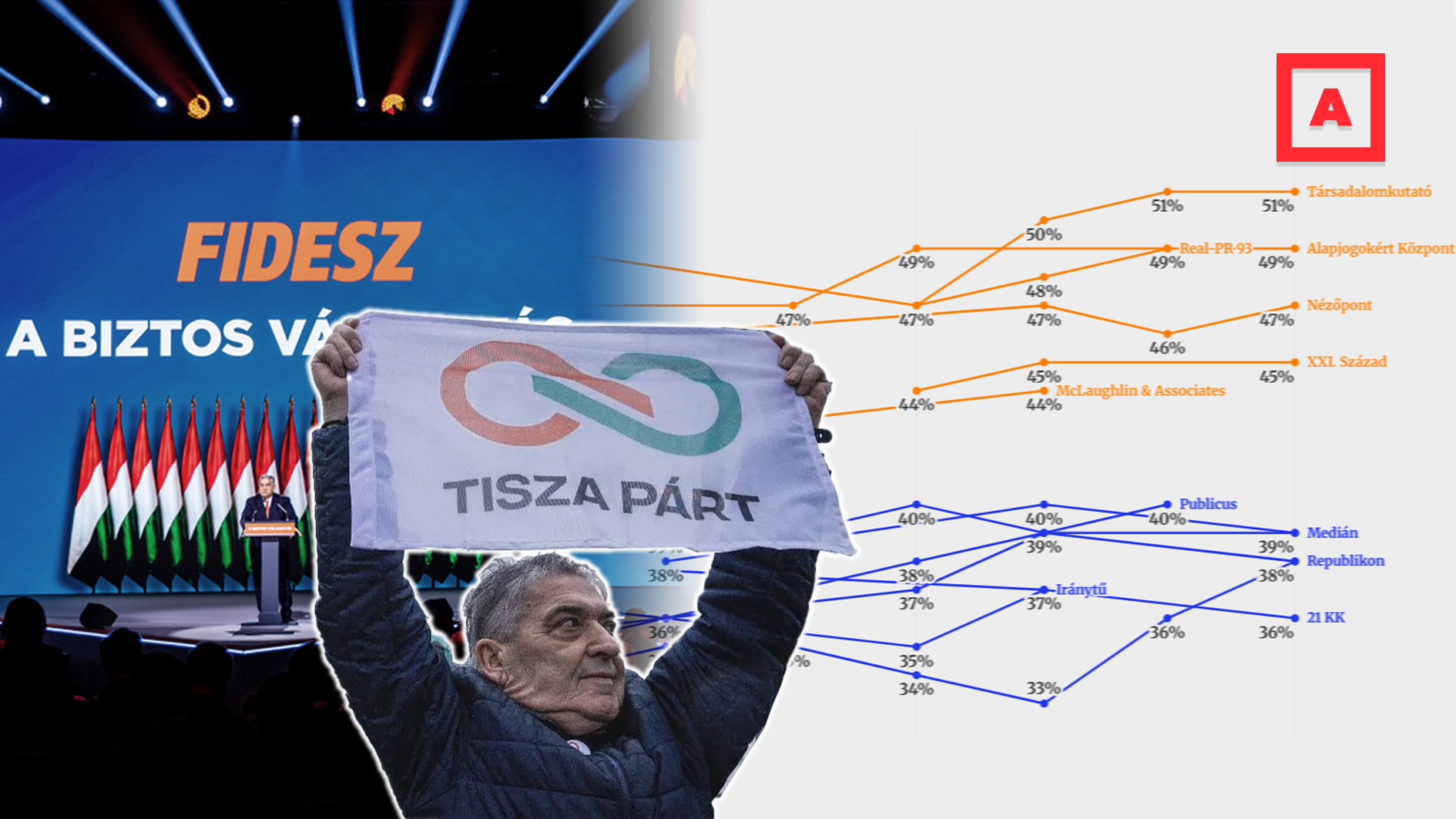
A huge gap has developed between polling numbers published by independent and pro-government pollsters in Hungary. The latter show an advantage for the opposition Tisza Party, while the former show an advantage for Fidesz. This was not the case before the last election, when parties were polling similarly with independent and pro-government institutes.
Since the emergence of the Tisza Party, a new phenomenon has appeared in opinion polls: pollsters close to the government (Nézőpont, Társadalomkutató, Századvég, etc.) and those independent of it (Medián, IDEA, 21. Kutatóközpont, etc.) have been publishing consistently different figures.

Pro-government institutes show Fidesz’s support at around 50%, while others show it at around 35–39%. We see similar gaps in the leading opposition party’s percentages: while the latest measurements by independent institutes show Tisza at around 50%, those close to the government show it at around 40%.
We compared all of the polling results from the last 13 months from major pollsters, as well as polling results from before the 2022 election. We primarily looked at polling among definite voters with a strong party preference where such data was available. Otherwise, we used definite voter figures.
We have compiled the data for 2025–26 in this interactive chart:
The difference between the two groups of pollsters was much smaller before the 2022 elections, when Viktor Orbán’s Fidesz was competing with a coalition of old opposition parties. As can be seen in the figure below, the lines of independent and pro-government researchers intersected several times. Although institutes independent of the government consistently overestimated support for the opposition coalition, the difference was not as great as it is now, and as the elections approached, the results converged.
Close to the election, all independent pollsters were showing Fidesz in the lead. Orbán’s party eventually won the election with 54.1% of the votes, and the opposition coalition only 34.4%.
We have compiled the data for 2021–22 in this interactive chart:
Independent pollsters at the time slightly underestimated Fidesz and massively overestimated support for the opposition coalition. This was also true, to a lesser extent, for institutes close to Fidesz.
The following two interactive infographics show the difference between support for the ruling party and the opposition parties. A positive number indicates an advantage for Fidesz, while a negative number indicates an advantage for the opposition.
In recent independent polls, the difference between Fidesz and Tisza is more stable than in the 2022 data, and as the elections approach, independent opinion polls are showing an increasingly uniform picture in this regard.
Only the 21 Research Center reports truly outlier values, with its last two measurements showing a 13% and 18% advantage for Tisza. Similarly, pro-government pollsters measure a comparably stable Fidesz advantage.
Nézőpont, Századvég, the XXIth Century Institute, and similar pro-government pollsters play a peculiar role in Hungarian politics. Such pollsters tend to have strong financial ties with the Orbán government and regularly probe public opinion, supplying a constant stream of secret polls for the ruling party. However, they also publish analyses and expert opinions in the media—which invariably support the position Fidesz is taking at the time. In that regard, they play a similar role to other Fidesz proxies, such as GONGOs using public funding to support Fidesz campaigns.
Civil society organisations supporting the ruling parties dominate National Cooperation Fund tenders
Published polling results can also be used to fire up a party’s base and demoralize another—and in recent months, pro-government polls showing Tisza trailing Fidesz have been featured heavily in pro-Fidesz media and politicians’ statements.
Looking at polling before the last elections, it is easy to assume that pro-government pollsters are trying to influence public opinion as well as probe it.
Independent pollsters’ numbers from that time tell a very believable story:
in early 2021, when it was first announced that opposition parties would join forces to oust Fidesz, the hypothetical coalition was polling ahead of Fidesz. In the following months, Fidesz regained its lead as opposition parties bickered about the technicalities of the coalition. In the autumn, the opposition agreed to hold primaries, and candidates campaigned actively until October—at which point the opposition once again polled ahead, as opposition voters were energized. The primaries ended with Péter Márky-Zay, an independent dark-horse candidate, being elected as the PM candidate.
Márky-Zay was prone to making gaffes and had a contentious relationship with the opposition parties, causing issues for the opposition campaign. This is reflected in independent polls, which show opposition support slipping once again after October 2021. Fidesz further expanded its lead in the months leading up to the April election due to increased welfare spending and the outbreak of the Russia–Ukraine war.
Pro-government polls—specifically those of the most active pro-government institute, Nézőpont—tell a different, less likely story: according to them, the opposition primaries actually had no effect on opposition support but energized Fidesz, which gained a massive lead in the autumn and winter of 2021.
For a short period in 2021, pro-government and independent opinion polls showed a similar gap to what we see today:
when the opposition was gaining the upper hand according to independent researchers, Nézőpont and Századvég suddenly started publishing analyses showing Fidesz leading by a wide margin.
However, in the months leading up to the election, Fidesz’s support fell dramatically according to pro-government pollsters and was not helped by either increased welfare spending or the war. Before the elections, the two blocs stood at nearly 50–50% (while independent polls indicated a Fidesz lead).
From a historical point of view, Nézőpont’s 2022 data does not make much sense. However, it may have been useful if the institute’s goal was not to gauge but to influence public opinion—for example, to dampen the enthusiasm of the opposition during the primary campaign period, and when Fidesz regained its lead, to measure a result of around 50–50% to prevent complacency.
Written and translated by Zalán Zubor, data visualization by Krisztián Szabó. The original Hungarian version can be found here. Cover image: montage by Átltászó.
