

Orbán government negotiated a new €5 billion Chinese financing deal weeks before Hungary’s election

In the weeks leading up to Hungary’s April 2026 parliamentary election, Viktor Orbán’s government was negotiating a new financing agreement worth up to €5 billion with the state-owned Export-Import Bank of China (CEXIM), a draft agreement obtained by Átlátszó reveals. The proposed deal could have financed railway infrastructure, geothermal energy projects, the battery industry and even the development of small modular nuclear reactors.
The document, prepared in the spring of 2026, outlines plans to significantly expand financial cooperation between Hungary’s Ministry of National Economy and China’s state-owned export-import bank. The proposed €5 billion financing framework would have been five times larger than the €1 billion Chinese loan Hungary took out in 2024.
The draft agreement identifies several potential areas of cooperation, including transport infrastructure, geothermal energy, the battery industry supply chain and small modular nuclear reactors (SMRs). It also envisages the issuance of Hungarian government bonds denominated in Chinese yuan, including so-called panda bonds and dim sum bonds.
The proposed €5 billion was not a single loan but an overall financing framework that could have included project-specific loans, investment financing and capital market transactions. The document contains no final interest rates, repayment schedules or commitments to finance specific projects.
Crucially, the document obtained by Átlátszó is an unsigned draft, not a final agreement. However, it contains proposed amendments, suggesting that substantive negotiations had already taken place. It remains unclear whether the parties ultimately reached an agreement or whether any financing was secured.
Átlátszó contacted the Ministry of Economy and Energy, the successor to the former Ministry of National Economy, and Hungary’s Government Debt Management Agency (ÁKK). Neither had responded by the time of publication.
China’s growing role in financing Hungary
Chinese lending became an increasingly important element of Orbán’s economic policy following the introduction of his government’s “Eastern Opening” strategy. In 2018, Átlátszó reported that many of the major Chinese investment projects promised to Hungary had failed to materialise. In the years that followed, however, Chinese investment and lending expanded significantly.
The most prominent example is the Budapest–Belgrade railway, a flagship infrastructure project under China’s Belt and Road Initiative. The Hungarian section of the railway was largely financed by a CEXIM loan. As Átlátszó previously reported, Chinese contractors and companies linked to Lőrinc Mészáros, Hungary’s wealthiest businessman and a longtime associate of Orbán, were among the major beneficiaries.
In April 2024, Hungary borrowed a further €1 billion from three Chinese financial institutions: the China Development Bank, China Eximbank and the Hungarian branch of the Bank of China. The government did not publicly announce the transaction, which was discovered by the Hungarian financial news outlet Portfolio in official government debt statistics. Some of the loan’s detailed terms only became public in 2026 following a freedom of information request.
The latest draft agreement points to an even broader role for Chinese financing in the Hungarian economy. Its focus on the battery industry reflects the growing presence of Chinese manufacturers, including CATL in Debrecen and BYD in Szeged. Átlátszó has extensively covered the environmental and public spending implications of these investments, including how the interests of a Chinese battery manufacturer led to the closure of a busy passenger railway line.
Negotiations continued ahead of the change of government
Further evidence of Hungary’s Chinese borrowing plans emerged after the 2026 election, which ended Orbán’s 16-year rule and brought Péter Magyar’s Tisza government to power.
In June, Hungary’s State Audit Office revealed that some HUF 286 billion (€715 million) in funding was missing from the state budget for three transport-related expenditure items. The former government had justified reducing budget allocations for railway construction by citing advanced negotiations with CEXIM over additional loan financing.
Hungary was also raising substantial funds on international capital markets in the run-up to the election. According to official debt management data, the government issued €3 billion in euro-denominated bonds in January 2026 and raised another $1.2 billion through a dollar-denominated bond issue in February. Following the change of government, Hungary issued another €3 billion in foreign currency bonds in July.
The proposed Chinese financing package would have represented a major expansion of Hungary’s financial relationship with Beijing. Beyond railway infrastructure, it could have opened the door to Chinese involvement in Hungary’s energy sector, nuclear technology and sovereign debt financing.
Whether the negotiations resulted in binding commitments remains unknown. The draft obtained by Átlátszó nevertheless raises important questions about the scale of the former government’s borrowing plans, the long-term implications for Hungarian taxpayers and the transparency of the country’s financial relationship with China.
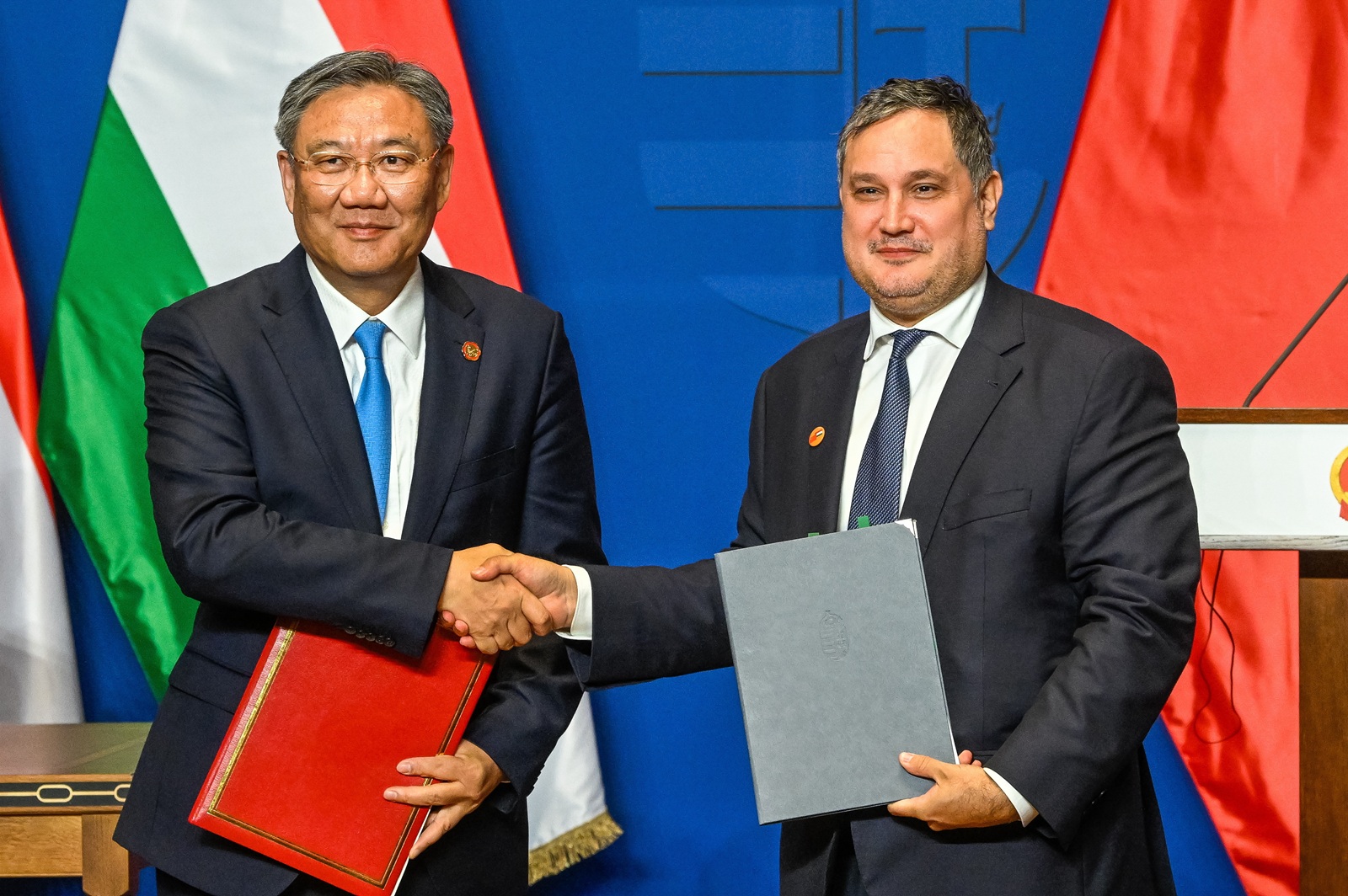
Written by Tamás Bodoky, the English summary was prepared with help of artificial intelligence. Read the original Hungarian article here. Cover photo: Minister of National Economy Márton Nagy and Chinese Minister of Commerce Wang Wen-tao after signing a memorandum of understanding on promoting the high-quality development of economic and trade cooperation zones at the Carmelite Monastery on May 9, 2024. MTI / Szilárd Koszticsák
Share:
Your support matters. Your donation helps us to uncover the truth.
- PayPal
- Bank transfer
- Patreon
- Benevity
Support our work with a PayPal donation to the Átlátszónet Foundation! Thank you.
Support our work by bank transfer to the account of the Átlátszónet Foundation. Please add in the comments: “Donation”
Beneficiary: Átlátszónet Alapítvány, bank name and address: Raiffeisen Bank, H-1054 Budapest, Akadémia utca 6.
EUR: IBAN HU36 1201 1265 0142 5189 0040 0002
USD: IBAN HU36 1201 1265 0142 5189 0050 0009
HUF: IBAN HU78 1201 1265 0142 5189 0030 0005
SWIFT: UBRTHUHB
Be a follower on Patreon
Support us on Benevity!
