

Police searches Fidesz propagandist’s home after alleged illegal archeological excavation
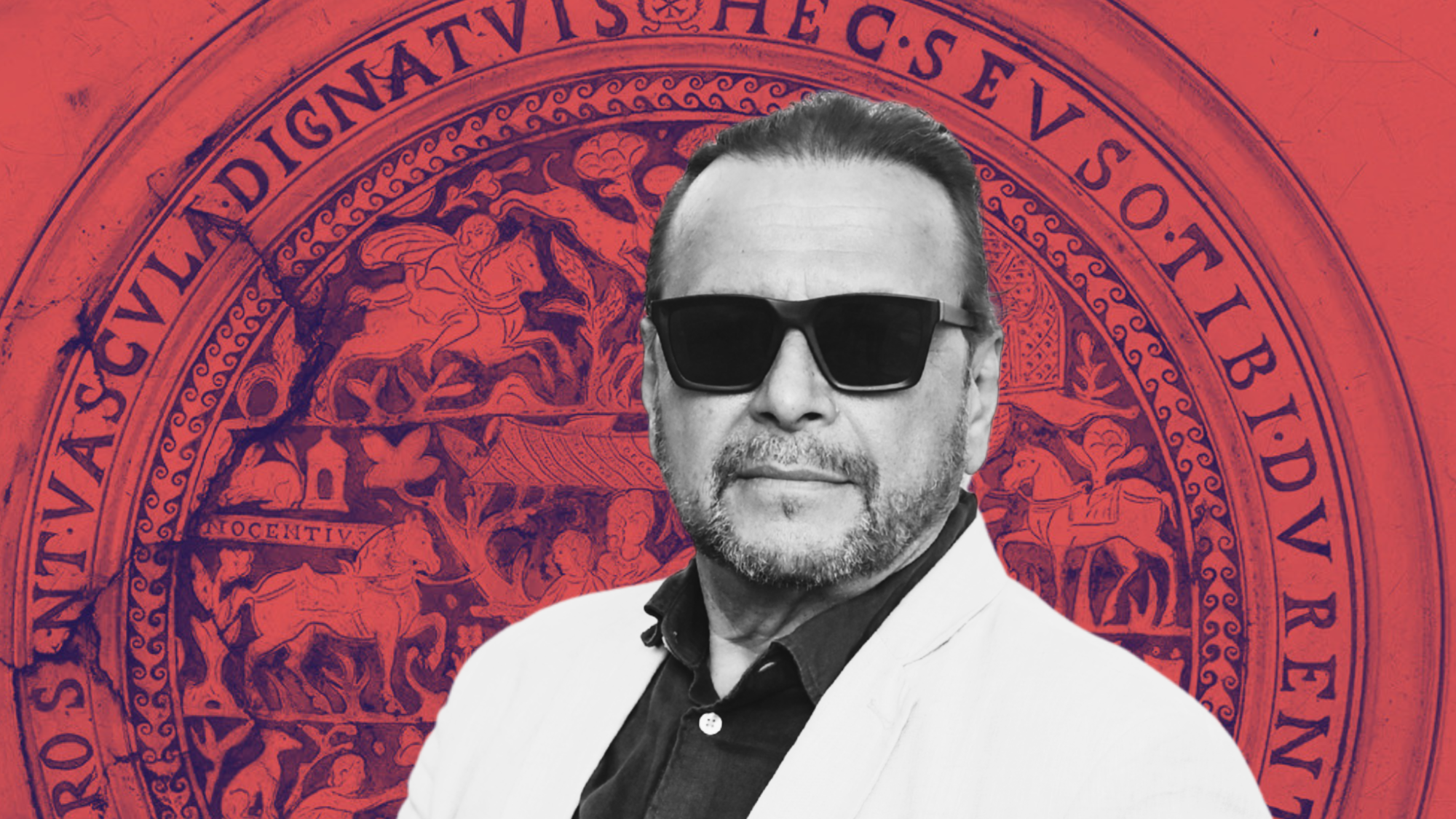
Zoltán Dézsy, a media personality frequently featured in pro-Fidesz media, was detained by police in June. However, the case has nothing to do with politics and everything to do with archaeology. Dézsy has been searching for alleged missing pieces of the mysterious Seuso Treasure, a quest he wants to chronicle in a documentary. His team, however, is suspected of using illegal means to hunt for the treasure, which led police to search Dézsy’s home as part of an investigation into the suspected theft of archaeological artifacts and protected cultural objects.
In the midst of a historic heatwave in June, three men with an excavator were preparing to begin work at the Kőszárhegy quarry in Fejér County, central Hungary. The quarry is well known in archaeology, as it was here that the Seuso Treasure—a unique collection of Roman-era artifacts—was discovered in the 1970s. The hoard, which became the subject of an international legal battle, is likely incomplete, and additional pieces are believed to be hidden at an unknown location. This was what the three men were looking for until the arrival of the police thwarted their search.

The Fejér County Police Headquarters detained two men at the Kőszárhegy quarry on June 27; one of them was Zoltán Dézsy, a journalist and film director. The police also seized pieces of brick and pottery, as well as human bones. The items were later identified by a staff member of the nearby King Saint Stephen Museum as archaeological finds, so the detainees will at least not become caught up in a murder investigation.
Dézsy worked as a journalist, reporter, and editor at Hungarian Radio and Hungarian Television in the 1980s and 1990s.
In recent years, he has been a prominent figure in pro-Fidesz media:
he was a recurring speaker on the news site Pesti Srácok and the television channel Hír TV. He also directed a film titled “Elment az öszöd,” dramatizing the 2006 political crisis, and, ahead of the 2026 elections, organized a counterprotest against Ákos Hadházy, an opposition MP known for investigating government corruption.
What was the plan with the excavator?
However, Dézsy’s longest-standing passion is the Seuso Treasure. He directed a documentary on the subject in 1997, another in 2016, and is currently filming a third. As he told Átlátszó, the film will be about the search for the missing pieces, which he is certain he and his team will find.
“That would be the dramatic conclusion to the film. It would be a huge deal, a tremendous joy—an immediate press conference, a museum exhibition—it would be a massive story,” says Dézsy. “Just think about it: a Roman-era jug turns up—a little damaged, but having survived some 1,500 years in that well. What a sensation that would be. Then I could sell that film to every documentary channel in the world.”
The mystery of the Seuso TreasureThe Seuso Treasure is a set of silver vessels crafted in the 4th century. The collection takes its name from its owner, Seuso, whose name is inscribed on one of the bowls. How and where the vessels were found remains unknown. Some historians suspect that the treasure was accidentally discovered by Hungarian soldiers during World War II on the outskirts of Szabadbattyán. They may then have hidden the objects in a nearby mineshaft. The soldiers who knew the hiding place may have been killed.It was in this mineshaft that József Sümegh, an amateur antiques collector who worked for a time as a laborer in the Kőszárhegy mine, discovered the treasure in the 1970s. He stored it in a nearby cellar for years, until, in 1980, the 24-year-old man’s body was found hanging in the same cellar. His death was ruled a suicide, but his family and friends disputed this conclusion. To this day, however, murder has not been proven. What is clear is that, around the same time, the Seuso Treasure was transported abroad by unknown means.In 1984, the treasure resurfaced in Los Angeles, where it was offered for sale to a museum. János György Szilágyi, then head of the Museum of Fine Arts’ Antiquities Collection, happened to be in Los Angeles at the time and noticed the inscription “Pelso”—the Roman-era name for Lake Balaton—on one of the objects. It was then that Hungarian researchers first took notice of the collection.In 1990, an English aristocrat, Lord Northampton, sought to sell the treasure at auction, at which point Hungary, Lebanon, and Yugoslavia all filed claims of ownership of the artifacts. The court rejected all the plaintiffs’ claims, and Hungary paid a total of more than $2 million as a result of losing the lawsuit. Despite this setback, Hungary did not relinquish its claim to ownership of the treasure, and, after lengthy negotiations and the payment of a total of 42 million euros in compensation, the artworks were returned to Hungary in 2017.
Based on his previous research,
Dézsy believes that the missing pieces of the Seuso Treasure were once thrown into an underground cave or well.
As he explained—and as can be seen in his Facebook posts—several local researchers have attempted to clear out the well in recent years, but so far without success. “Clearing out the well was incredibly exciting, and we’re continuing to look for clues pointing to a Roman-era wine cellar,” he says. “My witness told me that when they bulldozed that road in the mine area, he could see into a cavity, but there is a large rock covering it.” Dézsy’s team had hoped to excavate this cavity on June 27 and would have needed the excavator to do so.
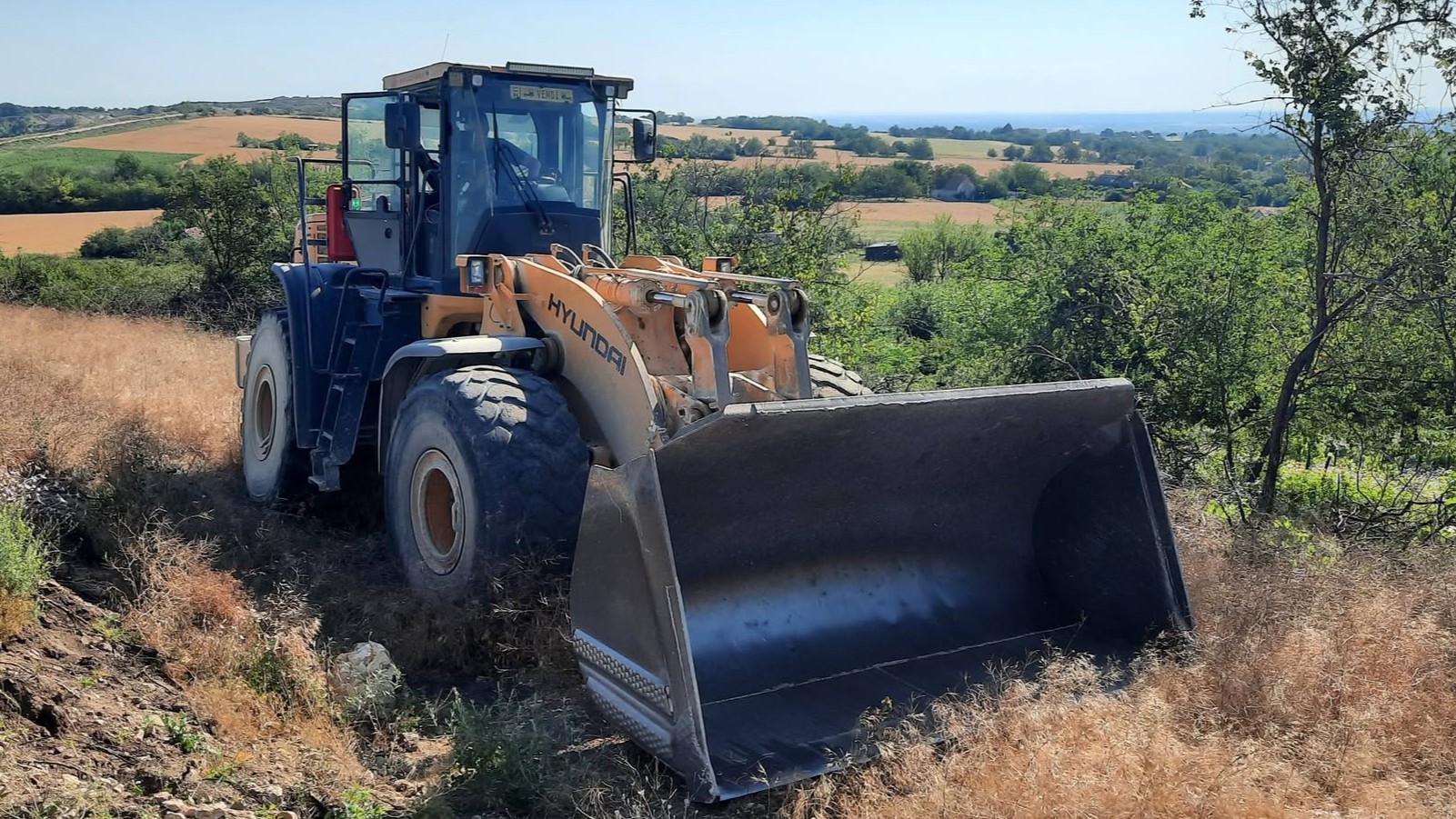
The excavator used by Dézsy’s team. Photo by Zoltán Dézsy
“The mine gave us the heavy equipment that was used to build the road last year. We needed it because we had to roll a large rock aside to uncover the cave (cellar) we were looking for. We started examining the surface of the ground at 8:00 a.m. We immediately noticed bones, but then the police arrived, and we had to suspend our work,” he wrote in a Facebook post.
According to our information, a search of Zoltán Dézsy’s home, conducted as part of the police investigation, yielded no results. The same was not true, however, of his partner, an antiques collector, who was taken into custody. According to our sources, the police found a stolen work of art in his possession during the search. Since we were unable to reach him and the Fejér County Police Headquarters did not release any details about the case for privacy reasons, we will not name the individual in question.
Questions and contradictions
According to Dézsy, the human bones found at the site were unearthed last year by a machine during the filming of an American feature film. “We did not conduct any digging; this is not even an archaeological site, but a mine—that is, private property. While driving down the road, you could see the bones sticking out of a pile of dirt that the mining machine dumped by the roadside last year,” he says. “You cannot really call those three vertebrae and two skull fragments ‘finds.’ I notified the museum in advance by email; I have a good relationship with them.”
However, according to Krisztián Pokrovenszki, director general of the King Saint Stephen Museum in Székesfehérvár,
the museum received a letter from Dézsy only after he was taken in by the police.
The museum director said he had asked Dézsy to bring the artifacts to the museum as soon as possible, but Dézsy has not yet done so.
Pokrovenszki recalled that someone other than Zoltán Dézsy had notified the museum that “someone intended to carry out some kind of illegal work at the site. A photo of the artifacts was attached to the letter.” He continued: “We went out there, but we could not locate the exact site based on the coordinates provided in the report. Then, on Saturday, the police chief called to say they had apprehended two individuals, likely in the area referred to in the report. One of my colleagues was able to go to the Polgárdi police station to examine the artifacts and, among other things, determined that the bones had likely been excavated from the ground roughly a week before the police intervention. So this was not a freshly unearthed find from that location.”
Although archaeological research had previously been conducted in the area in question, it was not listed among the officially registered archaeological sites. “Since then, my colleagues have gone out there and found artifacts from both the medieval and Roman periods. We have registered the site, so it is now listed in the official registry and is protected,” Krisztián Pokrovenszki tells Átlátszó. From this point on, fieldwork at the site is strictly regulated. However, “even before this area was officially registered as an archaeological site, work should have been halted upon the discovery of the first artifact or bone, and it should have been reported immediately.”
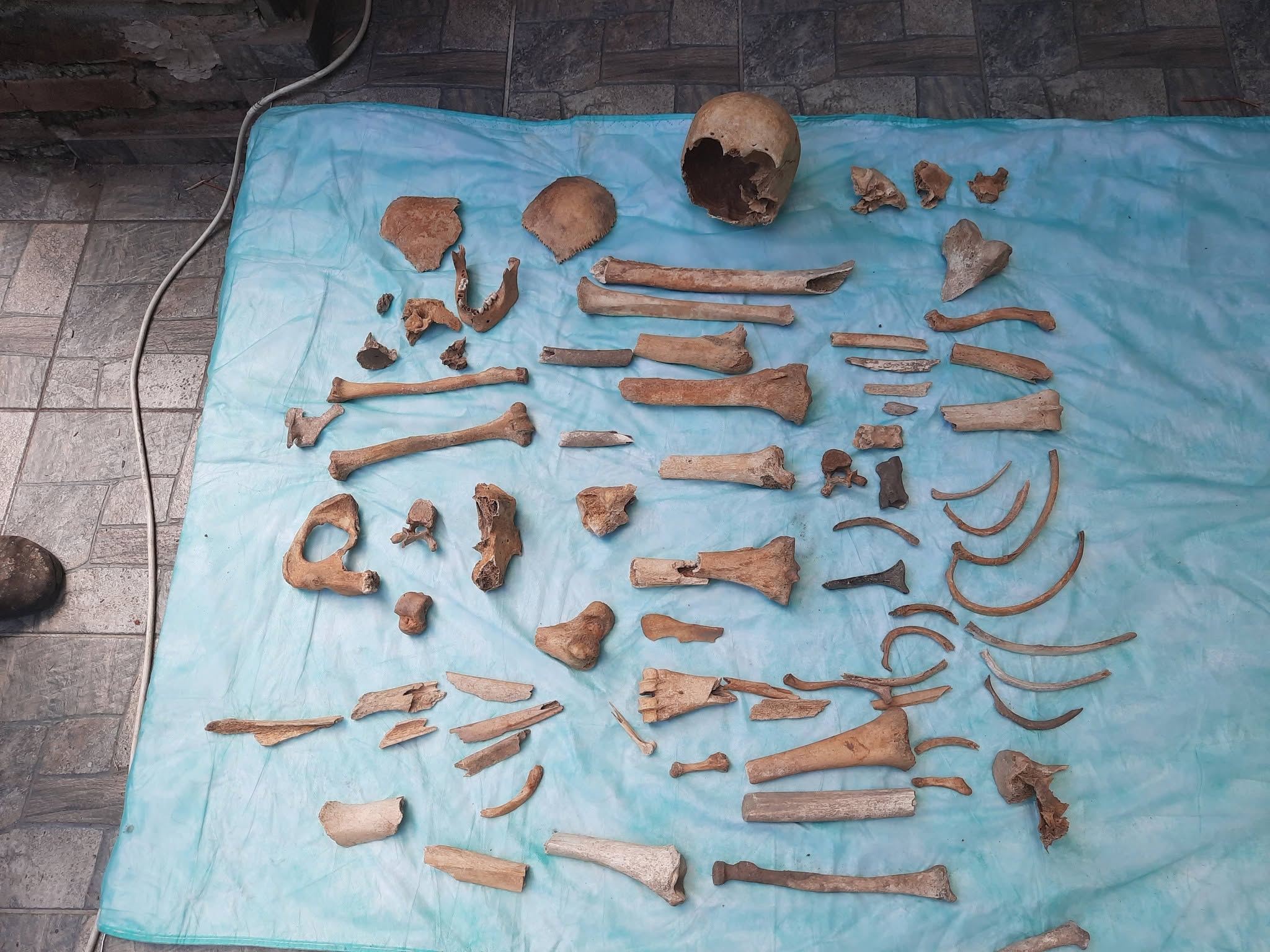
Some of the artifacts seized on Kőszárhegy on June 27. Photo by Zoltán Dézsy
Zoltán Dézsy, however, is undeterred. He says they will begin work on another well at the end of July, and he is extremely confident of success. When asked whether there is any official government project dedicated to searching for these treasures, he replies that there is not. “No one but me is pursuing this cause. I am the only one searching, using my own funds, and if by chance there are results, then I will find supporters,” he says.
Krisztián Pokrovenszki is somewhat surprised by the statement. “Unofficially, or perhaps semi-officially, it may be true that only Mr. Dézsy is searching,” he says. “But official archaeological research is still ongoing in collaboration between the National Museum and the King Saint Stephen Museum. Several archaeological excavations have taken place in recent years—though it is another matter that, due to the sensitivity of the issue, we do not publicize every detail.”
Treasure hunters vs. archeologists
Self-proclaimed archaeologists and treasure hunters can cause a great deal of frustration—and, in some cases, serious damage—to professional archaeology. According to Pokrovenszki, the museum typically deals with an average of four or five police cases per year, but it is likely that neither the museum nor the police are aware of many other incidents. Sometimes metal detectorists are caught; at other times, artifacts are found during house searches. Coin hoards are particularly popular, especially rare coins, which can be financially valuable if sold on the black market.
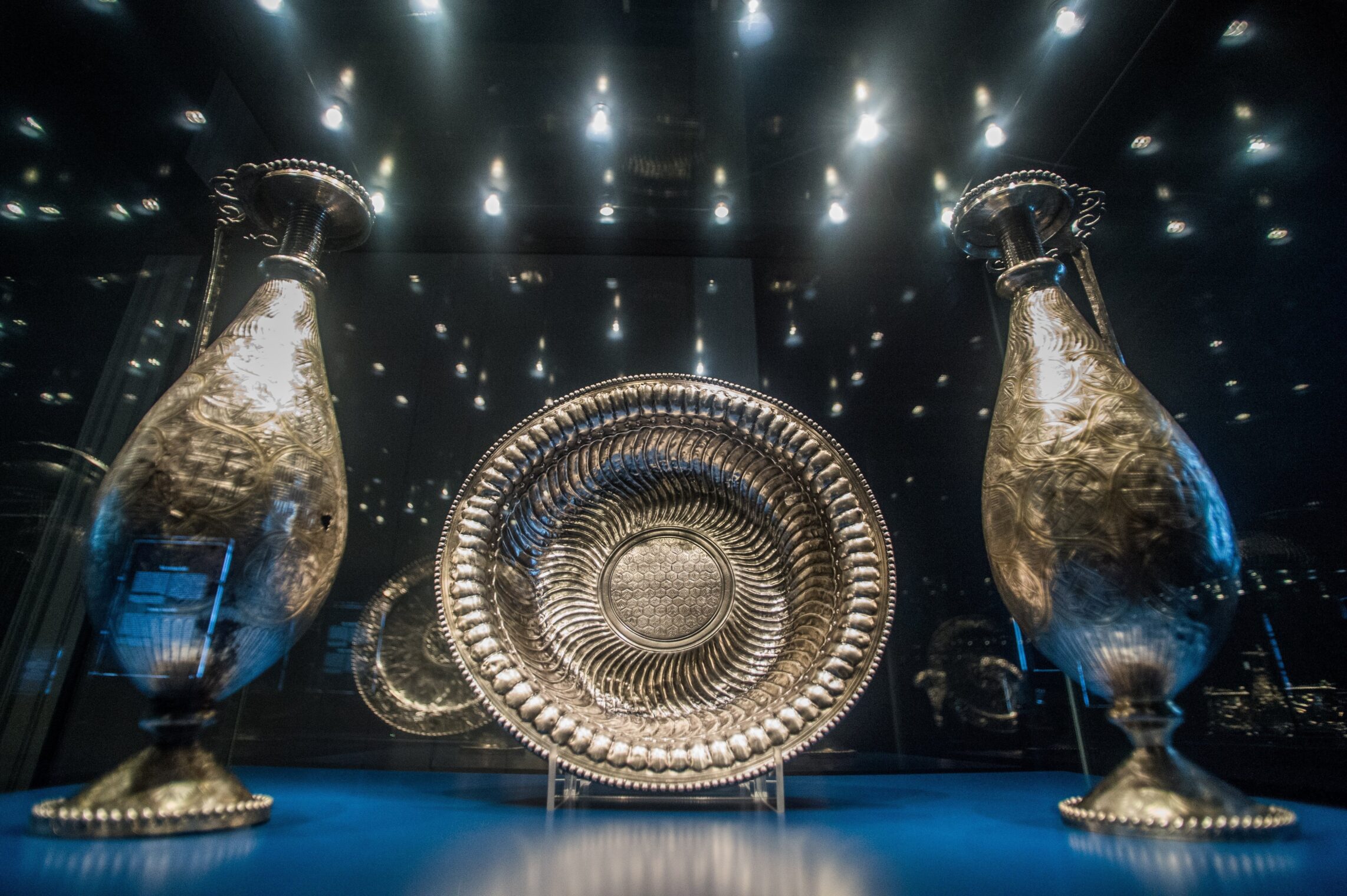
Part of the Seuso Treasure, Budapest, June 26, 2018. MTI Photo: Zoltán Balogh
“The biggest problem with illegal excavations is that data experts could use for further research is lost. For example, it is already very difficult to identify the artifacts found at Kőszárhegy after the fact, because once the objects or bones are dug up in this way, we can no longer tie them to a specific context—we do not know what other items they were next to, how deep they were, or what the stratigraphic context was,” says the museum director:
“Schliemann did indeed find Troy, but in the process, he disrupted the archaeological layers, and as a result, science lost an incredible amount of data.”
In an interview with the pro-Fidesz news site Origo last year, Zoltán Dézsy said that if he did not find the missing Seuso treasures, he would “jump down a well.” “The artifacts must be there; I think I am on the right track, and I am working with undiminished determination on the third part of the Seuso film, which I hope will have a happy ending. I cannot even imagine any other scenario.”
Dézsy told Átlátszó that, following the police investigation, he filed a complaint alleging data theft. According to him, someone posted confidential information and even Dézsy’s own photos on Reddit.
Written by Orsolya Fülöp, translated by Zalán Zubor. The original Hungarian article can be found here. Cover image: Zoltán Dézsy and a detail of the Seuso bowl.
Share:
Your support matters. Your donation helps us to uncover the truth.
- PayPal
- Bank transfer
- Patreon
- Benevity
Support our work with a PayPal donation to the Átlátszónet Foundation! Thank you.
Support our work by bank transfer to the account of the Átlátszónet Foundation. Please add in the comments: “Donation”
Beneficiary: Átlátszónet Alapítvány, bank name and address: Raiffeisen Bank, H-1054 Budapest, Akadémia utca 6.
EUR: IBAN HU36 1201 1265 0142 5189 0040 0002
USD: IBAN HU36 1201 1265 0142 5189 0050 0009
HUF: IBAN HU78 1201 1265 0142 5189 0030 0005
SWIFT: UBRTHUHB
Be a follower on Patreon
Support us on Benevity!
