

MCC’s Brussels branch concealed the ultimate beneficial owners in its UBO declaration
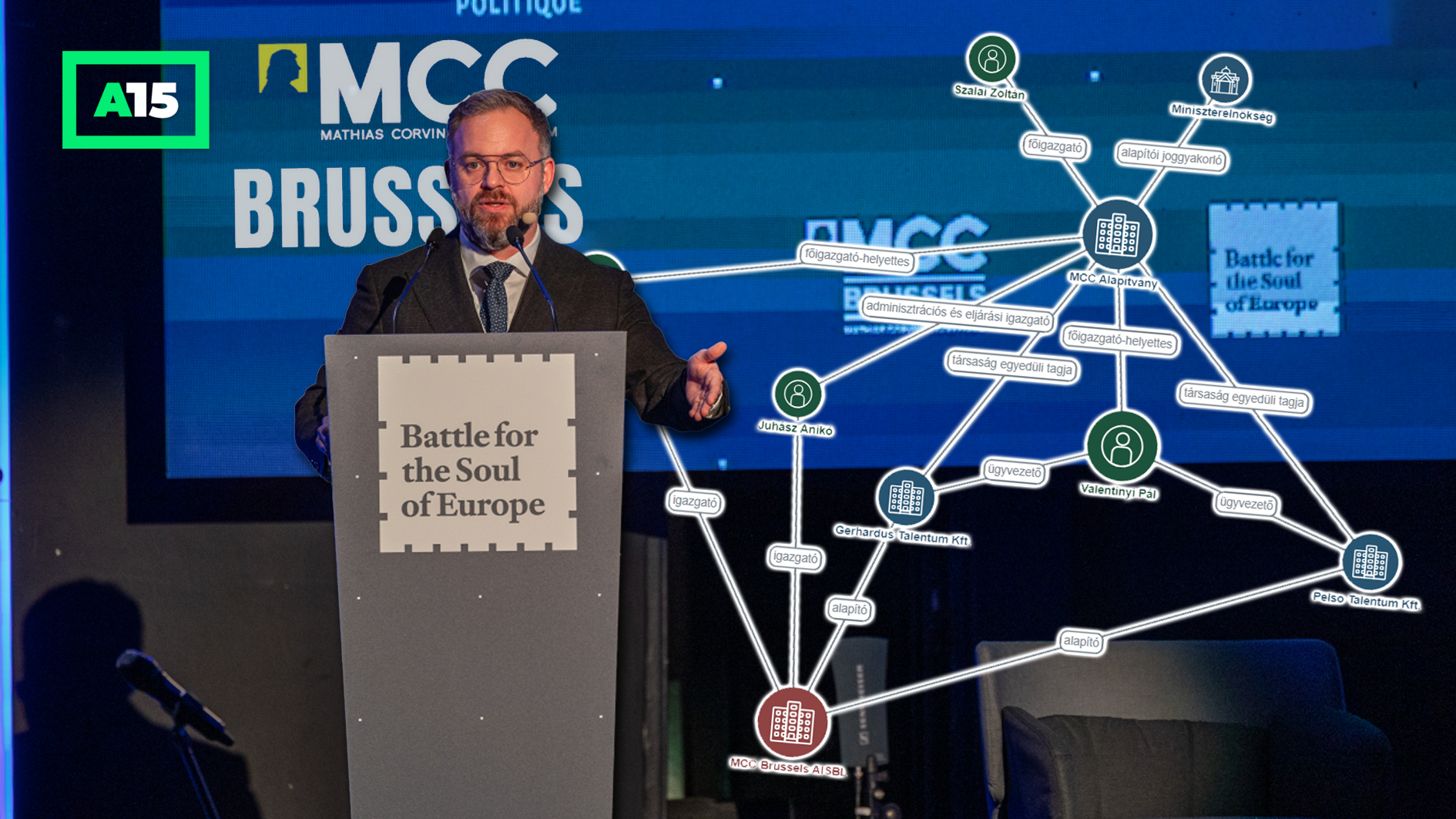
MCC Brussels was registered in Belgium as a nonprofit organization in 2022. Despite its branding, it is not officially part of the Mathias Corvinus Collegium in Hungary, which operated as a ‘KEKVA’ foundation—an institution unique to Orbán-era Hungary. KEKVAs are semi-national asset management foundations. While the Hungarian MCC is branded first and foremost as an educational institution, MCC Brussels openly operates as a lobbying organization.
On its website, the organization lists influencing European policymakers as one of its goals: “Drawing on its outstanding network of experts and through its unique approach to the political, socioeconomic, and cultural issues of our time, the MCC seeks not only to inform European policymakers but also to influence them.” In 2024, MCC Brussels even organized a protest against the EU’s agricultural policy, featuring several European far-right politicians, including Marion Maréchal, who was then a candidate for Éric Zemmour’s Reconquête party.
Under new management
MCC Brussels AISBL’s articles of incorporation are publicly available on the website of the Belgian Judicial Office. The document reveals that the organization was registered as an international nonprofit association and that its founders are two Hungarian companies: Pelso Talentum Real Estate Development Ltd. and Gerhardus Talentum Real Estate Development Ltd. The Hungarian MCC Foundation is the sole owner of both companies, which are just two of the many subsidiaries that manage the MCC’s real estate portfolio, worth billions of forints.
Pelso Talentum, one of the Brussels branch’s founders, owns the academy’s summer resort in Révfülöp, near Lake Balaton.
The other founder, Gerhardus, owns a massive office complex on Gellért Hill in Budapest that once served as the headquarters of the Communist-era Workers’ Guard.
MCC had planned to build a new educational center there for more than HUF 1.5 billion (EUR 4.12 million), but the plan was scrapped after the elections in April.
In one of its first executive acts, Péter Magyar’s incoming government ordered the dissolution of all KEKVA foundations. The MCC Foundation is set to be dissolved at the end of July, and all its assets—including its subsidiaries and real estate holdings—will be reclaimed by the state.
Possible violation of UBO disclosure requirements
Átlátszó, in collaboration with the Belgian newspaper De Morgen and the British nonprofit Hope Not Hate, obtained the ultimate beneficial owner (UBO) declaration that MCC Brussels submitted to the Belgian Ministry of Finance. Under Belgian law, all businesses and companies are required to disclose their UBOs. Despite the key role they played in founding MCC Brussels, the declaration does not mention any of the Hungarian MCC subsidiaries. Instead, it lists only two individuals as ultimate beneficial owners: Péter Lánczi and Anikó Juhász, who, according to the articles of incorporation, were appointed directors of MCC Brussels.
Péter Lánczi is also deputy director general of the Hungarian MCC. Anikó Juhász served as director of the Young Talent Program at the Hungarian MCC, as well as director of administration and procedures for the organization.
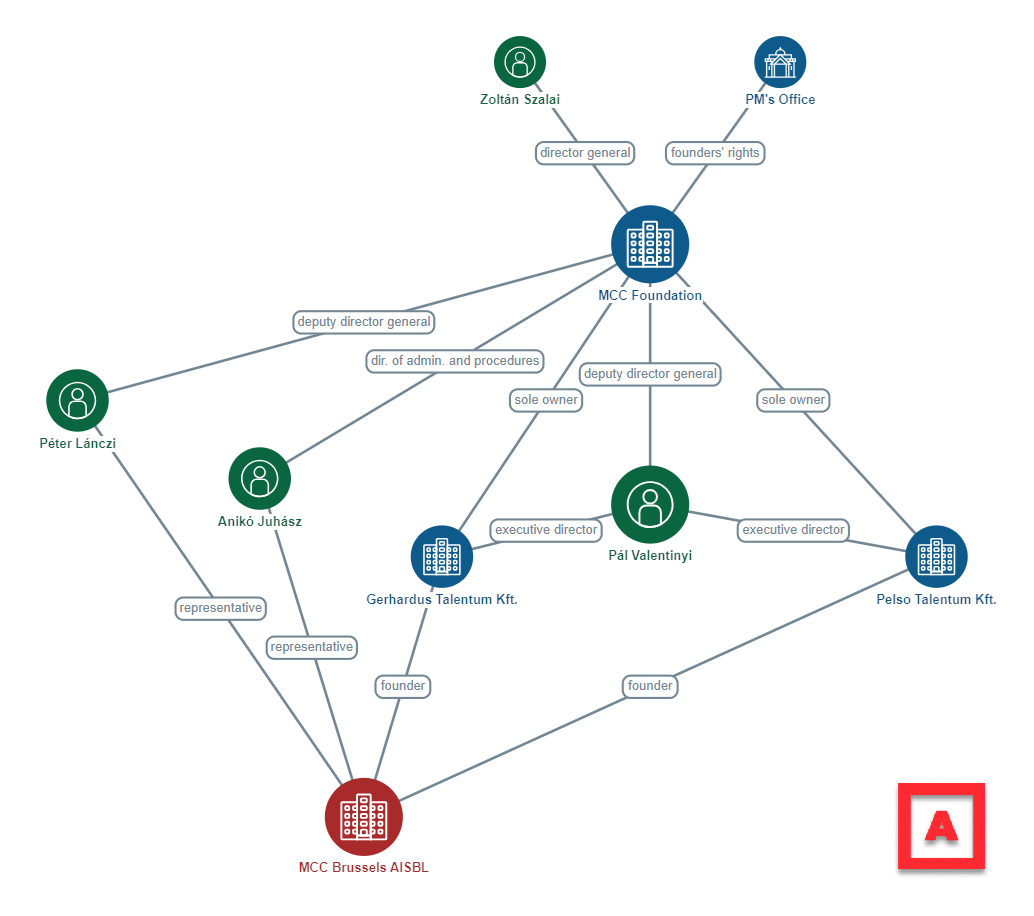
Connections of organizations and individuals mentioned in the article
Crucially, the organization’s founding documents show that Gerhardus Kft. not only played a key role in the incorporation of MCC Brussels but
also retains the right to appoint at least one of the organization’s two directors—a point relevant to the possible UBO violation.
“The association is governed by a board consisting of at least two directors. The directors are appointed by the general meeting for an indefinite term. At least half of the directors must be appointed from among the persons listed on the roster proposed by the founding Hungarian limited liability company, Gerhardus Talentum Real Estate Development Limited Liability Company,” the document states.
In light of this, the UBOs of MCC Brussels may include, through Gerhardus Kft., the head of the Hungarian MCC Foundation—currently Zoltán Szalai, who succeeded Balázs Orbán—as well as the head of the ministry that exercises the founder’s rights over the MCC KEKVA foundation. That ministry is the Prime Minister’s Office, meaning that the actual ultimate owner is currently Bálint Ruff, who succeeded Gergely Gulyás.
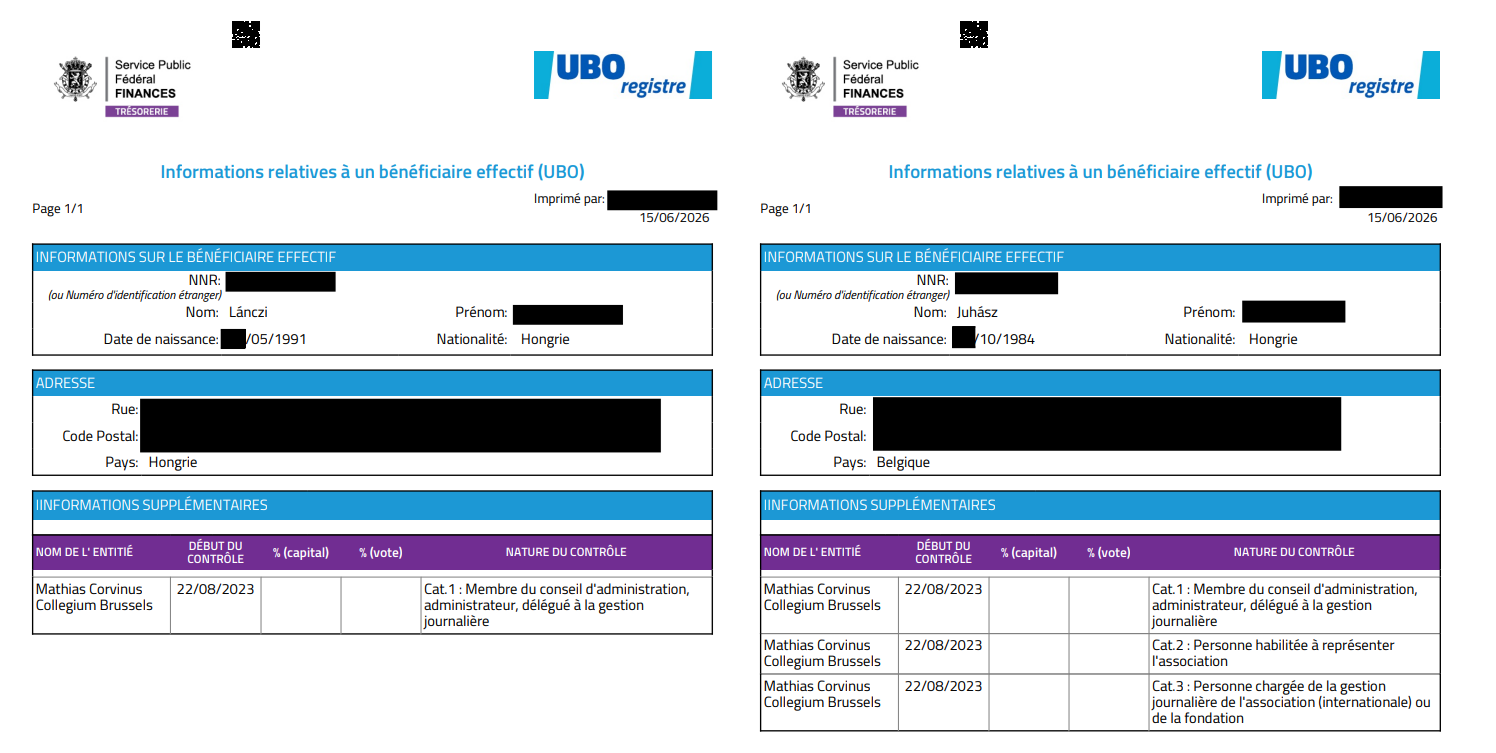
Excerpts from MCC Brussels’s UBO Statement
If MCC Brussels’ beneficial ownership report violates the law, the organization could face a fine ranging from EUR 250 to EUR 50,000, or even criminal penalties.
In response to a question from De Morgen, John O’Brien, communications director at MCC Brussels, replied: “As the MCC Foundation is not a natural person, it should not be registered in the UBO register; it would technically be impossible to register it.”
However, according to Michel Maus, a law professor specializing in anti-fraud legislation, omitting the companies behind MCC Brussels from the declaration may constitute “a potential violation of corporate and association laws, as well as anti-money laundering laws.”
“It is not enough to disclose the organization behind your organization, because you must then continue until you reach the natural person who is the ultimate beneficiary. The register was created to facilitate greater transparency among associations,”
he said.
According to the website of the Belgian Financial Services and Markets Authority, the UBO declaration must also include the names of all entities and individuals that may influence the organization’s operations.
EUTR: MCC Hungary and Brussels are the same
In a separate case, the secretariat of the European Union Transparency Register also argued that MCC Brussels and the MCC Foundation in Hungary are one and the same. Earlier this year, MCC Brussels was suspended from the Transparency Register, a database of lobbying organizations. This means that MCC Brussels can no longer participate in meetings of the European Commission’s expert groups or in committee hearings of the European Parliament.
Initially, the EUTR secretariat launched an investigation because it suspected that MCC Brussels had not properly reported its finances. Although the financial reports were in order (MCC Brussels reported that it operated on a budget of EUR 6.37 million in 2024, funded almost entirely by the Hungarian MCC Foundation),
the organization was found to have violated the so-called “single registration” principle.
According to the Transparency Register, MCC Brussels and the Mathias Corvinus Collegium Foundation cannot be listed separately; they should have a single joint entry. MCC disputed this in a press release, saying that the two organizations are separate legal entities and that “their advocacy activities are completely different.” It criticized the decision as “politically motivated,” arguing that other international organizations, including certain branches of the WWF, are also registered separately.
Transportation ministry may take over
With the MCC Foundation’s upcoming dissolution, the future of MCC Brussels is also in question. According to the government decree, assets owned by the Mathias Corvinus Collegium Foundation, including its subsidiaries, will also be transferred to the state. Specifically, the Minister of Finance will exercise ownership rights over most companies, except for “business entities engaged in real estate development,” which will fall under the authority of the Minister of Transportation and Investment, Dávid Vitézy. As Gerhardus Kft. falls into the latter category, Dávid Vitézy may, in theory, have a say in the future selection of MCC Brussels’ board of directors through the company.
We contacted the Ministry of Transportation and Investment about the matter, but by the time of publication, we had not received a response explaining what influence the state and the ministry would have over MCC Brussels.
Written and translated by Zalán Zubor, the Hungaran version of the story is here. Cover image: MCC Brussels/Átlátszó montage. This article was produced in collaboration with Átlátszó, the U.S.-based Inkstick Media, the U.K.-based Hope not Hate, and the Belgian newspaper De Morgen.
Share:
Your support matters. Your donation helps us to uncover the truth.
- PayPal
- Bank transfer
- Patreon
- Benevity
Support our work with a PayPal donation to the Átlátszónet Foundation! Thank you.
Support our work by bank transfer to the account of the Átlátszónet Foundation. Please add in the comments: “Donation”
Beneficiary: Átlátszónet Alapítvány, bank name and address: Raiffeisen Bank, H-1054 Budapest, Akadémia utca 6.
EUR: IBAN HU36 1201 1265 0142 5189 0040 0002
USD: IBAN HU36 1201 1265 0142 5189 0050 0009
HUF: IBAN HU78 1201 1265 0142 5189 0030 0005
SWIFT: UBRTHUHB
Be a follower on Patreon
Support us on Benevity!
