

Orbán’s foreign ‘fellow travellers’ cite privacy to shield state-funded payouts

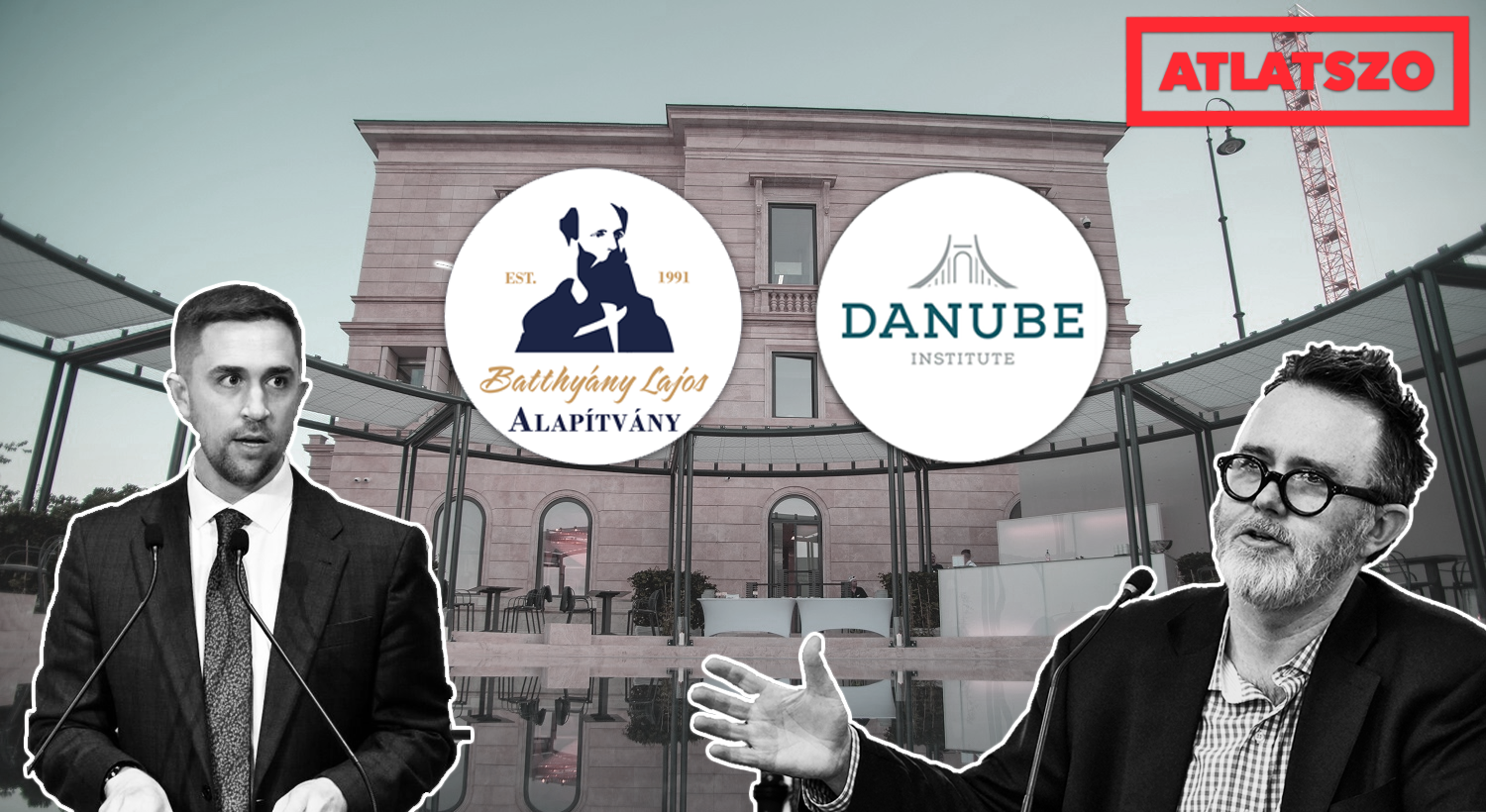
Past and present fellows riding the million-euro gravy train at Hungary’s authoritarian influence outfit, the Danube Institute, cited “safety concerns”, “right to privacy”, and fear of “marketers” to keep high-paying government-funded contracts anonymous. The institute is a key link in the chain between JD Vance and Orbán’s regime.
Several dozen past and present fellows at Hungary’s Danube Institute (DI) requested that their contracts with the organisation be withheld, an Atlatszo reporter has found upon reviewing nearly a hundred agreements – and associated GDPR forms.

“The details of my contract are an entirely private matter”,
wrote one particularly eloquent fellow, adding that they “object in the strongest terms to the financial details of a commercial contract being disclosed in the public realm”.
The journalist accessed the contracts via a freedom of information procedure as they catalogue public spending: the institute operates under the auspices of the Batthyány Lajos Foundation (BLA), an entity practically entirely financed by the Hungarian government. The DI and its host the BLA are both key institutions in Russia-friendly PM Viktor Orbán’s international soft power machinery. Notably, the DI is a partner of the Heritage Foundation in the US and is believed to have partaken in shaping Project 2025, the blueprint of the second Trump presidency. Vice-president J. D. Vance, who is currently visiting Hungary, is reportedly close with the Heritage Foundation.
UK, US personalities on Orbán’s payroll identified
While the DI obligingly scrubbed the names of its collaborators from the documents, Atlatszo has nonetheless managed to identify numerous DI fellows – mostly public persons of a UK or US background – based on indirect evidence contained in the documents and further information (including the copies of some contracts) obtained through journalistic means.
Atlatszo identified the fellow eloquently objecting to the disclosure of his contract as Lord David Frost, Conservative peer and former chief Brexit negotiator.
Atlatszo’s identification of Lord Frost was based on the particular wording of the GDPR notes, evidence that the fellow in question was based in London rather than Budapest, and the nature of the tasks performed for the DI, which included a lecture on the “state of Anglo-Saxon conservatism” in March 2024. Atlatszo didn’t receive an answer from Lord Frost to an email requesting comment.
While Hungarian PM Viktor Orbán’s formerly soft euroscepticism wooed many from the Tory elite, his initial popularity waned after he didn’t move a finger to assist the United Kingdom in getting a better Brexit deal – a member of the diplomatic community talking on background to describe sensitive matters told Atlatszo’s reporter.
Lord Frost however doesn’t seem to be holding a grudge as he signed altogether four agreements with the DI for the grand total of 12 months of fellowship in 2024 and 2025. Atlatszo’s calculation is that he pocketed a monthly average fee of more than EUR 3,600, or on the whole more than EUR 43,000 from the DI for tasks that included being featured “regularly or at least twice a month” in British media“.
Disclosure of the details included in his contract with the DI “may affect political clearance and government job considerations” wrote another fellow,
identified by Atlatszo as Carlos Roa, a current contributing editor (and former executive director) of the National Interest, a US international relations magazine.
Atlatszo identified Roa based on the wording of the GDPR notices and the details of his tasks, which included producing several texts on the “HAIKU countries”. This unusual theory, the brainchild of Roa, argues that a rising group of diverse new middle powers such as Israel and Azerbaijan should create a trade league with Budapest. Roa signed several contracts with the DI covering a sum total of 16 months for 160,000 USD altogether. Roa didn’t answer Atlatszo’s questions on the matter.
The publication of his salary might “tell potential thieves whom and where to target as victims” and cause “marketers to direct undue attention” to him, another fellow wrote, adding that “American journalists from left wing outlets have already sought interviews” with him “in an effort to discredit the Danube Institute and would use any information they received in a negative way”.
Atlatszo identified this fellow as Timothy Burns, professor of political science at Baylor University based on the lecture he held at the DI. Burns was contracted for 36 days in 2024 and was paid USD 12,500, plus a return trans-Atlantic plane ticket.
Their “privacy is very important as an academic” – wrote another fellow, identified as philosopher David L. Dusenbury, a professor at the University of Florida. Professor Dusenbury’s apparent shyness is somewhat contradicted by the fact that he authored several books under his contracts with the DI and was expected, among other tasks, to represent the institute at a festival in Romania and a conference in Oxford, and hold a course at a Hungarian university. The privacy-conscious professor pocketed a monthly average of EUR 4,666 for three years, altogether EUR 168,000.
In a reply, Dusenbury explained his longstanding interest in Hungarian literature and noted he was a visiting professor a Hungarian university during this period, teaching one seminar per semester.
A fellow identified as Jonathan Price, research associate at Oxford University, waxed nothing short of lyrical.
“I am a semi-public person, who only earns money from my writing appearances, lecturing and short-term contracts”,
Price wrote. “The risk to my reputation from a careless journalist is great. My work supports my fair children and wife”. Notably, the self-described “semi-public person” is a regular contributor to the Hungarian Conservative, a magazine published by a company owned by the BLA, in which he is described as an author whose “writings have appeared in publications such as the National Review, First Things, The Washington Times, Volkskrant, and Die Presse”. Price received a monthly EUR 5,000 for 12 months from the DI, bringing his total to EUR 60,000. He didn’t answer an email seeking comment.
Hindering journalists
Since 2024, DI started to regularly append a GDPR form to fellowship contracts – including retroactively. Before, the DI upon request would provide some members of the public with contracts that included the names of the fellows but where further personal data, such as addresses or passport numbers, were redacted. Since then, the policy appears to be to fully anonymise the documents wherever there is a signed GDPR form.
While the ultimate fact that DI fellows are paid from Hungarian public funds has never been in dispute, this practice make reporting on the DI more challenging and time-consuming for journalists, who now can only inspect the requested documents in person at DI headquarters and are denied the opportunity to make copies.
What the Institute is trying to hide is that they hand out cozy, handsomely paid gigs to UK, US and West European intellectuals willing to praise Orbán – all financed by the Hungarian taxpayer.
One of the best jobs in the Hungary
Being a DI fellow must be one of the easiest jobs in the world, and – at least in Hungary , one of the best-paid ones as well.
Under the contracts seen by Atlatszo, DI fellows are often but not always required to provide some “research” at the direction of the institute leadership, but such “research” is apparently not published by the institute.
Otherwise, the fellows seem to be mainly tasked with writing for and appearing in the media (including that affiliated with the DI and the BLA), and at public events.
According to the contracts seen by Atlatszo, which cover 2020-2024 and the first half of 2025, fellows at DI were paid the equivalent of more than EUR 2.6 million.
The lowest remuneration of a DI fellow Atlatszo has seen, which was a monthly EUR 2,000, constituted more than 150 percent of the average Hungarian wage at the time.
Higher paid DI fellows can afford to rent apartments in prime spots of the city, a high standard of living and likely to make significant savings as well. US writer Rod Dreher, whose main task is to widen the “circle of Christian-conservative contacts” of the Institute, earns USD 105,000 a year from the DI. The sum means that Hungarian taxpayers pay Dreher better than they do a state secretary.
Common ventures
While Dreher apparently rents an apartment at a coveted riverside spot on the bank of the Danube, other DI fellows favour the city centre. Carlos Roa lives around the back of the Opera House, less than a stone’s throw from glitzy Andrássy avenue, a boulevard that is also a UNESCO world heritage landmark.
Former DI fellow Wael Taji Graeme Miller has an address in the infamous party district, in walking distance to Instant-Fogas, a club well-liked by tourists.
Miller wrote on his GDPR form that the potential release of his name would be
“likely to substantially harm both [his] interests as well as those of [his current] employer”, which ”is an independent and politically neutral organization”.
Miller’s current employer is Axióma foundation, a Christian media organisation led by Áron Giró-Szász, PM Viktor Orbán’s commissioner for coordination with Christian movements.
His GDPR-related objection “was not intended to oppose transparency regarding the use of public funds”, Miller wrote to Atlatszo, adding that his former tasks as a DI researcher “did not include activities related to government objectives”.
In addition to his career as a researcher, Miller is the co-founder of the Hungarian-registered company Lumiblu Kft., which sells dietary supplemental pills that are supposed to help the ability to focus. Another co-founder is Marcell Bagdy-Tóth, the Hungarian trade attaché in Tokyo.
In 2024 Carlos Roa invested EUR 20,000 in Lumiblu for a minority stake, and bought further shares a year later to bring his total ownership to 7.5 percent.
Miller and Bagdy-Tóth both own around 29 percent of the company.
As of 2024, which is the last year it has published an annual report for, Lumiblu didn’t make any revenue. The company has “no connection to the Danube Institute or to any form of public funding”, Miller wrote to Atlatszo, explaining that the owners know each other through prior association.
Written and translated by Márton Sarkadi Nagy. The Hungarian version of this story is here. Cover image: montage by Átlátszó
Share:
Your support matters. Your donation helps us to uncover the truth.
- PayPal
- Bank transfer
- Patreon
- Benevity
Support our work with a PayPal donation to the Átlátszónet Foundation! Thank you.
Support our work by bank transfer to the account of the Átlátszónet Foundation. Please add in the comments: “Donation”
Beneficiary: Átlátszónet Alapítvány, bank name and address: Raiffeisen Bank, H-1054 Budapest, Akadémia utca 6.
EUR: IBAN HU36 1201 1265 0142 5189 0040 0002
USD: IBAN HU36 1201 1265 0142 5189 0050 0009
HUF: IBAN HU78 1201 1265 0142 5189 0030 0005
SWIFT: UBRTHUHB
Be a follower on Patreon
Support us on Benevity!
