

Rural town is taking legal action against polluting battery plant
In recent years, serious accidents have frequently occurred at the two Hungarian plants of the Korean company SungEel Kft., and workers have been continuously exposed to carcinogens — at times, nickel levels measured in the workplace air were 2,000 times the limit. Yet it appears that Hungarian authorities continue to place their trust in the company, which plans to increase the volume of defective batteries processed at its Bátonyterenye plant to 27,400 tons. The council of the small town has now challenged the expansion permit in court.
The South Korean company SungEel Hitech Hungary Kft. operates battery recycling facilities in Szigetszentmiklós and Bátonyterenye. We have previously reported in several articles that SungEel Kft. has routinely violated domestic legal regulations; it has seriously endangered its employees for years, and its facilities have been the site of multiple fires, explosions, and fatal accidents.
The occupational safety authority has also fined the company on numerous occasions, including for exceeding the permissible limits for carcinogenic heavy metals; for example, a 2022 inspection found levels of nickel in the workplace air that were 2,000 times the permitted limit.
The authorities justified the previous one-year suspension of operations at the Hungarian facilities by citing the volume of hazardous waste that had been accumulated illegally and without a permit. However, there is still no answer to the question of what responsibility the company bore for the illegal storage of hazardous waste in these warehouses.
As we previously reported, SungEel labeled the barrels filled with stinking battery cells with a false waste code and handed over thousands of tons of them to an unlicensed contractor. This massive amount of hazardous waste was then hidden in various warehouses lacking fire safety measures in Iklad, Abasár, Aszód, and Mohora.
However, in 2024, Hungarian authorities saw no issue with reissuing permits for the collection and processing of defective batteries at the two Hungarian facilities. Yet in 2025, an investigation once again detected carcinogenic nickel in the bodies of workers at the Bátonyterenye plant.
Last spring, an inspection identified further serious waste management violations in Bátonyterenye: the company had stored large quantities of “un-discharged” batteries without a permit for over a year and had also failed to comply with its waste reporting obligations.
As a result, the company was fined 5.5 million HUFs (14,000 EUR) — the “maximum amount” — last July.
The authority justified the severity of the penalty by noting that this was the sixth time SungEel had committed a similar violation, and that previous fines had “failed to act as a deterrent.” It was also determined that the plant’s previous suspension of operations had occurred “in part due to violations of the same nature.”
The Hungarian authorities keep supporting the Korean company
Meanwhile, SungEel Hitech was unable to open a battery recycling plant in Germany due to protests from local residents and experts. However, in 2025, it received another permit from the Hungarian authorities to significantly expand its capacity at both of its Hungarian sites.
In the future, SungEel Hitech will be able to process 27,400 tons of scrap batteries at its facility in Bátonyterenye, and it has expanded its capacity to 10,000 tons per year at its plant in Szigetszentmiklós.
The “curiosity” of the plant in Szigetszentmiklós is that, despite being located just a few hundred meters from residential buildings and a school, the authorities did not require any environmental or industrial safety permits for its operation, nor was it classified as hazardous — even though, due to the 1,090 tons of hazardous battery waste stored on-site at any given time, it should have been classified as a high-risk facility under the Disaster Management Act.
However, István Orosz, the mayor of Bátonyterenye, appealed the expansion permit,
and the environmental authority acting as the appellate body annulled the permit and ordered a new proceeding to be conducted.
Following the repeat proceedings, however, the capacity expansion was approved again in November 2025, which the mayor appealed once more. The Deputy State Secretariat for Environmental Protection at the Ministry of Energy, acting as the second-instance environmental authority, decided at the end of February to uphold the permit — with additions and amendments.
The municipality of Bátonyterenye has therefore filed a lawsuit with the court, seeking to have the permit revoked. “The ‘results’ of the applicant’s activities to date include multiple explosions and fires, as well as several life-threatening and fatal industrial explosions and accidents,” states the complaint filed with the court. Among other things, the complaint also notes that despite requests to appoint forensic experts who could have reviewed the content of the plant’s environmental impact assessment documentation, this did not occur.
According to the town administration’s argument, the facility of this company—which consistently violates regulations — has “no place in the heart of the town, within a residential area, in the immediate vicinity of surface water, or approximately 100 meters from the water intake wells of the local water utility.”
The municipality of Bátonyterenye also requests that: that, as part of immediate legal protection, the court prohibit SungEel from “conducting any economic activity at the site — including the collection of batteries — or even initiating trial operations” until a court order is issued in the lawsuit challenging the permit.
Inaccurate waste quantities in SungEel’s permit
The municipality also objects to the fact that the appellate authority “removed” the brine waste used for battery discharge from the list of wastes included in the original permit.
According to the ministry, this is merely “technological waste” generated at the plant, which SungEel Kft. will transfer to another company for treatment; therefore, it does not need to be listed in the issued permit. However, this argument is completely at odds not only with Hungarian but also with EU legal requirements. In fact, an environmental or waste management permit must specify not only the type and quantity of waste received, but also the type and quantity of waste generated by the technology.
But the authorities are also using another trick to make the amount of hazardous waste to be processed at the Bátonyterenye plant “appear” smaller.
They state that the plant will handle 5,000 tons of non-hazardous waste. This includes unopened defective batteries, which they justify as follows:
“It is currently standard practice for battery manufacturing plants operating in Hungary and for waste management companies processing battery waste generated as scrap at these plants to classify and collect scrap batteries under the non-hazardous waste code (16 06 05 other batteries and accumulators).”
However, the European Commission abolished this “other batteries and accumulators” code last March and established new waste codes for batteries — precisely because defective batteries generated during production clearly contain hazardous substances.
EU member states are required to apply the new waste list by November 2026 at the latest. And it appears that Hungarian authorities are using even these few remaining months to continue classifying flammable and toxic “unopened” defective batteries as non-hazardous waste.
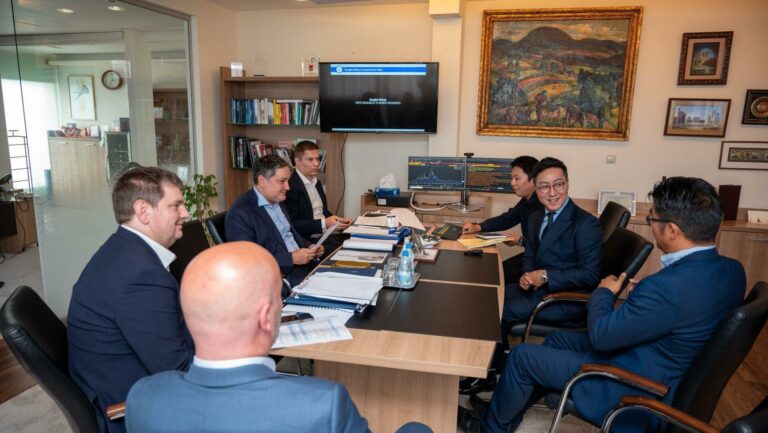
Written by Zsuzsa Bodnár, translated by Zalán Zubor. The original Hungarian articles can be found here. Cover photo: On June 28, 2024, Minister of National Economy Márton Nagy received Geun Ki Mun, Deputy Director of the Ministry of Economy of the Republic of Korea; Soo Chul Park, Managing Director of SungEel HiTech Europe Kft. and SungEel HiTech Hungary Kft., and Dong Wook Chu, Director of SungEel HiTech Hungary Kft., in his office on June 28, 2024. (photo: kormany.hu)
Share:
Your support matters. Your donation helps us to uncover the truth.
- PayPal
- Bank transfer
- Patreon
- Benevity
Support our work with a PayPal donation to the Átlátszónet Foundation! Thank you.
Support our work by bank transfer to the account of the Átlátszónet Foundation. Please add in the comments: “Donation”
Beneficiary: Átlátszónet Alapítvány, bank name and address: Raiffeisen Bank, H-1054 Budapest, Akadémia utca 6.
EUR: IBAN HU36 1201 1265 0142 5189 0040 0002
USD: IBAN HU36 1201 1265 0142 5189 0050 0009
HUF: IBAN HU78 1201 1265 0142 5189 0030 0005
SWIFT: UBRTHUHB
Be a follower on Patreon
Support us on Benevity!
