

Convicted hitman confessed to have committed bombings to help Fidesz win election in 1998

Jozef Roháč, infamous hitman of Hungary’s 1990s criminal underworld admitted responsibility for a series of unsolved bombings. In 1998, before the parliamentary elections, bombs were detonated in front of various right-wing politicians’ homes and offices without harming anyone. Roháč claims that he was instigated to set up the bombs to improve Viktor Orbán’s Fidesz party’s election prospects.
The Slovakian-born Jozef Roháč was one of the most notorious figures of Hungary and Slovakia’s chaotic ‘90s. A career criminal, who kidnapped a Minister of Communist Czechoslovakia, got sentenced to prison for terrorism, broke out, and later served as a hitman for both Slovakian and Hungarian criminal gangs – and possibly, for intelligence services.
After committing a series of high-profile murders and bombing, including the bombing on Aranykéz Street, Budapest, which killed 4 people, Roháč was finally arrested in 2008, and is currently serving a life sentence, where he started writing a book about his life story.
While Roháč admitted to other bombing and murders, in March, he, through his attorney, has reached out to Átlátszó’s journalists, and admitted to have been behind the 1998 political bombings.
In 1998, explosives were detonated near the headquarters of the Fidesz party,
the apartment József Torgyán (then the leader of the Independent Smallholders’ Party which later formed a coalition with Fidesz), and the home of Fidesz politician József Szájer.
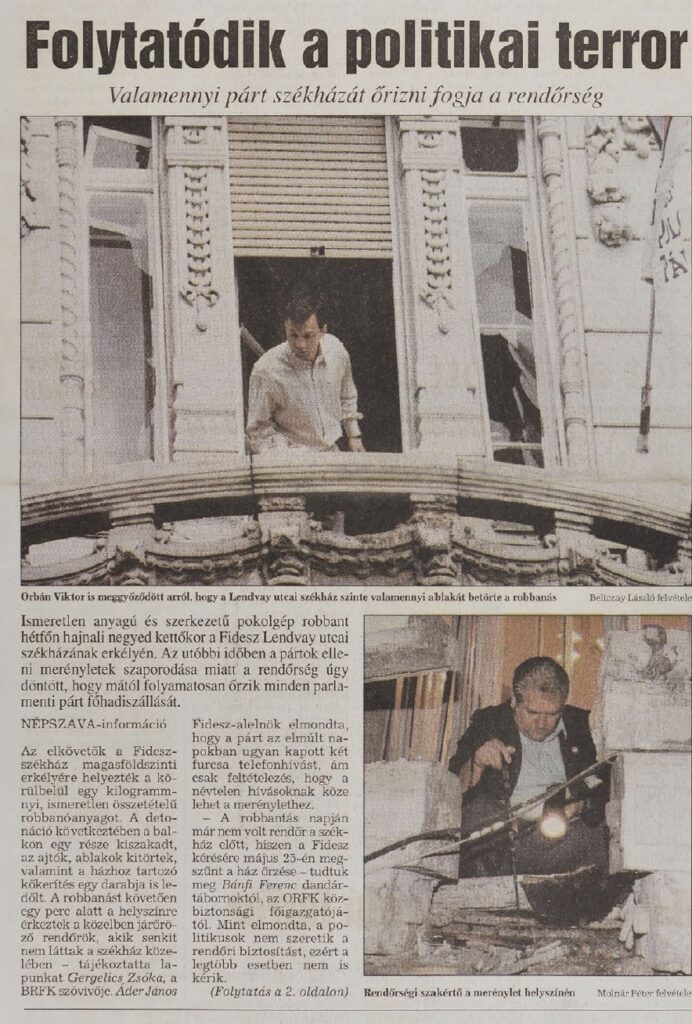
Viktor Orbán at the Fidesz hadquarters looking at the damage caused by the explosion. Scan of an 1998 issue of Népszava.
The investigation into the bombings was closed without result, and the crimes have long since become time-barred, no charges can be brought against the perpetrators. The bombings at the time caused a massive outrage which likely contributed to the right-wing parties’ subsequent electoral victory.
According to Roháč’s legal representative, Ilona Patócs, attorney, Roháč did not select the bombing targets himself, instead, he was instructed to the attacks by a third person whom the convict had not yet named – but he promised to reveal the culprit’s name in his upcoming book.
Roháč also claimed that it was made clear to him that the bombings are meant to benefit Viktor Orbán’s Fidesz party, which was campaigning to replace the incumbent Socialist-Liberal administration. Rohác claimed that he had to set up a bomb so that no one would actually get hurt.
Although Roháč’s claims would lead one to suspect false-flag attacks, it should be added that he did not present evidence that someone tied to Fidesz ordered the bombings, and at the time, Fidesz’s campaign machine at the time did not blame their opponents for the attacks.
It is instead possible that that a group involved with the criminal underworld or foreign intelligence services attempted to influence the elections with the bombings.
One source believes that the secret service of the Mečiar government in Slovakia is on the list of suspects. In 1998, relations between Slovakia and Hungary were very poor, and the aim of such a series of bombings could have been to weaken the Hungarian government. After the fall of Communism, Slovak-Hungarian relations were soured by the dispute over the Bős-Nagymaros dam. Moreover, the Mečiar government was known to have hired criminal gangs for political assignments.
One of the targets, József Torgyán (who died in 2017) also wrote in his 2005 book that “all that is known is that the perpetrators were Slovaks.”
Whoever committed them, the bombings were a serious attempt to interfere with and influence the elections of the time. In his book about the ‘90s criminal underworld, investigative journalist András Dezső quoted József “Fürge” Szemán, a made man of mob boss Tamás Portik. Szemán confessed that the purpose of the bombings was “to bring down the left-wing government and bring the right-wing to power. The right-wing parties knew nothing about this. Only a small circle within the underworld was privy to the information. This was how they ‘did politics’.”
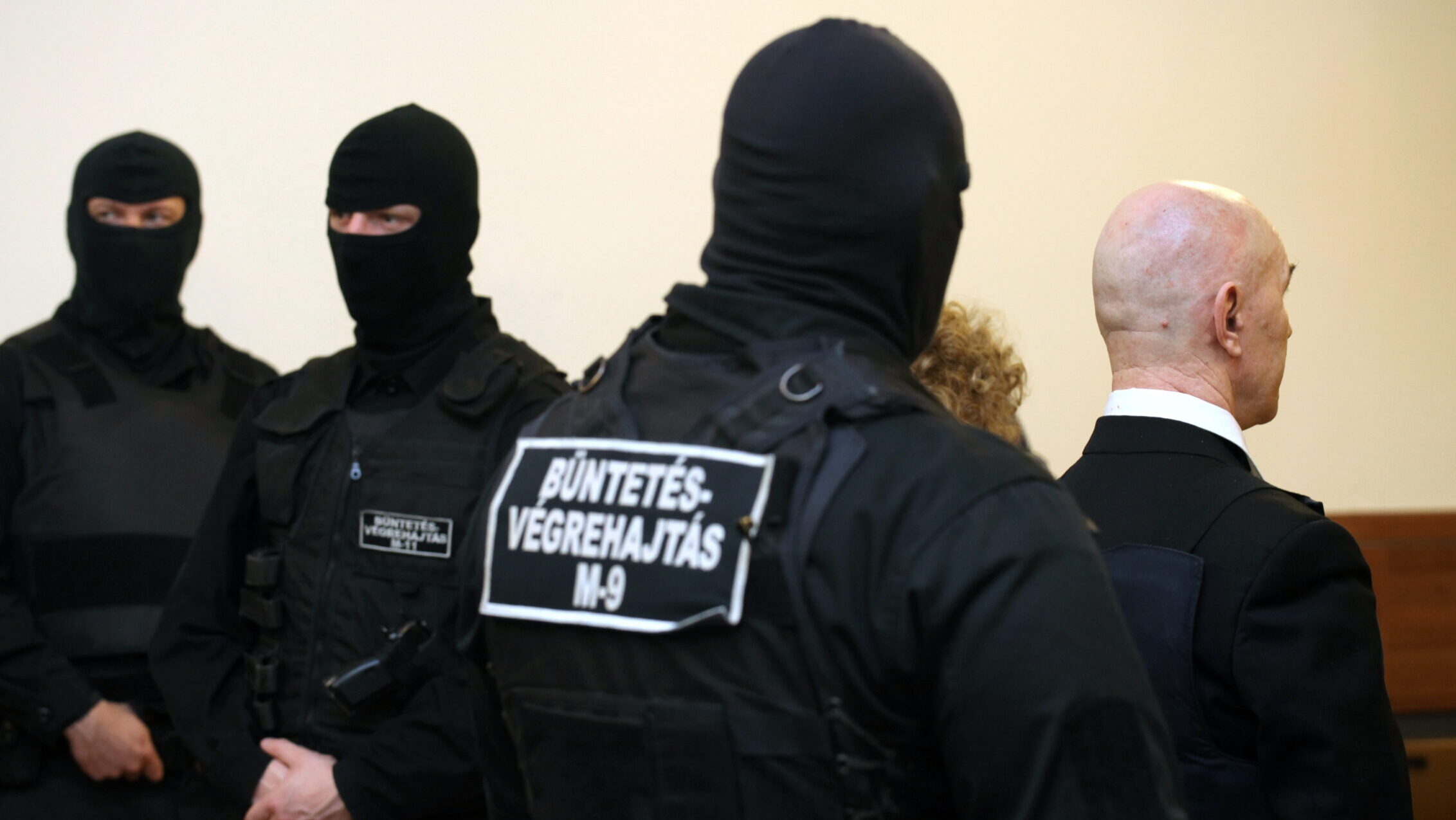
Written by László Tamás Papp, translated by Zalán Zubor. The original Hungarian articles can be found here. Cover image: Prison guards stand next to Jozef Rohác (right), wearing a bulletproof vest, in the courtroom of the Budapest Municipal Court on February 23, 2010. (photo: MTI/Balázs Mohai)
Share:
Your support matters. Your donation helps us to uncover the truth.
- PayPal
- Bank transfer
- Patreon
- Benevity
Support our work with a PayPal donation to the Átlátszónet Foundation! Thank you.
Support our work by bank transfer to the account of the Átlátszónet Foundation. Please add in the comments: “Donation”
Beneficiary: Átlátszónet Alapítvány, bank name and address: Raiffeisen Bank, H-1054 Budapest, Akadémia utca 6.
EUR: IBAN HU36 1201 1265 0142 5189 0040 0002
USD: IBAN HU36 1201 1265 0142 5189 0050 0009
HUF: IBAN HU78 1201 1265 0142 5189 0030 0005
SWIFT: UBRTHUHB
Be a follower on Patreon
Support us on Benevity!
