


OLAF uncovered fraud in EU rural grant that supported the infamous treeless canopy walkway

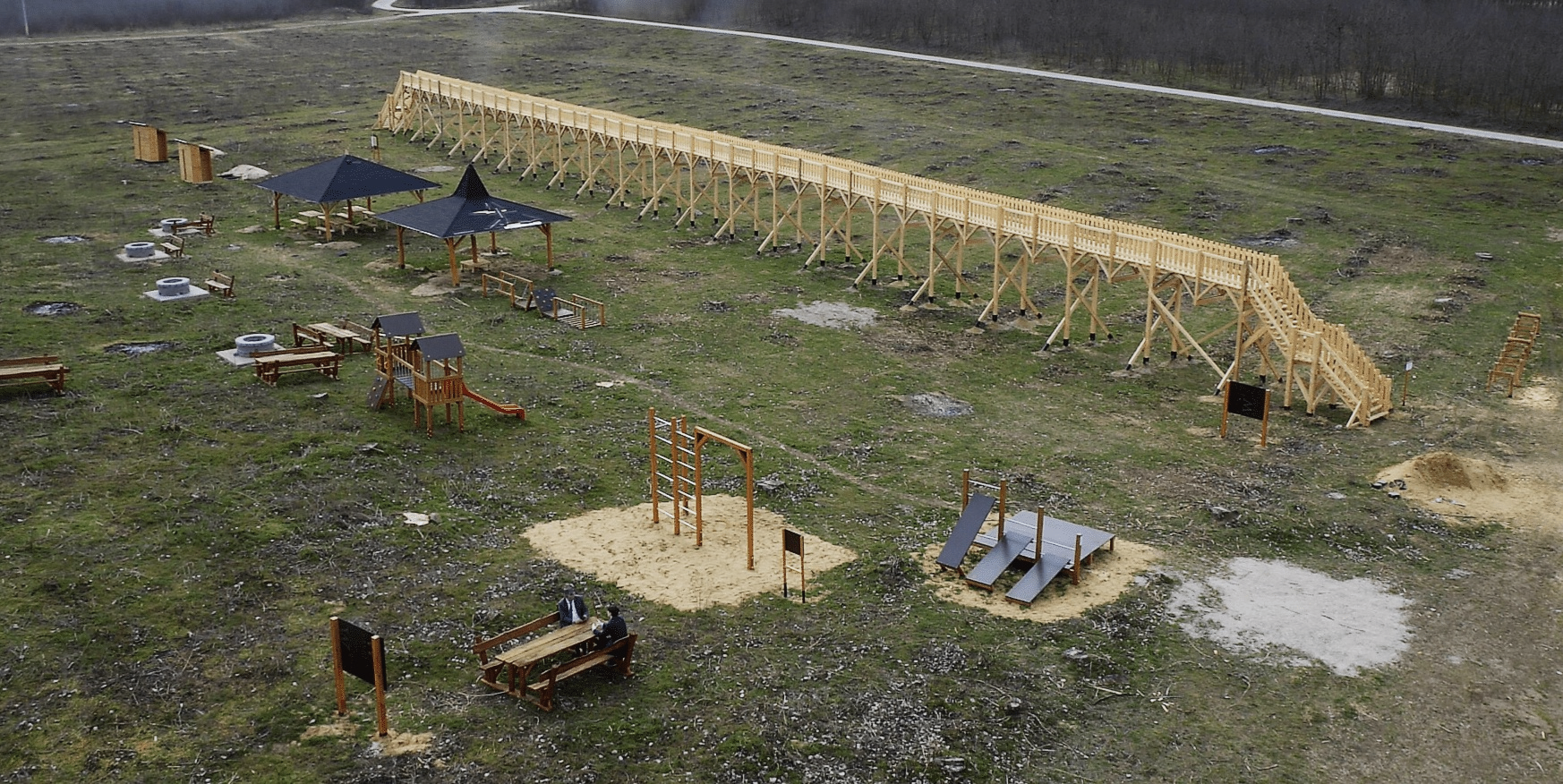
European Anti-Fraud Office (OLAF) found serious irregularities in several EU-funded Hungarian projects, including the infamous canopy walkway in Nyírmártonfalva, following the investigation prompted by Átlátszó’s reporting.
In March 2023, the European Anti-Fraud Office (OLAF) launched an investigation into the Széchenyi 2020 Rural Development Program, which was funded by the European Agricultural Fund for Rural Development. According to a recent OLAF statement, the investigation revealed “manipulated” public procurement procedures and overpricing.

Although the office does not name the projects involved in the fraud, it cites as a specific example the case in which “the forest was cut down on site during the construction of the canopy walkway, making it impossible to achieve the original objectives of the project.” There was only one such project: the canopy walkway in Nyírmártonfalva, which gained international fame as probably the world’s only canopy walkway built in the middle of a treeless field.
The OLAF investigation, which has now been closed, revealed structural weaknesses in the systems for managing and controlling EU grant applications. For example, applications received in response to the call for proposals were processed inconsistently and with significant delays, during which time construction costs rose significantly, reducing the cost-effectiveness of the program. The Office also found that
the competent authorities did not establish clear requirements for the sustainability of projects, including, for example, the prevention of deforestation.
In addition, they allowed very similar projects to be implemented in the same area, which reduced their impact and effectiveness. OLAF was probably referring to the fact that two more canopy walkways were also built in Nyíradony, a town neighboring Nyírmártonfalva: one was built by the local Fidesz politician Sándor Tasi, vice-president of the county council, and the other by László Tasó, the Fidesz MP representing the region.
Tasi received 61.5 million HUFs and Tasó received 64 million HUFs for the project from the Rural Development Program.
According to OLAF, the investigation prevented the irregular spending of approximately half a million euros, or roughly 200 million HUFs. It is unclear whether the EU will withhold this amount or whether Hungary will have to repay the funds it has already received.
Proceedings were initiated following Átlátszó’s reporting
We first reported on the treeless canopy walkway of Nyírmártonfalva in March 2023. Located on the outskirts of the village in South-East Hungary, next to plowed fields, abandoned farmhouses, and disused animal farms, the facility was originally designed to be at the level of the tree canopy, but during construction, the forest around it was cut down. Filemon Mihály, the mayor of the village at the time, won nearly 64 million forints in funding for the project as a private individual.
Incidentally, after our story was published, he unsuccessfully sued Átlátszó for a correction.
Following the publication of our article, opposition MPs Ákos Hadházy and Anna Donáth filed a report with the European Anti-Fraud Office, while Transparency International Hungary (TI) referred the matter to the Hungarian Integrity Authority (IH), which is responsible for monitoring the use of EU funds.
The Integrity Authority published its summary report on the case in February 2024. According to the report, serious irregularities were found at every major stage of the EU program VP4-8.5.2.-17, entitled “Development of the public welfare functions of forest ecosystems provided free of charge,” which was implemented at a cost of HUF 1.61 billion. These irregularities were found to violate the rules governing the use of European Union subsidies.
For this reason, the Integrity Authority filed a complaint against persons unknown for the crimes of budget fraud and anti-competitive agreements in public procurement and concession procedures, as well as for the offense of using false private documents under Section 345 of the Criminal Code. It also initiated competition supervision proceedings with the Hungarian Competition Authority and called on the managing authority to conduct irregularity proceedings.
Additionally, the prosecutor’s office announced on January 7, 2026, that the Criminal Directorate of the National Tax and Customs Administration questioned the former mayor of Nyírmártonfalva as a suspect in the case of the canopy walkway in Nyírmártonfalva for attempted budget fraud causing significant financial loss and the use of false private documents.
Written by Orsolya Fülöp, translated by Zalán Zubor. The original Hungarian version can be found here. Cover image: photo by Átlátszó
Share:
Your support matters. Your donation helps us to uncover the truth.
- PayPal
- Bank transfer
- Patreon
- Benevity
Support our work with a PayPal donation to the Átlátszónet Foundation! Thank you.
Support our work by bank transfer to the account of the Átlátszónet Foundation. Please add in the comments: “Donation”
Beneficiary: Átlátszónet Alapítvány, bank name and address: Raiffeisen Bank, H-1054 Budapest, Akadémia utca 6.
EUR: IBAN HU36 1201 1265 0142 5189 0040 0002
USD: IBAN HU36 1201 1265 0142 5189 0050 0009
HUF: IBAN HU78 1201 1265 0142 5189 0030 0005
SWIFT: UBRTHUHB
Be a follower on Patreon
Support us on Benevity!
