

As State Billions Have Dried Up, Fidesz’s Media Empire Is Shrinking

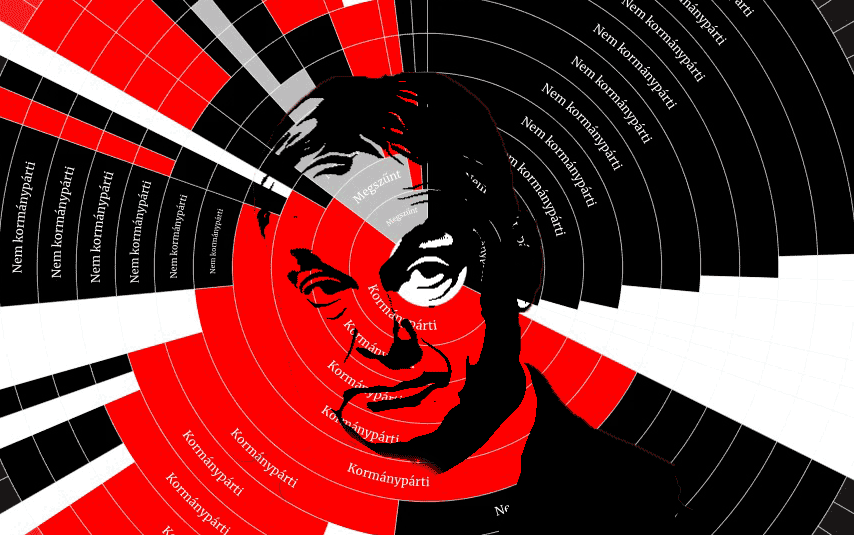
For decades, state billions flowed into Hungarian pro-government media outlets. After April’s parliamentary elections ended with Viktor Orbán’s defeat, however, the situation changed rapidly: mass layoffs are sweeping through Fidesz’s media empire.
Mediaworks is Hungary’s largest media publishing company was owned by Lőrinc Mészáros, the country’s wealthiest businessman, a former gas fitter and mayor of Prime Minister Viktor Orbán’s home village of Felcsút, whose rapid rise since 2010 has made him one of the most controversial figures. Since becoming part of the pro-government Central European Press and Media Foundation (KESMA) in 2018, the company has been widely regarded as a key pillar of Orbán’s media system and has relied heavily on state advertising revenues.
Media companies close to the previous government now have begun a restructuring affecting hundreds of employees: Pesti Srácok — a pro-government news and opinion website known for its strongly partisan and conservative commentary — has dismissed all of its staff, Népszava — Hungary’s oldest continuously published newspaper, traditionally associated with the left and one of the country’s few remaining opposition-leaning outlets — is struggling for survival after losing its print edition, while layoffs and cost-cutting measures are coming at the country’s largest tabloid newspaper, Blikk and TV2, one of the two largest commercial television broadcasters, widely considered to be aligned with the Orbán government in recent years.
Taken together, these steps illustrate the post-election reality: the drying up of state funding taps is fundamentally reshaping the Hungarian media market.
The Empire Is Shrinking
Magyar Hang reported on Monday that Mediaworks announced a collective redundancy program: pro-Fidesz tabloid Bors will cease publication, Magyar Nemzet — Hungary’s main pro-government news outlets under the Orbán administration — will become a weekly newspaper, Pesti Srácok will dismiss all of its employees, and the majority of the eighteen county newspapers will also switch to weekly publication. Mediaworks, which belongs to the Central European Press and Media Foundation (KESMA), owns more than seventy media products in addition to the county papers, including notorious publications such as Origo, Hír TV, Ripost, Világgazdaság, and Metropol — the latter having already suspended publication in May.
The pro-Fidesz media company, which closed last year with a loss of fourteen billion forints (about €40 million), found itself in such a difficult situation because state advertisements accounted for a significant portion of its revenues, virtually disappearing immediately after the elections. According to Magyar Hang, only three printed county newspapers currently have a chance of survival, as these currently sell the highest number of copies.
According to our sources, changes do not stop at Mediaworks: further layoffs may be expected at Népszava following the end of its print edition, while at Blikk — which was acquired by the Orbán-government last October — layoffs already took place immediately after the elections, and austerity measures were announced in recent days because of declining revenues.
According to hvg, these changes could affect nearly two hundred people, not counting layoffs with immediate effect — according to company records, this represents about ten percent of the company’s workforce.
In its statement, Mediaworks describes the situation as a “modernization-driven portfolio restructuring,” citing “changing content consumption habits” and “audience needs.”
Népszava Out, Blikk Next?
There have indeed been problems with sales in recent years: Bors, once considered a flagship publication and now being discontinued, sold approximately seventy thousand copies per day at the beginning of 2015, whereas by the end of 2025 average daily sales had fallen to only thirteen thousand copies — a decline of about eighty percent over a decade. Printing of Metropol was suspended “for an indefinite period” at the end of May — the publisher a month earlier claimed that street distribution was being halted because employees were being harassed — and most freelance and contracted contributors were dismissed. It was also reported at the end of May that the printing company owned by Mediaworks terminated its contract with Népszava.
In the short term, this process could result in Hungary becoming the first EU country where the majority of the population no longer has access to a single printed daily newspaper. Distribution — through Medialog and Lapker networks also owned by Mediaworks — will become prohibitively expensive if only a few tens of thousands of copies need to be delivered nationwide.
Gergely Huth, editor-in-chief of Pesti Srácok told 24.hu on Tuesday that although Mediaworks is dismissing all of the paper’s employees, this does not necessarily mean the publication itself will cease to exist, as there is a realistic chance of survival “with readers’ support.”
The print edition of Népszava ceased publication at the end of May after more than one hundred and fifty years. Due to the termination of its printing and distribution contracts, the paper is now struggling for online survival, appealing for subscribers. The historic newspaper led a hybrid existence during the Orbán-era: it was essentially sustained by government advertising, and although a tone that appeared critical and left-leaning was tolerated, there were forbidden topics — such as matters concerning the Orbán family — that were regularly omitted.
As 444 wrote on an opinion peace, Népszava was the „pseudo-independent part” of the government media kept on a short leash. According to Miklós Haraszti, writer and former OSCE observer, the last remaining printed opposition daily was ultimately reached by Fidesz’s belated revenge.
Our sources agree that ending the print edition was not a business decision but rather a political one. They are generally not optimistic about the newspaper’s future: in their opinion, print is already beyond saving.
Just as at Népszava, layoffs are also expected at Blikk, which fell into the hands of Orbán allies last year. The publisher of the formerly market-leading tabloid, Ringier Hungary was acquired at the end of October by Indamedia, owned by Miklós Vaszily, the chairman and CEO of TV2. He played a key role in the 2020 overtake of Hungary’s formerly largest independent news website, Index, whose editorial staff resigned en masse after growing political pressure and interference. The outlet has since been widely regarded as aligned with the Orbán government.
Indamedia concluded an official strategic partnership agreement with Mediaworks in 2023. The acquisition was financed by a thirteen-billion-forint loan from the bank owned by Lőrinc Mészáros, followed by the immediate removal of the editorial leadership, and after Fidesz’s electoral defeat, former managing director Tibor Kovács was quickly replaced as well.
According to our sources, additional employees were dismissed from Blikk after the elections, and the owner recently announced austerity measures.
Government Favorites Keep Losing Lawsuits
According to data from the Budapest Metropolitan Court, it has been the pro-government media outlets that have most frequently lost press correction lawsuits over the past nearly ten years.
At Átlátszó, we first published data in early 2018 on correction lawsuits lost by various media outlets (both pro-government and independent), and we have continued monitoring ever since. In 2017, propaganda media lost fifty-three correction cases; in 2018, one hundred and nine; in 2019, seventy-three; in 2020, fifty-seven; and in 2021, fifty-four. In 2022, the pro-government press lost twenty-nine correction lawsuits, and in 2023 it was found liable twenty-two times, with Origo holding the record that year.
In 2024, Magyar Nemzet lost twenty-four cases, Origo and Ripost thirteen each, HírTV five, and TV2 accumulated numerous adverse judgments (no aggregate data are available for the latter). Altogether, Fidesz’s media lost sixty-seven lawsuits that year.
Last year, Orbán-aligned news outlets lost forty-nine cases: Magyar Nemzet was the record-holder with eighteen, while Origo and HírTV shared second place with nine adverse rulings each.
This amounts to a total of five hundred and thirteen lost press correction lawsuits between 2017 and 2025. By comparison, independent media such as Átlátszó, RTL Klub, Telex and Magyar Hang won all of their press cases in both 2024 and 2025, while 444 and hvg were sanctioned by the courts only twice, and 24.hu only once.
So Called Consolidation
Movement can also be sensed at Index: András Murányi, the last editor-in-chief of Népszabadság, which was also unexpectedly shut down by Mediaworks in 2016, joined the paper in early June as managing editor. In 2020 he had described those involved in bringing Index under Fidesz’s control as “untrustworthy and vile,” but now speaks of a “new chapter” in rebuilding the press.
Editor-in-chief Zoltán Fekete-Szalóky left the newspaper in the weeks following the elections. According to sources, its operation had been characterized by the direct influence of senior Fidesz politician and former minister of the Prime Minister’s Cabinet Office, Antal Rogán and other governmental and political actors, self-censorship and manipulated materials.
When it comes to TV2, Vaszily himself acknowledged that restructuring and consolidation are necessary now that state funding taps are drying up — one element of this being the termination of Tények, their flagship evening news programme known for its pro-government editorial line.
Much of the current restructuring will continue over the coming months, so it is not yet clear how great the losses will be for the Hungarian media market. What is already apparent, however, is that the companies facing the greatest difficulties are those whose business models relied on state propaganda advertising and the media monopoly built under Orbán. Following his electoral defeat, these revenues disappeared almost overnight.
The closures, layoffs and cost-cutting measures together demonstrate a post-election reality: while actors within the pro-government media empire had been able to operate for years independently of market logic, they are now facing the question for the first time: what kind of product can truly sustain itself without state backing and relying solely on readers’ support.
Update (18 June): An earlier version of this article mistakenly attributed a sentence to Miklós Haraszti. The sentence was in fact written by László Szily, and the article has been corrected accordingly.
Written and translated by Hanna Solti. The Hungarian version of this story is here. Cover image: Átló
Share:
Your support matters. Your donation helps us to uncover the truth.
- PayPal
- Bank transfer
- Patreon
- Benevity
Support our work with a PayPal donation to the Átlátszónet Foundation! Thank you.
Support our work by bank transfer to the account of the Átlátszónet Foundation. Please add in the comments: “Donation”
Beneficiary: Átlátszónet Alapítvány, bank name and address: Raiffeisen Bank, H-1054 Budapest, Akadémia utca 6.
EUR: IBAN HU36 1201 1265 0142 5189 0040 0002
USD: IBAN HU36 1201 1265 0142 5189 0050 0009
HUF: IBAN HU78 1201 1265 0142 5189 0030 0005
SWIFT: UBRTHUHB
Be a follower on Patreon
Support us on Benevity!
