


In Szeged, 23 patients on the knee replacement waiting list died before their turn came
The Szeged University is known internationally as the alma mater of Katalin Karikó, who was awarded the Nobel Prize in Physiology or Medicine for her work on mRNS vaccines. However, the university’s hospital is struggling with long waiting list. While the university claims to perform operations such as knee replacement surgeries at a quick rate, patients may have to wait for over 2 years for an appointment.
Approximately, 10 percent of all adults require knee replacement in their lifetime, making it one of the most common surgeries. The Hungarian National Health Insurance Fund (NEAK) maintains a waiting list for knee replacements. In South-Eastern Hungary, such procedures are performed in Kecskemét, Gyula, Békéscsaba, Szeged and Kiskunhalas. At the time of writing, the “Average actual waiting time in the previous 6 months” in Szeged is reported to be 235 days, while in Békéscsaba it is 68 days and in Kecskemét it is 118 days. This does not seem unsustainable.
However, the actual waiting time may be significantly longer.
We requested information from the national health service (NEAK) about wating times in a freedom of information request. We asked how many patients have been treated for knee replacement surgery in the institutions of the South-East region since 2022, and how many surgeries have been postponed due to lack of capacity. According to the data received, in 1019 working days, there were 1,572 patients in Szeged receiving normal care, while there were still 4,245 on the waiting list.
In Kecskemét, the ratio was better: there were 3,164 people on the list, of which 2,135 were provided with normal care.
The term “normal care” in the NEAK data means that the patient received the surgery in the given hospital according to the planned, regular treatment schedule after being placed on the waiting list. This does not mean an emergency procedure or an unscheduled, early surgery. The patient waited for the time allotted to him on the list, and then the institution performed the procedure within its own capacity. The category therefore shows how many patients actually received surgery in the “regular” waiting list system.
The data thus shows that a daily average of 1.5 knee replacement surgeries were performed in Szeged. This means that even if no new patients were added to the list in Szeged,
It would take almost 7 years to complete the waiting list
– at least according to NEAK’s figures.
But it seems that more than that is being operated on in Szeged, at least based on the reply given by the Szeged University of Sciences (SZTE), the institution operating the city’s hospital.
“During the period in question, we performed 2,557 knee replacement surgeries, broken down by year, see the graph below, supplemented with the expected data until the end of 2025,” wrote the SZTE, after we asked about the values calculated based on NEAK data. They added: “All of the cases we provided were publicly funded cases, which SZTE reported to NEAK and received funding for. We do not know the reason for the discrepancy – we recommend that you contact the National Health Insurance Fund with the data you have received.”
The university continued its response by saying that “this previously meant an average of 1.8 such surgeries per day (normal, advanced, urgent), but in 2025 this had increased to 3 surgeries per day (calculated on working days).
The reason for the smaller decrease in 2025 (30 surgeries) is that the capacity loss due to the complete modernization of the operating rooms of the children’s clinic had to be made up at the New Clinic, which will cease from 2026.”
Appointment 2 years later
SZTE also wrote to Átlátszó that “The number of knee replacement surgeries at SZTE is gradually increasing, this is due to efficiency improvements (merging orthopedics and traumatology) and the launch of robotic surgical procedures that require slightly less time from the second half of 2025. In 2022, the period between being placed on the waiting list and the actual surgery date was an average of 200 days (median 167), which shortened to an average of 169 days (median 160) days in 2025 among those receiving normal (non-urgent and non-advanced) care.”
The university also stated that “currently, on 01/06/2026
the latest date issued is 2028.03.14 (14 months, 300 working days), and there are 1357 patients waiting on the list.
This also shows that even with 3 surgeries per day, the waiting list is longer than expected in reality, which is probably due to the fact that patients do not fill the surgery days evenly, but rather, since these are elective surgeries. Of the current 1,357 patients, there will obviously be modifications in several cases, see the table below, which will also mean bringing some patients forward.
An “elective surgery” is a planned procedure that is not an emergency. The patient’s condition warrants the surgery, but it can be scheduled in time, so it is placed on a waiting list. This includes knee and hip replacement surgeries, for example. These are not immediate life-saving procedures, but postponing them can cause significant pain and a decrease in quality of life. “Elective” does not mean that the surgery is optional or unnecessary, but that it is a planned procedure, not an emergency.
People died before their appointements
The SZTE then explained the long wait by the patients’ wishes. As they wrote, “the number of patients on the waiting list at a given time and the most recent date can be misleading, in many cases the patient cancels/postpones the surgery or has the surgery done elsewhere, which the current statement cannot reflect. In addition, since these are elective surgeries, in many cases the patient, depending on their life situation, requests a later date than the waiting list would allow.”
Thus, NEAK’s report on waiting times does not reflect the truth. Data by SZTE shows that since 2022, 754 surgeries were “cancelled due to other reasons”, which is 77% of all cancelled operations (this means that it is not known why the surgeries were cancelled). The data we received also shows that 56 surgeries were canceled due to lack of capacity, and that 23 patients died before their appointments.
The university suggested that we ask NEAK what the reason for the discrepancy in the data was. We did this several times, but we did not receive any response from the state agency.
The situation is no better in other hospitals.
Besides SZTE, we requested data from other regional hospitals as well. Their data shows a similar picture as seen in Szeged. Based on the data, real waiting time may be up to twice as long as NEAK’s report suggests.
The data on the NEAK waiting list page may technically be correct, but only because it is only about a 6 months-window.
The two data sources do not contradict each other, but rather present the waiting characteristics of the same services at different points in time and for different analytical purposes. Both are true, but if we look at the longer term, the actual number of procedures performed over the years may give a more accurate picture of the length of waiting lists than the six-month data reporting.
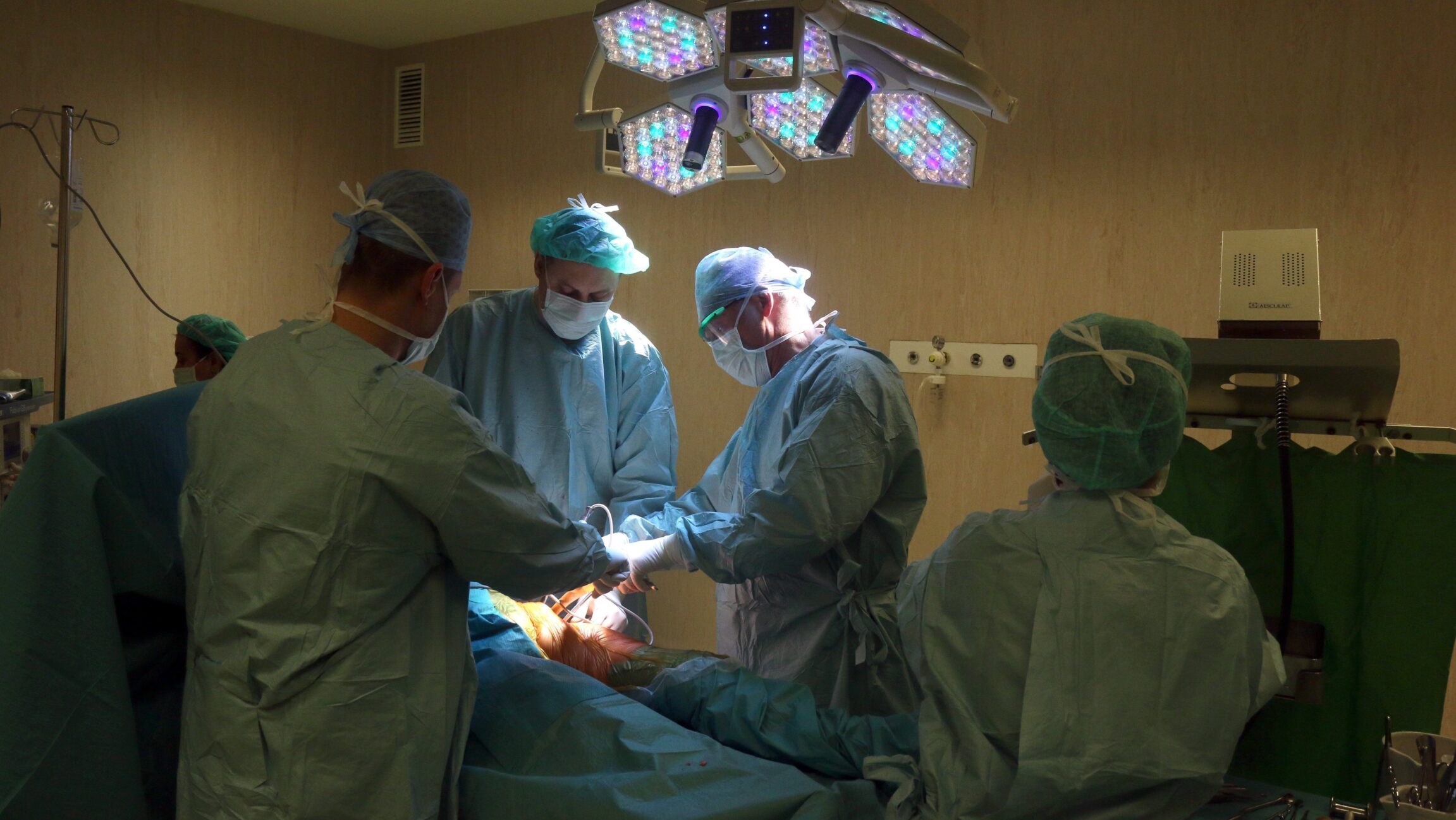
Written by Csaba Segesvári, translated by Zalán Zubor. The original Hungarian articles can be found here. Data visualization: Krisztián Szabó. Cover image: Under the supervision of head physician Miklós Papp (j2), a hip replacement is performed without muscle separation at the Orthopedic Surgery Department of the Borsod-Abaúj-Zemplén County Hospital and University Teaching Hospital in Miskolc on March 9, 2017. (photo: MTI/ György Varga)
Share:
Your support matters. Your donation helps us to uncover the truth.
- PayPal
- Bank transfer
- Patreon
- Benevity
Support our work with a PayPal donation to the Átlátszónet Foundation! Thank you.
Support our work by bank transfer to the account of the Átlátszónet Foundation. Please add in the comments: “Donation”
Beneficiary: Átlátszónet Alapítvány, bank name and address: Raiffeisen Bank, H-1054 Budapest, Akadémia utca 6.
EUR: IBAN HU36 1201 1265 0142 5189 0040 0002
USD: IBAN HU36 1201 1265 0142 5189 0050 0009
HUF: IBAN HU78 1201 1265 0142 5189 0030 0005
SWIFT: UBRTHUHB
Be a follower on Patreon
Support us on Benevity!
