

For years, the government has fiercely defended the Göd Samsung SDI factory
Since 2022, members of the Hungarian government were asked repeatedly in parliament about scandals related to Samsung SDI. Although today, the government denies any culpability, parliament records show that they were confronted with questions about endangering workers, locals, and the pollution of air and groundwater.
“No factory can be built or operated if it endangers people’s lives or the environment. (…) The whole world wants these investments, only the Hungarian left doesn’t.” – this is how Tamás Menczer, State Secretary of the Ministry of Foreign Affairs, responded to written questions about the Göd battery factory. Moreover, on several occasions: Menczer sent the same template letter to four different questions from four opposition members.
We have collected from the parliament’s website the written questions that opposition members have asked various government members regarding Samsung SDI’s Göd battery factory since the formation of the current Orbán government in May 2022. In total, we found nearly 60 such letters that opposition members wrote to various ministers and the Attorney General regarding the Göd factory issues.
The factory became a focus of national attention in February, when news site Telex reported that the Hungarian domestic intelligence services investigated the factory’s pollution, reporting directly to Viktor Orbán. According to Telex, the investigation confirmed that the company exposes employees to toxic, carcinogenic chemicals, and tried to cover up the extent of the pollution.
Although authorities fined the factory numerous times, in has continued to operate the same way, and in 2023, Samsung received 133 billion HUF (352 million EUR) government aid to expand its Göd operations.
Átlátszó has been uncovering the factory’s pollution for years, which apparently prompted Samsung to attempt to lobby the government to shot the news site down. In a leaked memo, the factory’s management discussed measures to stop Átlátszó from reporting about the Samsung factory. Three months later, the Sovereignty Protection Office launched an investigation into Átlátszó, and the factory’s management expressed hope that it could lead to the site “ceasing operations.”
Letters about the Samsung SDI were sent by over 12 MPs and were addressed to a diverse set of government members, including Prime Minister Viktor Orbán, Minister of Foreign Affairs Péter Szijjártó, and Minister of the Interior Sándor Pintér. However, neither Orbán nor his ministers ever personally answered the questions: instead, the task was delegated to state secretaries, lower-level officials serving under a minister. Most often, to Zsófia Koncz, the state secretary of the Ministry of Technology and Industry, later renamed the Ministry of Energy.
Koncz did not overcomplicate the answers: she usually sent the same or very similar template answers to the various questions from the opposition.
For example, the sentence “All investments in Hungary can be implemented and operated in compliance with the strictest environmental protection rules” is included in Koncz’s 4th response, while the sentence pair “The mayor of Göd filed a complaint in the case. In such a case, the results of the authorities’ investigation must be awaited.” was included in 5 different letters.
New tactic: blame the Left
After Koncz became State Secretary for Family Affairs, Gábor Czepek wrote the answers on behalf of the Ministry of Energy. Czepek answered the nearly 60 written questions we collected 9 times, sometimes also scolding the opposition for questioning Samsung’s affairs.
“It is unfortunate that the left continues to not shy away from spreading scare stories and stirring up emotions for short-term political gain.”
– this is what the Secretary of State wrote in his response to the question of Bertalan Tóth of the Socialist Party of Hungary (MSZP) in the fall of 2024 regarding the toxic solvent NMP that had been found in the Göd wells.
Átlátszó reported about the independent investigation that in local wells in 2022. Even back then, László Palkovics, the then newly appointed Minister of Technology and Industry denied that the pollution originated in the factory.
“This is a phenomenon in which, if they drilled the same hole, say, 10 kilometers away, and did the same thing there, they would probably find the same thing there. So, I’m not saying that this was a political matter, because there are cases like this there, but it hasn’t been confirmed.”
Goverment officials similarly downplayed air pollution. In 2024, Átlátszó revealed a report showing that the Göd battery factory emitted 88 tons of toxic solvents into the air between 2019 and 2022. The article also cited an official decision by the Pest County Government Office, which stated that many times the permitted amount of carcinogenic heavy metals was detected in the plant, and in addition, the exposure of workers to toxic substances has been continuously increasing over the years.
In 2021 and 2022, a total of 133 people were found to have increased exposure at the battery factory on seven occasions, and then another 44 people in 2023.
According to the 2021 tests, the permissible concentrations of nickel and cobalt in the workplace air were ten and twenty times the limit values, and according to the measurements in June 2023, the amount of nickel was 250 times higher than the permissible level.
After the Átlátszó article, Lóránt László Keresztes (LMP) asked Energy Minister Csaba Lantos what the government was doing to prevent workers from being endangered by carcinogenic substances at the Göd battery factory in the future, and whether the government planned to restrict the operations of Samsung SDI.
Secretary of State János Fónagy also answered this question in March 2024, in which he did not deny the exposure of workers to toxic materials, but wrote that after inspections, “a significant investment was made in the ventilation system, as a result of which the workplace air quality measurement data showed an improvement.”
You did see graphite
This step was likely taken after in 2023, public sentiment across the country was turning against the expanding (and heavily subsidized) battery industry, leading to a high-level government probe into Samsung’s activities. According to Telex, in early 2023, even the closure of the factory was discussed. However, the government instead went back to business as usual, and Samsung has continued to operate and violate regulations.
At the beginning of 2025, Telex wrote that such a large amount of black dust had been escaping through the three vents of the Göd battery factory for years that it had turned the roof of the building black. Then, Átlátszó published that, according to the disaster management fines imposed on the factory, the authority had previously banned the unauthorized use of hundreds of tons of carcinogenic raw materials in the very parts of the plant where the leaking dust had turned the roof of the factory black.
Átlátszó obtained an information letter that the government office wrote to the president of the Pest County Assembly, in which the authority also provided details about the pollution.
According to the letter, the black spots clearly visible on satellite images were caused only by graphite dust.
This was the answer given by Gábor Czepek, State Secretary of the Ministry of Energy, to the question raised by Ágnes Vadai (DK) . “On March 4, 2025, an official inspection took place at the Samsung factory in Göd, during which the experts determined that the black discoloration on the roof was caused by graphite – which is otherwise non-toxic. No toxic, carcinogenic substances were released,” Czepek wrote .
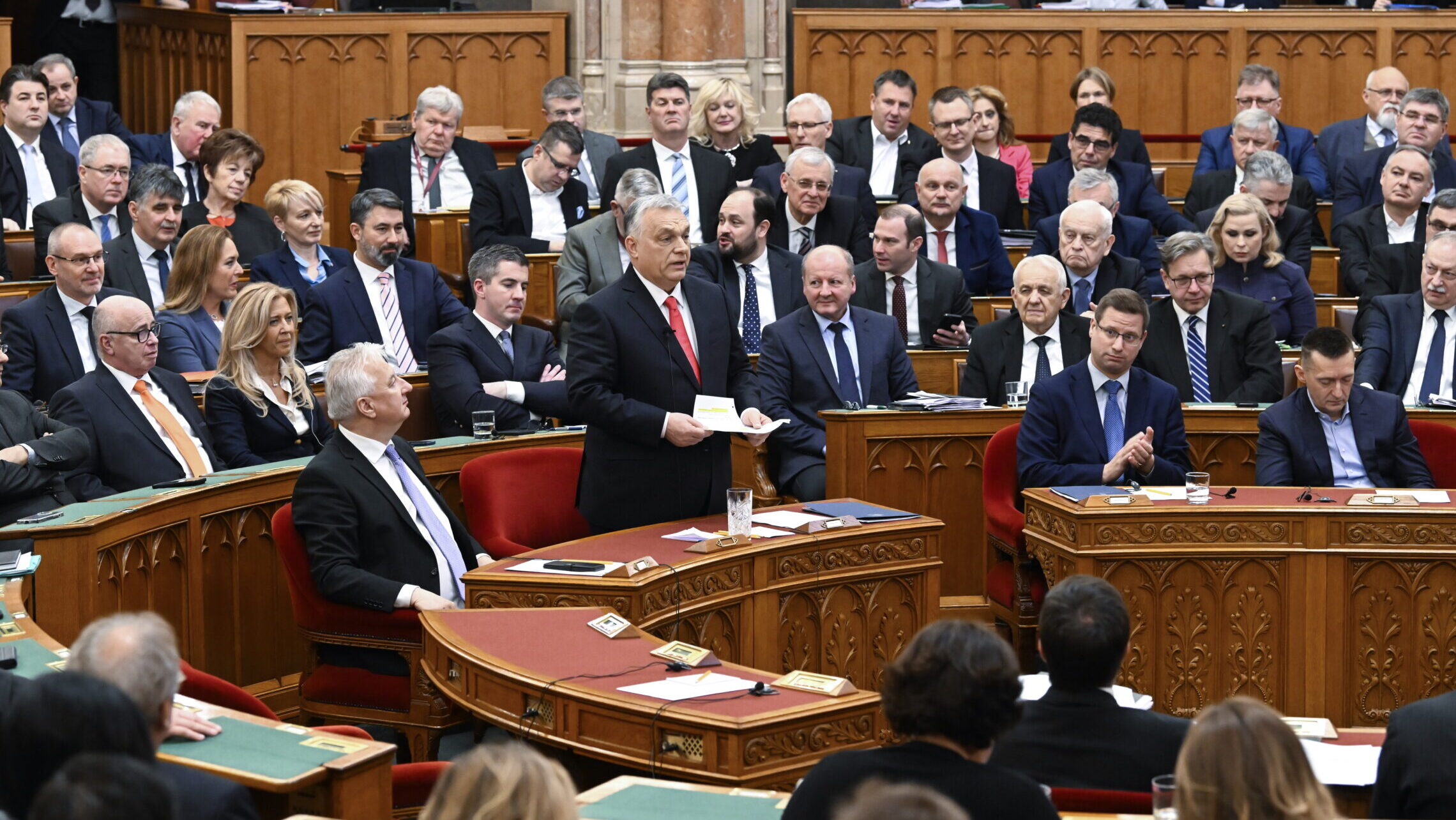
Written by Katalin Erdélyi, translated by Zalán Zubor. The original Hungarian articles can be found here. Cover image: Prime Minister Viktor Orbán responds to the speeches of the faction leaders, who reacted to the head of government’s pre-agenda speech at the plenary session of the National Assembly on February 24, 2025. (photo: MTI/Zoltán Máthé)
Share:
Your support matters. Your donation helps us to uncover the truth.
- PayPal
- Bank transfer
- Patreon
- Benevity
Support our work with a PayPal donation to the Átlátszónet Foundation! Thank you.
Support our work by bank transfer to the account of the Átlátszónet Foundation. Please add in the comments: “Donation”
Beneficiary: Átlátszónet Alapítvány, bank name and address: Raiffeisen Bank, H-1054 Budapest, Akadémia utca 6.
EUR: IBAN HU36 1201 1265 0142 5189 0040 0002
USD: IBAN HU36 1201 1265 0142 5189 0050 0009
HUF: IBAN HU78 1201 1265 0142 5189 0030 0005
SWIFT: UBRTHUHB
Be a follower on Patreon
Support us on Benevity!
