

Protected forests going up in smoke – we document deforestation in national parks and natural reserves

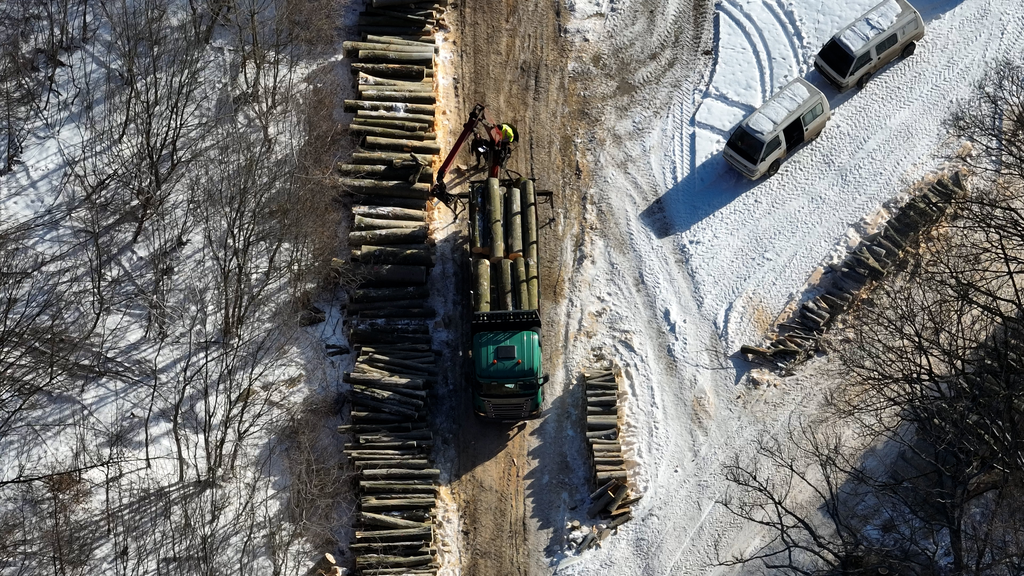
While the Ministry of Agriculture says everything is fine with how Hungary’s forests are managed, numerous experts and environmental organizations argue that urgent action is needed to protect forests within national parks. Last autumn, the Hungarian Ornithological and Nature Conservation Society pointed out that the habitat of the endangered white-backed woodpecker is threatened. Since then, no measures forbidding forestry activity in its habitat have been issued. On the contrary: several protected forest areas within the Bükki National Park have seen tree felling in recent weeks.
In the winter, few people hike in the Bükk region, so forest managers don’t have to worry about too many witnesses. Despite that, chainsaws were heard in many forest sections over the past weeks, and Átlátszó’s reporters filmed the logging and spoke with several conservation specialists about the problems of forest management in Hungary. Forestry companies on the other hand refused interview requests.

A few months ago, Átlátszó reported that conservationists and bird experts turned to the Ministry of Agriculture seeking protection for the white-backed woodpecker. They argued that this rare bird – now largely extinct from its habitat of western Hungary – can only survive in undisturbed forest areas and urged the creation of protective zones.
However, that has not happened, and the Bükk National Park Directorate did not respond to questions about the issue. Two forestry companies said in general terms that they consider the habitats of protected bird species in their forestry operations, omitting to explain whether this “consideration” leads them to limit logging.
Átlátszó’s Hungarian-language video report on the logging industry can be watched here:
Court confirmed protective restrictions
The Ministry of Agriculture responded to inquiries by saying that the current way forests are managed does not in any way endanger the habitats of the rare woodpecker. However, just like the forestry companies, the ministry’s reply only contained generalities. They stated that if needed, forest plans can be modified at the request of nature conservation – for example by introducing either gentler logging that supports different age classes of trees, or complete non-intervention.
They however made no indication that any such steps were taken.
They also said that protective zones are never created “automatically or schematically”, but measures depend on local conditions and include, for example, limiting logging around nesting sites and leaving dead wood behind.
In practice, nature-conservation considerations are very difficult for national park experts to enforce during forest planning. One example: Szombathely Forestry Co. challenged in court the Őrség National Park Directorate’s decision to ban tree cutting in several forest parcels to protect the white-backed woodpecker and another protected species, the collared flycatcher. The forestry company argued the ban was unnecessary and claimed it was about “forest regeneration”.
A court appointed a forensic nature-conservation expert, who found that the type of cutting used by the forestry companies is not suitable to preserve the habitats of protected birds, and that these species would disappear from the affected forests due to logging. The Győr Regional Court rejected the forestry company’s claim and upheld the protective restrictions.
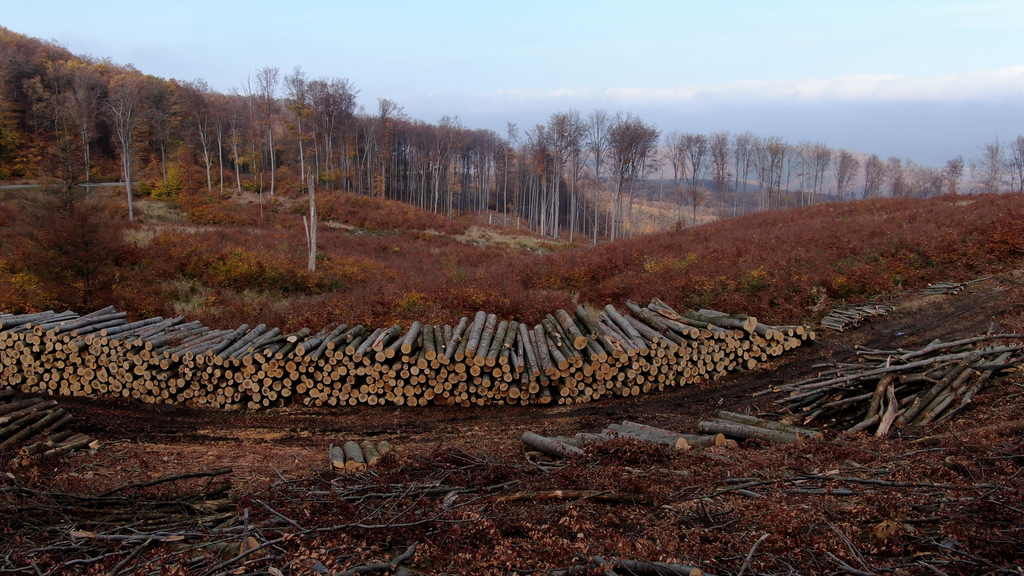
Felled trees in the Bükk National Park (Photo: Gergely Pápai/Átlátszó)
Protected forests are not really protected
Forestry in protected forests within national parks has already drawn protests from several experts and environmental organisations. In a recent petition, Greenpeace Hungary states:
“Protected areas should be refuges for wildlife in a world dominated by human activities. They should be places where the interests of nature conservation prevail.”
Greenpeace also urged national park directories to forbid commercial logging in high-naturalness forests on protected land.
Several other organizations also consider urgent measures necessary to protect forests. At a forest protection conference held by the Great Lakes and Wetlands Association under the Civil EU Presidency in the fall of 2024, experts drew attention to the alarming state and proportion of protected and Natura 2000 classified areas: according to 2024 data from the Ministry of Agriculture, only 454 hectares of natural forest are registered in Hungary.
Tree felling takes place in a protected forest area of the Bükk National Park in January 2026 (Gergely Pápai/Átlátszó)
Wood from protected forests burned in power plants
Nature documentarist Balázs Szendőfi has been monitoring and documenting tree felling in national parks and the endangerment of natural forests and the protected plant and animal species living in them for a long time. He explained to Átlátszó that large sections of protected forests are being cut down to fuel biomass power plants.
Ádám Harmat, a geographer specializing in renewable energy sources confirmed that nearly one-third of all firewood – much of which comes from forests that are valuable from a nature conservation perspective – is used by five large biomass power plants in Hungary.
“Since 2003, these power plants have received 323 billion forints in state subsidies, compared to 185 billion forints in subsidies for solar and wind energy, while their role in the domestic electricity system is minimal,”
writes Ádám Harmat.
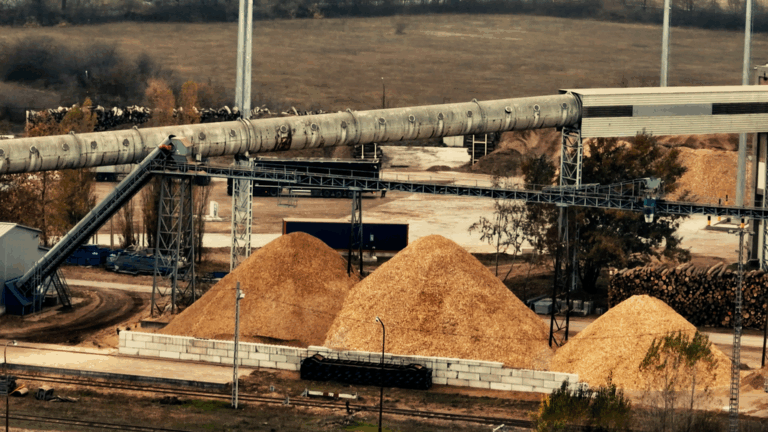
Shredded trees at the Oroszlány thermal power plant (Gergely Pápai/Átlátszó)
Forestry engineer József Fidlóczky is one of the experts who has long criticized the practice of “clear-cutting” forest management in Hungary. He is associated with the founding of the Pro Silva Hungaria Association 26 years ago, which has done a great deal to promote nature-friendly forest management methods.
In his opinion,
the twenty-two national forestry companies are on a profit-oriented path and follow the two-hundred-year-old clear-cutting forestry practice,
which continuously weakens and impoverishes Hungarian forests. However, forestry operations do not generate significant economic benefits, contributing only 0.02% to national income.
József Fidlóczky recently sent an open letter to Péter Zambó, State Secretary for Forests and Land Affairs at the Ministry of Agriculture. In it, he drew the state secretary’s attention to the fact that the condition, naturalness, and biodiversity of the tree populations in national parks “have not improved since their establishment, but have deteriorated, which is perceived and rejected by increasingly broad sections of society.”
According to the expert, in order to protect national parks, it is essential that the state-owned forests covering their territory be transferred to the management of the national park authorities and removed from the scope of forestry management planning. Forest management should be regulated by Nature Conservation Management Plans drawn up in accordance with the law, and the law should also stipulate that only timber from invasive and alien tree species may be removed from forests managed by national parks.
“Taxpayers’ money spent on burning forests should be reallocated to cover the additional tasks associated with the management of park forests and Natura 2000 areas,” emphasizes József Fidlóczky.
Written by Zsuzsa Bodnár, translated by Zalán Zubor. Photos and video by Gergely Pápai. The original Hungarian version can be found here. Cover photo: Tree felling in a protected forest area of the Bükk National Park in January 2026
Share:
Your support matters. Your donation helps us to uncover the truth.
- PayPal
- Bank transfer
- Patreon
- Benevity
Support our work with a PayPal donation to the Átlátszónet Foundation! Thank you.
Support our work by bank transfer to the account of the Átlátszónet Foundation. Please add in the comments: “Donation”
Beneficiary: Átlátszónet Alapítvány, bank name and address: Raiffeisen Bank, H-1054 Budapest, Akadémia utca 6.
EUR: IBAN HU36 1201 1265 0142 5189 0040 0002
USD: IBAN HU36 1201 1265 0142 5189 0050 0009
HUF: IBAN HU78 1201 1265 0142 5189 0030 0005
SWIFT: UBRTHUHB
Be a follower on Patreon
Support us on Benevity!
