

Emergency barrier built to save Paks NPP has washed away 30,000 cubic meters of riverbed

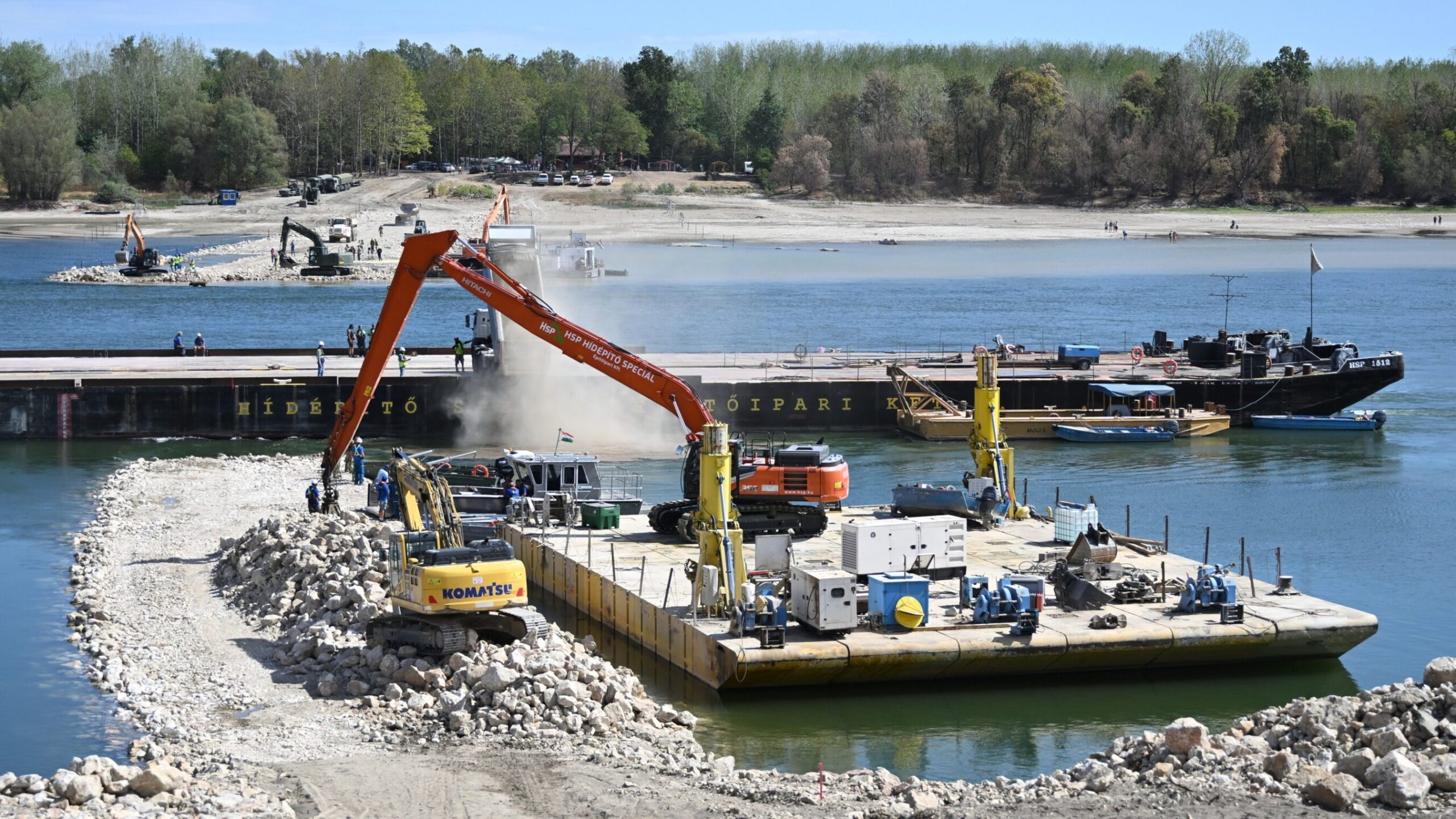
An emergency riverbed weir designed to protect Hungary’s Paks Nuclear Power Plant from record-low water levels has caused extensive erosion of the Danube bed. According to official documents obtained by Átlátszó, the accelerated current has washed away approximately 30,000 cubic metres of sediment. The structure now requires additional reinforcement, while experts question its long-term stability and environmental impact.
During the summer of 2026, an exceptionally severe drought pushed the Danube to record-low water levels, threatening the operation of the Paks Nuclear Power Plant, located approximately 100 kilometers south of Budapest.

The facility operates four nuclear reactors and is one of Hungary’s most important sources of electricity. It relies on large quantities of water from the Danube to cool its reactors and associated equipment.
Although the river still carried considerable volumes of water,
its level had fallen so low that the plant’s intake pumps could no longer reliably withdraw enough cooling water.
Three of its four reactor units had to be taken offline in early August, bringing the facility close to a complete shutdown.
To prevent a prolonged energy crisis, Prime Minister Péter Magyar’s government ordered emergency engineering works. Two 80-metre-long barges were initially sunk in the Danube to help raise the upstream water level, followed by the construction of a submerged barrier known as a riverbed weir.
According to an environmental assessment submitted by Hungary’s General Directorate of Water Management (OVF) in late September, approximately 30,000 cubic metres of original riverbed material have been eroded. The report also acknowledges that the accelerated current could cause further erosion downstream.
The damage has undermined the project’s original purpose.
As the riverbed deepened, the artificially raised upstream water level began to decline. Hydraulic engineer Attila Takács identified this phenomenon in official measurements: on 2 October, a discharge of 637 cubic metres per second produced a water level of 111 centimetres, while ten days later, the same level required 659 cubic metres per second.
Environmental economist András Jánossy argues that the structure functions more like a hydraulic clamp than a conventional riverbed weir. He believes the resulting acceleration of the current was inadequately modelled, leading to the formation of a large underwater scour hole extending approximately 150 metres downstream.
The authorities now propose additional reinforcement, including a one-metre-thick protective layer of rocks along a 200-metre section downstream and further stabilisation of the riverbanks.
Shipping disrupted and environmental approval still pending
The erosion has also caused significant problems for navigation. Much of the displaced sediment accumulated approximately 300 metres downstream in the shipping channel, requiring dredging. Navigation through the affected section of the Danube has been suspended since 13 August.
Takács also identified discrepancies between the official construction documentation and satellite images of the completed structure.
According to his calculations, the remaining navigation channel is only about 120 metres wide instead of the originally planned 160 metres, potentially compromising both shipping and the plant’s cooling-water supply during future droughts.
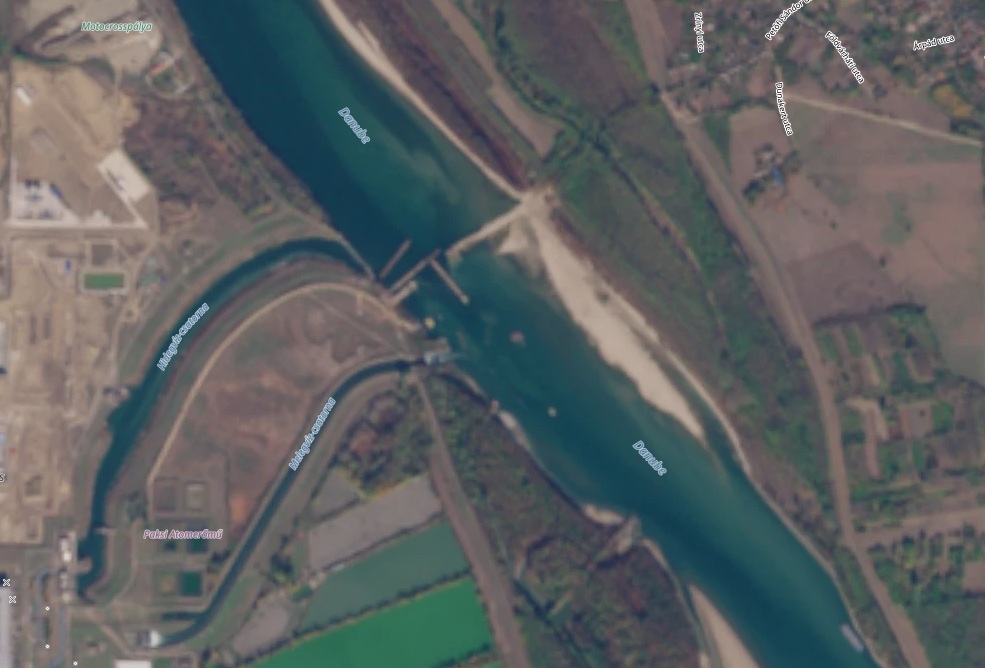
The weir on a Sentinel-2 satellite image taken on October 28
The project was exempted from the usual environmental approval procedures by the government because of the emergency. Consequently, OVF applied for an environmental operating permit only at the end of September, when construction was already nearing completion.
The water management authority and the Ministry of Defence have denied construction failures, while Prime Minister Magyar dismissed Átlátszó’s earlier reporting on riverbed erosion as alarmist. However, the newly submitted official assessment confirms the extensive damage and the need for additional protective measures.
The head of OVF, István Láng, resigned effective 15 October, although it remains unclear whether his departure was connected to the project.
Takács believes the structure will require continuous monitoring and potentially expensive repairs. In his assessment, the barrier should be considered a temporary solution with a lifespan of no more than ten years.
Written by Orsolya Fülöp. The english summary was prepared with the assistance of artificial intelligence. The original Hungarian version of the story can be found here. Cover photo: Construction of the Danube riverbed weir in Paks, August 2026. Image source: Facebbok/Romulusz Ruszin-Szendi
Share:
Your support matters. Your donation helps us to uncover the truth.
- PayPal
- Bank transfer
- Patreon
- Benevity
Support our work with a PayPal donation to the Átlátszónet Foundation! Thank you.
Support our work by bank transfer to the account of the Átlátszónet Foundation. Please add in the comments: “Donation”
Beneficiary: Átlátszónet Alapítvány, bank name and address: Raiffeisen Bank, H-1054 Budapest, Akadémia utca 6.
EUR: IBAN HU36 1201 1265 0142 5189 0040 0002
USD: IBAN HU36 1201 1265 0142 5189 0050 0009
HUF: IBAN HU78 1201 1265 0142 5189 0030 0005
SWIFT: UBRTHUHB
Be a follower on Patreon
Support us on Benevity!
