

Following our data request, Hungarian railway designer files criminal report over hazardous constructions


For years, railway ballast bonding works commissioned by Hungary’s state railway company MÁV may have been carried out without the mandatory engineering plans required by the railway operator’s own technical regulations. The contracts went mainly to companies belonging to the V-Híd group, controlled by billionaire businessman Lőrinc Mészáros. After learning about this omission, the engineering company holding the relevant patent filed a criminal complaint, saying that these works may have pose a safety hazard for rail travelers.
In January 2026, the Hungarian national railway company’s (MÁV) track operator (MÁV Pályaműködtetési Zrt.) launched a public procurement procedure for ballast bonding works in its Budapest and Szeged regions, with a net framework value of 192.7 million forints (EUR 528,000). committed to ordering at least 70 percent of this amount. The only bidder for all three lots was V-Híd Vagyonkezelő Kft., part of the business empire of Lőrinc Mészáros. As fewer than two bids were submitted, MÁV declared the procedure unsuccessful. A subsequent tender launched in July was also withdrawn after a potential bidder challenged some of its conditions.

Following this, the national railway company conducted a preliminary market consultation and received several comments. After the consultation concluded, MÁV issued a new tender in July. However, this process also ran aground: one of the interested economic operators filed a preliminary dispute resolution request, which MÁV partially granted, and subsequently withdrew the call for bids.
Practice against MÁV’s own regulations
One disputed requirement was that MÁV would only accept references for ballast bonding work completed during the previous three years. This condition benefited V-Híd, which was only potential candidate with such recent experience. We have learned of this thanks to a freedom of information request we submitted to MÁV. In it, we asked, among other things, where and what types of ballast bonding work had been carried out over the past 10 years, at what cost, and who the designers and contractors were.
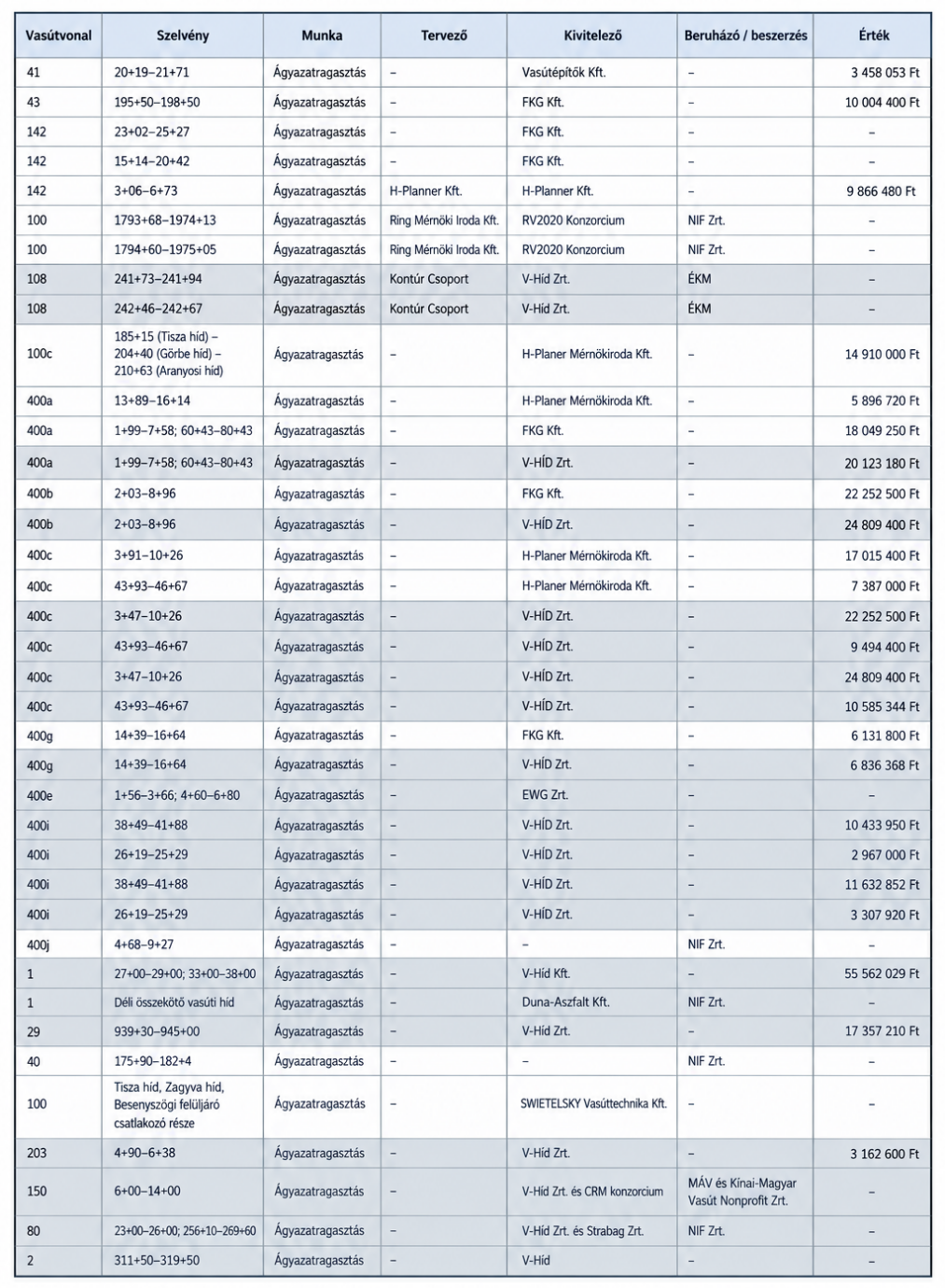
List of ballast bonding projects supplied by MÁV
In their reply, MÁV provided a table showing recent ballast bonding procurements,
but the designer was omitted from almost all entries.
Asked why, the railway company said: “in regard to work for which no specific designer was designated in the project, it was the duty and responsibility of the contractor – or its subcontractor – to provide the necessary plans, technical documentation, and technology.”
They added that this practice is fully in compliance with applicable laws – however, MÁV’s own technical rules are much stricter: they state that ballast bonding must be designed in advance based on the technical parameters of the railway track. A technical description must be prepared, and where the bonded ballast functions as a supporting structure, detailed construction plans and structural calculations are required. The plans must also be approved by MÁV’s central infrastructure organization.
Designer files criminal reports, fearing accidents
In Hungary, only one company, the H-Planer Engineering Office owns a utility model patent for bonded railway track structures, which means that they are the only entity authorized to design ballast bonding projects.
Despite that, as the list shows, several companies have carried out ballast bonding work in recent years, primarily V-Híd. On August 12, we asked the company who their designer was. However, as of the publication of this article, we did not receive a response.
In response to our question about the reasons for MÁV officially requiring designers for ballast bonding projects, H-Planner replied that
“the design and sizing of the track’s supporting and underpinning structures are essential requirements for the accident-free operation of the railway. (…) If a structure intended to support or underpin a railroad track is not properly dimensioned but is constructed only on an ad hoc basis, the long-term accident-free operation of trains cannot be guaranteed.”
The company added that failure to properly design the structures built using ballast bonding raises the possibility of a direct safety hazard during railway operations. Therefore,
“H-Planer Kft. is filing a criminal complaint regarding non-compliant construction, as well as on suspicion of a criminal offense endangering the safety of rail traffic and other criminal offenses,”
They added that, in their opinion, “the complete lack of dimensioning and plans, as well as the opening of the track to traffic in this condition, constitutes a direct threat. H-Planer Kft. maintains that, for all these reasons, there is clearly a well-founded suspicion of crimes affecting the safety of rail traffic, since, due to the violation of the cited technical specifications, it cannot be determined exactly what structures were constructed, which, in the case of a railway track in service, pose a direct and extremely serious threat to the safety of rail traffic.”
Written by Eszter Katus. The english summary was prepared with the assistance of artificial intelligence. The original Hungarian version of the story can be found here. Cover image source: DepositPhotos
Share:
Your support matters. Your donation helps us to uncover the truth.
- PayPal
- Bank transfer
- Patreon
- Benevity
Support our work with a PayPal donation to the Átlátszónet Foundation! Thank you.
Support our work by bank transfer to the account of the Átlátszónet Foundation. Please add in the comments: “Donation”
Beneficiary: Átlátszónet Alapítvány, bank name and address: Raiffeisen Bank, H-1054 Budapest, Akadémia utca 6.
EUR: IBAN HU36 1201 1265 0142 5189 0040 0002
USD: IBAN HU36 1201 1265 0142 5189 0050 0009
HUF: IBAN HU78 1201 1265 0142 5189 0030 0005
SWIFT: UBRTHUHB
Be a follower on Patreon
Support us on Benevity!
