

The Boy I Raised – Mourning and Remembrance of Benjamin Asher in Ukraine

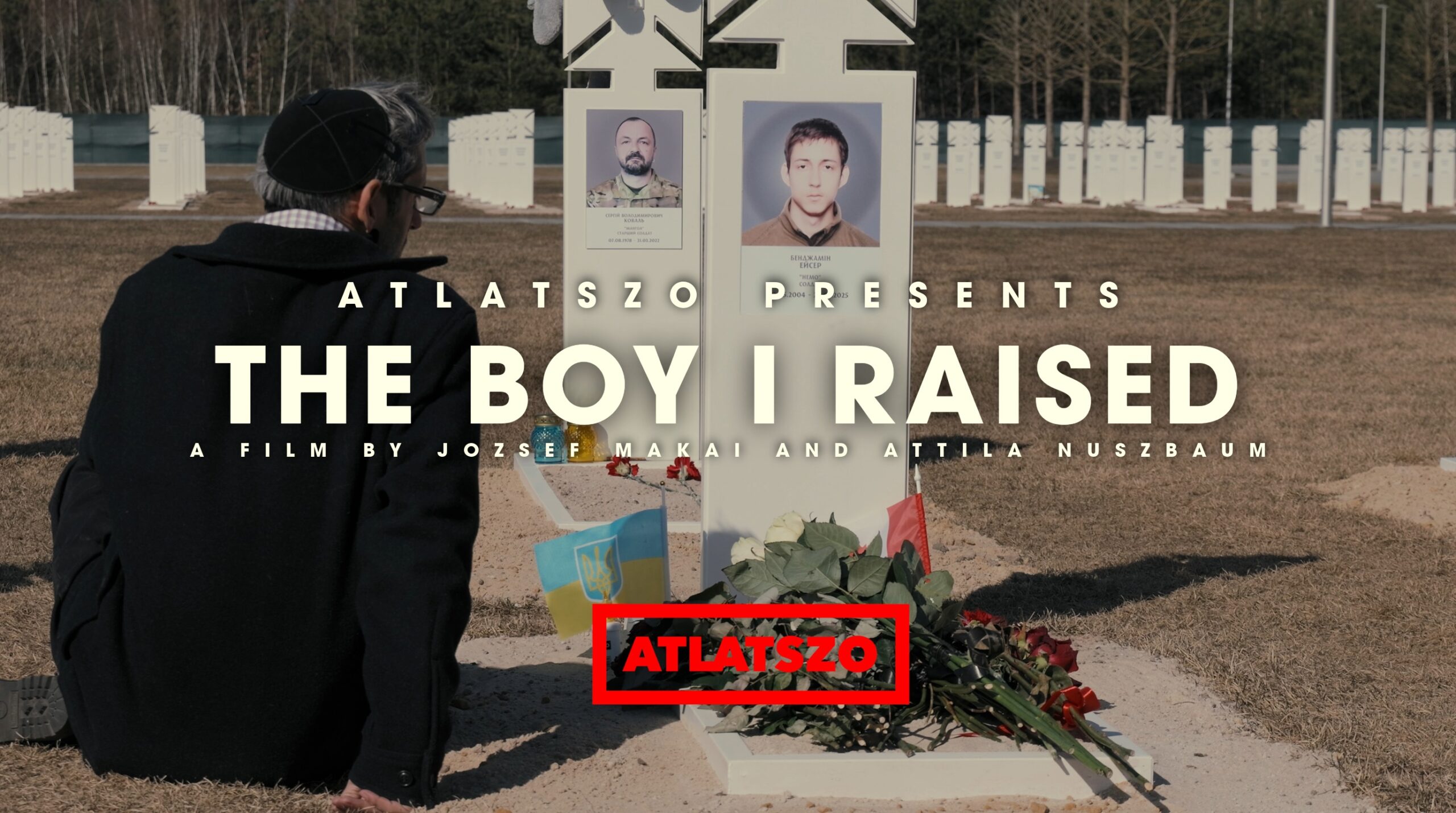
When he was informed last year that his son had been killed near Kharkiv, Nathan Asher thought there must have been some mistake. He knew, of course, that Benjamin was fighting as a volunteer, although very little information from the front ever reached him. He had to wait six months for his son’s funeral. We accompanied Nathan on his next trip to Ukraine.
This story neither began nor ended on the day Benjamin Asher was buried in Kyiv’s military cemetery.
On a November morning, we gathered in the courtyard of Mortuary No. 1, behind the Institute of Forensic Medicine on Pravednykiv Street. It is an address people dread. Small groups of relatives arrived clutching bouquets as they came to collect their dead. Across the street stood a cemetery.
“I don’t know how I’m going to get through this,” said Nathan Asher, Benjamin’s father.
There was a long wait. There were several funerals that day. The procedure was always the same: a coffin was brought out, loaded into a hearse, a photograph of the deceased placed behind the windscreen. Young men, older men. The hearses left with the families. We waited.
The heavy, unsettling smell of the morgue stayed with me for a long time.
The colour of mourning is black in Ukraine too, but those waiting for Benjamin Asher’s coffin were mostly men in uniform. They had come from the unit where he completed his basic training.
We first spoke to the giant in the concrete yard behind the forensic institute, gleaming from the early morning rain.
I would see him in tears later, at the wake.
“He didn’t know the city. He had no idea where he was,” the giant recalled. “But he found us and reported for duty. I told him to stand at attention until I found him a uniform. Twenty minutes later I looked down from upstairs. He was still standing exactly where I’d left him. He hadn’t moved. I remember thinking: he’s committed. Really committed.”
Benjamin Asher was killed while serving with Ukraine’s 3rd Assault Brigade. During his training he was attached to the Revanche unit. Several soldiers from the unit, which is integrated into the foreign legion operated by Ukraine’s military intelligence service, the HUR, attended the funeral. They wore masks in public. Skulls and daggers on their berets and insignia.
Nathan Asher, who lives in Canada, decided to bury his son in Kyiv. Benjamin volunteered for Ukraine’s armed forces in March 2023. He was killed near Kharkiv on 24 May last year. He was the first volunteer fighter from Hungary to be killed while serving in the Ukrainian military since the start of Russia’s aggression.
“He found his purpose here,” said one of his former comrades, an Argentine. “But war shows no mercy. This is a wild place.”
Benjamin Asher’s coffin, draped in the Ukrainian flag, was placed in a minibus. The convoy drove to Maidan Nezalezhnosti, Kyiv’s central square, where a farewell ceremony was held. From there we continued to the military cemetery.
Military honours. A flag. A rifle salute.
I watched Nathan and wondered how he was enduring it. The Chief Rabbi took off his coat and placed it around Nathan’s shoulders. The rabbi is a large man; Nathan is not. He disappeared inside the coat.
At Benjamin’s grave, the funeral rite was conducted by a Ukrainian Orthodox priest. That is the custom in the Revanche: they have their own priest, he conducts the funerals. They have their dead, too.
The Chief Rabbi and several Jewish men from Kyiv waited a few steps away until they could pray. When the Orthodox clergy stepped aside, the Jewish mourners moved forward. Nathan accepted the arrangement. So did the Orthodox priest. So did the Chief Rabbi.
After a funeral, somehow, people have to find their way back to the city, back to life, back to the day they left unfinished. I sat next to Nathan in the car and we talked about Benjamin. They had stayed in touch, but over time it was Benjamin who decided how often they spoke.
“I thought we’d have so much more time to talk,” Nathan said. “And that’s gone. That’s what I miss. And it’s simply not natural that I should bury my son. That should never happen.”
At the wake we sat around tables pushed together. Hardly anyone touched the pizza. Several people apologised to Nathan for not being able to protect Benjamin. Sometimes we sat in silence, sometimes we talked. Gradually, almost everyone drifted away.
I could think of nothing comforting to say.
In March, Attila and I waited for Nathan at the nondescript airport in Chișinău, where he arrived on a flight from Frankfurt. We had stayed in touch after the funeral, and he agreed to let us accompany him on his first return visit to Benjamin’s grave. From Chișinău to Odessa, from Odessa to Kyiv, from Kyiv to Kharkiv, and then back again. The film captures a fragment of that journey.
There is still no consolation.
Reporter: József Makai – Video: Attila Nuszbaum. The Hungarian version of this story is here.
Share:
Your support matters. Your donation helps us to uncover the truth.
- PayPal
- Bank transfer
- Patreon
- Benevity
Support our work with a PayPal donation to the Átlátszónet Foundation! Thank you.
Support our work by bank transfer to the account of the Átlátszónet Foundation. Please add in the comments: “Donation”
Beneficiary: Átlátszónet Alapítvány, bank name and address: Raiffeisen Bank, H-1054 Budapest, Akadémia utca 6.
EUR: IBAN HU36 1201 1265 0142 5189 0040 0002
USD: IBAN HU36 1201 1265 0142 5189 0050 0009
HUF: IBAN HU78 1201 1265 0142 5189 0030 0005
SWIFT: UBRTHUHB
Be a follower on Patreon
Support us on Benevity!
