

“Even a soap factory is dangerous” – the tale of two mayors and two battery processing plants

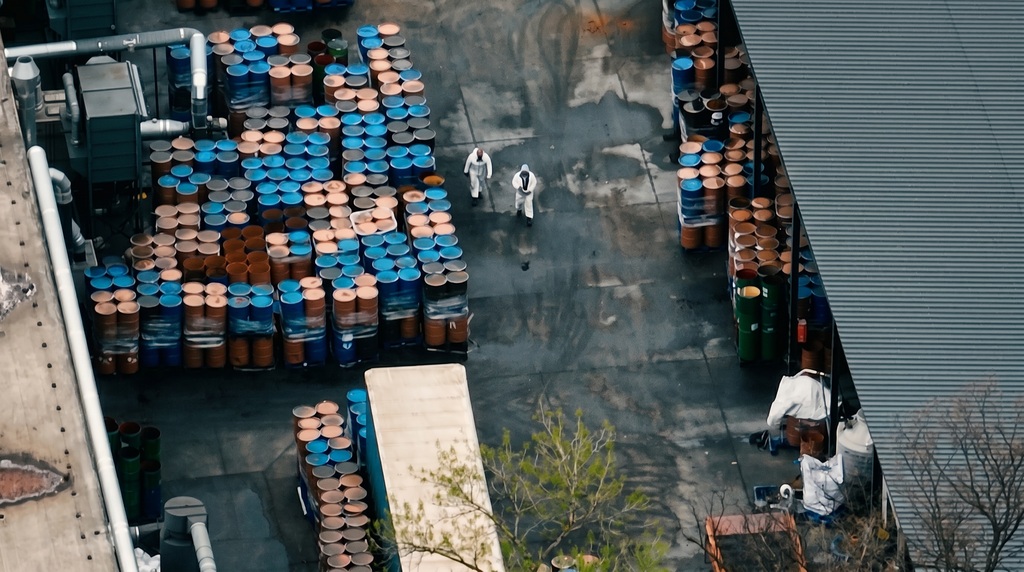
The municipality of Bátonyterenye filed a lawsuit challenging the expansion permit for SungEel Hitech Hungary Kft.’s battery processing plant and requested the prohibition of the plant’s operations until the lawsuit is resolved. The Budapest Regional Court granted the request, justifying its decision by stating that “the public interest in a healthy environment” outweighs the interests of the company operating the processing plant. The situation is quite different in the town of Szigetszentmiklós, which also hosts a SungEel battery processing plant. There, the local government has not raised any objections to its expansion, arguing that the plant poses no threat to the environment or the population.
The local leadership of Bátonyterenye has long been fighting against the operations of a Korean company that processes battery waste. Mayor István Orosz considers the court ruling issued in mid-April – which prohibits the plant from operating until the lawsuit filed by the municipality is resolved – to be a positive development.

In March, we reported that the local government of Bátonyterenye (Northern Hungary) had challenged the expansion permit for the battery plan – which would increase the annual volume of waste processed to 27,400 tons – in court, after having appealed the permit twice to the second-instance environmental authority.
A dangerous facility that regularly violates regulations
“has no place in the heart of the town, within a residential area, in the immediate vicinity of surface water, or approximately 100 meters from the intake wells of the local water utility association.”
– the municipality argued.
Court takes into account the interest in a healthy environment
They also claimed that during the granting of the environmental permit, the authorities did not inspecti the plant’s equipment and appointment of experts. The local government then requested that the court prohibits “the pursuit of any economic activity” at the site and suspend the enforceability of the expansion permit.
On April 15, the Budapest Regional Court granted the request, siding with of “the public interest in a healthy environment” over the company’s economic interests. Consequently, until the court concludes its proceedings and rules on the contested environmental permit, “the use of the environment may not commence or continue” at the SungEel plant.
However, the Nógrád County Government Office takes a different view on the plant’s ability to continue operations. In response to our question, it stated: “SungEel Hitech Hungary Kft. may continue its current operations not on the basis of an environmental permit, but on the basis of its previously issued waste management permit, given that at the time the waste management permit for its current activities was obtained, an environmental permit was not yet a prerequisite for these activities, and this was not retroactively required by the legislative changes that have occurred in the meantime.”
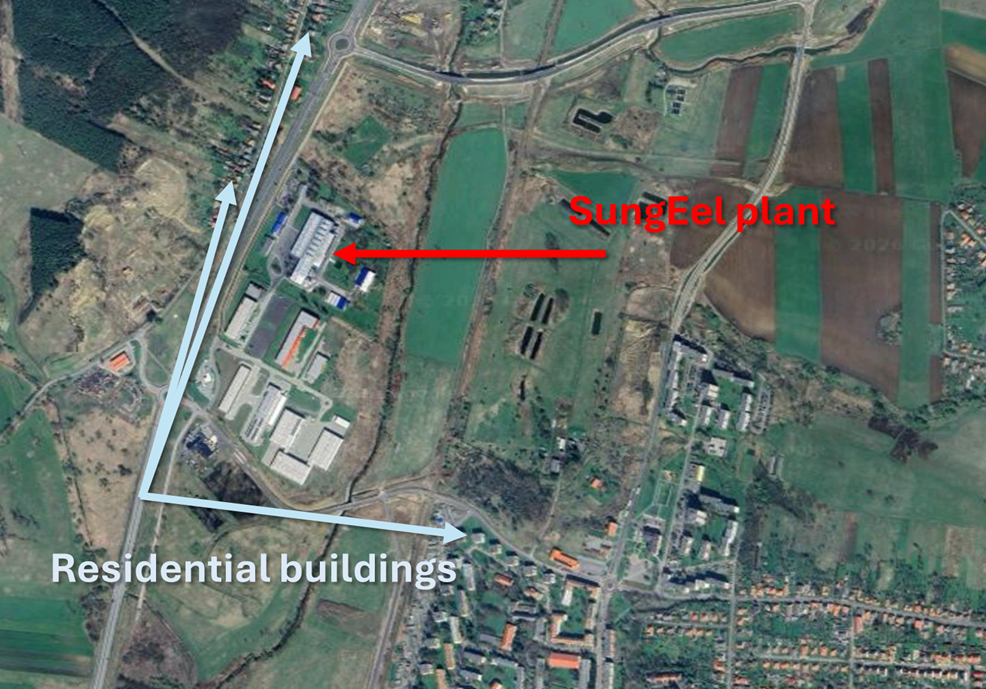
Nearly 5,000 people live within a 1.5-kilometer radius of the SungEel battery recycling plant. (Source: Google Maps)
In other words,
the Bátonyterenye plant “may carry out its activities authorized prior to the legislative change even without an environmental permit,” states the government office.
The plant must also obtain a new disaster management permit before expansion, for which the authority has initiated a separate procedure. As part of this, a new Safety Report was prepared, regarding which interested parties could submit comments and questions in writing to the authority.
Although the government office did not announce a public hearing with in-person attendance regarding the disaster management procedure, Mayor István Orosz (independent) nevertheless called a meeting for residents on April 27. Representatives from the authorities and the Korean company attended the event and attempted to answer residents’ questions – with most locals expressing dissatisfaction and distrust regarding the plant’s operations.
Two mayors, two opposing viewpoints
The battery processing plant, which was fined several times, is located in the heart of the town, putting residents at risk, claims István Orosz. The mayor told us that the police are still investigating previous accidents – some of which resulted in fatalities – as well as the defective batteries transported from SungEel Kft’s facilities to illegal warehouses and stored there without a permit.
The mayor also expressed confidence that an independent court would rule in their favor in the lawsuit filed against the plant’s operating permit.
SungEel’s other domestic battery processing plant is located in Szigetszentmiklós, and received a permit for an annual processing capacity of 10,000 tons in 2025. The plant operates solely under a waste management permit, as the authorities did not require an environmental protection or industrial safety permit for its operation.
We contacted János Nagy, the independent mayor of Szigetszentmiklós, to learn his views on the plant’s permits, its operations, the accidents that have occurred there, and the serious cases of poisoning affecting workers. During our interview with him, however, we did not receive much information about the permits—as the mayor was not familiar with their contents.
Regarding the risks associated with the plant’s operation, he stated: “Even a soap factory is dangerous.”
According to Mayor János Nagy, the operation of the battery recycling plant poses no danger to the environment or the residents of the town.
He also said that he had asked the Korean company to support the installation of air pollution monitoring devices in the town to reassure the public, but this has not yet taken place. We also learned that the mayor hopes that by tightening occupational safety inspections and enforcing regulations, further workplace accidents can be prevented.
At one point during the interview, the mayor called in the town clerk to answer our questions. However, the town clerk viewed the questions as an “attack” and began to defend herself vehemently; in her view, the local government had never had the opportunity to intervene in the issuing of permits by the environmental authorities.
We sent the following questions to the Pest County Government Office regarding the plant in Szigetszentmiklós:
- Why was SungEel Kft. not required to conduct an environmental impact assessment for the battery waste processing plant operating in Szigetszentmiklós pursuant to Government Decree No. 314/2005. (XII.25.), even though the plant’s waste management permit was amended in 2025 and it was granted permission to expand its capacity?
- Was an industrial safety authority proceeding initiated following the 2025 capacity expansion of the Szigetszentmiklós plant, and what was the outcome of this? Regarding the 1,090 tons of hazardous waste, the maximum permitted amount that can be stored at the Szigetszentmiklós plant, did the industrial safety authority classify the Szigetszentmiklós site into the appropriate category?
We received the following response from the government office:
“In the case of SungEel Kft., the authority issued the waste management permit regarding the modified capacity following a preliminary investigation conducted in accordance with the relevant government decree—Decree No. 314/2005 (XII.25.)—and taking into account the results of that investigation. Since this preliminary investigation procedure was initiated before September 29, 2024, the regulations requiring an environmental impact assessment for battery industry activities did not apply in this case. At the same time, the authority had previously revoked the industrial safety permit for SungEel’s Szigetszentmiklós site; no activities may be carried out there in which the amount of hazardous materials – as defined by industrial safety regulations – present on the site at any given time exceed one-quarter of the lower threshold limit.”
However, the government office’s response contradicts the information contained in the permits. According to the waste management permit issued on February 11, 2025, SungEel Kft. submitted the documentation required for the permit amendment to the authority on December 9, 2024—by which time the provision requiring an environmental impact assessment had already entered into force.
The response regarding the revocation of the industrial safety permit is hard to justify, since according to the 2025 permit, “the amount of hazardous waste that can be collected at the site at any one time will change from 880 tons to 1,090 tons as a result of the amendment.” Based on this, this waste processing facility is considered a hazardous facility, which should also hold a disaster management (industrial safety) permit.
Written by Zsuzsa Bodnár, translated by Zalán Zubor. The Hungarian version of this story is here. Video and cover photo by Gergely Pápai
Share:
Your support matters. Your donation helps us to uncover the truth.
- PayPal
- Bank transfer
- Patreon
- Benevity
Support our work with a PayPal donation to the Átlátszónet Foundation! Thank you.
Support our work by bank transfer to the account of the Átlátszónet Foundation. Please add in the comments: “Donation”
Beneficiary: Átlátszónet Alapítvány, bank name and address: Raiffeisen Bank, H-1054 Budapest, Akadémia utca 6.
EUR: IBAN HU36 1201 1265 0142 5189 0040 0002
USD: IBAN HU36 1201 1265 0142 5189 0050 0009
HUF: IBAN HU78 1201 1265 0142 5189 0030 0005
SWIFT: UBRTHUHB
Be a follower on Patreon
Support us on Benevity!
