

Media blacklists, fake news, and angry birds – how government officials obstructed press inquiries

During the Orbán era, government institutions avoided answering questions from independent media unless forced to do so by public-interest data-request lawsuits. One insider source from the Ministry of Agriculture told us that they were instructed to “not answer even the most basic questions asked by hostile media”. Since the elections, there has been a dramatic shift in the government’s reaction to media inquiries.
A core part of journalists’ work is asking questions. Normally, government institutions answer them; if not, we submit a public-interest data request, which they usually respond to. However, in practice, public data requests are often denied, leading to years of expensive litigation until the requested information is released.
In the past 16 years, the Orbán governments did their best to dismiss media inquiries. Government institutions routinely used the option to extend the 15-day deadline to answer public interest data requests by a further 15 days. In many cases, requests were denied on the basis that the ministry in question does not handle the requested data, or that the request was not filed correctly.
In many cases, these legal arguments were just excuses to prevent the release of politically sensitive information.
Case in point: we then initiated and won lawsuits against the Ministry of Construction and Transportation, the Hungarian State Treasury, the Prime Minister’s Office and the Ministry of Finance over data requests they initially denied. Regardless, this strategy has been effective at obstructing the work of journalists, as litigation is expensive and takes a lot of time.
After April 12, all that changed instantly: answers began to pour in for messages sent weeks ago. State institutions called me after the election, telling me that they would send the requested information immediately, and apologizing for the one-month delay.
Encouraged by this, I contacted members of state-owned companies’ communication teams and asked them if our suspicions of a media blacklist’s existence were correct, and whether Átlátszó was on it.
Everything had to go through the ministry
The officials did not want to give names, but with the intention of rebuilding relations, they explained in detail how the process worked.
Although state-owned companies are well-equipped to answer questions, all media inquiries had to be forwarded to the superior ministry. For example, in th case of forestry-related inquiries, journalists and officials reported that “in the case of non-sensitive questions, the ministry’s press department reacted immediately and approved the answer, but if the journalist asked about a topic they considered sensitive, they delayed the answer, often deflected or they wrote the answer for us” – said a journalist who is confident that the new directive will no longer be so strict.
Several people said that the 15-day extension of deadlines was most often due to this centralization. Even when companies had the requested data, they were not allowed to share it on their own and had to wait for the ministry’s answer.
“In every case, the inquiries addressed to us were sent to the Ministry of Agriculture, and if it was a request for public data, it had to be approved by the ‘Rogán Works’”
– one official recalled, referencing the Orbán regime’s centralized propaganda and communications department led by Antal Rogán.
A spokesperson of Vérteserdő Zrt., a national forestry company, said that communications were being coordinated with the owner, which applies to both media inquiries and public interest data requests.
“We collect data, prepare a response proposal, but it had to be approved by the current owner. When a response was approved, we typically received stylistic guidance or comments that served to present the entire group of companies in a comprehensible, yet uniform and informative way.”
We also contacted ministries, asking about their official policies. According to the Ministry of Agriculture, “the Press Office prepared the press response to each request based on background material received from the relevant professional field, after which the draft response was sent back to the relevant department. The professionally approved response – after the press director’s permission – was forwarded to the Prime Minister’s Cabinet Office (the government body led by Antal Rogán) for consideration. Based on this, approval, a correction proposal or negative feedback could be received.”
The Prime Minister’s Office – already under new management – responded that the new government of Hungary has no information about the principles and procedures of the previous government in responding to media inquiries. Which is strange because the people working in the press departments are mostly the same as under the previous government, so they know exactly how and on what basis they responded to press inquiries until April 12.
The communications department of the Ministry of the Interior stated that:
“the Ministry’s Communications Department has operated and continues to operate in accordance with the ‘Organizational and Operational Regulations’ currently in effect. In our work, we strive for a consistent and supportive partnership.”
If partnership means not responding to press inquiries, then that is certainly the case, as I have not received a response to a single inquiry from the Ministry of the Interior since March 11, 2021.
“Friendly” and “hostile” media
An insider working at a national park, who wished to remain anonymous, said that the Ministry of Agriculture had previously held a briefing for the organizations under its jurisdiction, during which they were told:
“You must not answer even the most basic questions asked by hostile media, but you must answer everything from friendly media.”
We were curious to know if they had listed who were considered “friendly” and “hostile” media, but we received no answer. However, this preferential treatment was confirmed by others: regardless of how trivial the topic, officials were forbidden to answer questions from certain media outlets.
The director of one national park also mentioned that all responses were controlled, even regarding the smallest articles and statements.
“When a colleague of mine wrote an article about birds, we had to submit it for approval. Even press releases for Earth Day had to be approved to a certain degree.”
He did not hear of a specific media blacklist, but there were times when he was told not to respond to a particular media outlet.
According to a statement from the Duna-Ipoly National Park, “operations and daily activities are conducted on a professional basis, intentionally isolated from the political sphere as much as possible. Press releases were handled in accordance with a directive from the Ministry of Agriculture (No. 1/2020, dated January 24), which stipulated that national parks must “seek prior approval from the Ministry of Agriculture’s Press Office before issuing any statements.”
Sometimes the answer was no better than silence
The Pest County (Central Hungary) Government Office also denied having any media blacklist and claimed that they strive to answer questions from all media outlets. However, to the five inquiries I sent to the Government Office between 2020 and 2025, I received only one response, when I asked questions regarding a landfill near Kisoroszi. But even then, I did not receive comprehensive information; I was told only that: “An investigation into the matter is currently underway by the Pest County Government Office.”
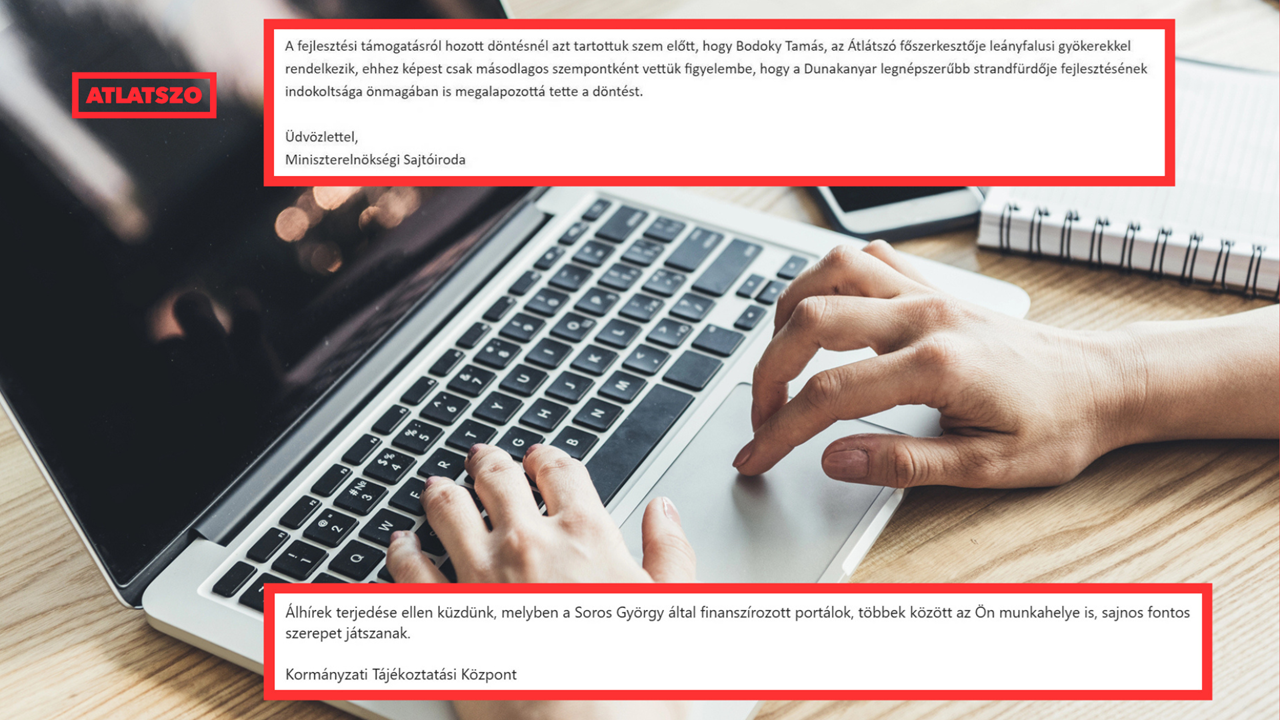
So, even when government institutions responded, it was often of little help. For example, we received a letter in which the Government Information Center sent the following response to our inquiry:
“We are fighting the spread of fake news, in which portals financed by George Soros, including your workplace, unfortunately play an important role.”
Or, for instance, regarding a development grant from the Prime Minister’s Office, we received the following non-reply:
“In making the decision regarding the development grant, we considered the fact that Tamás Bodoky, editor-in-chief of Átlátszó, has roots in Leányfalu. In comparison, we considered it only a secondary factor that the beach resort is the most popular one in the Danube Bend, which alone makes the decision to develop it well-founded.”
Written by Zsuzsa Zimre, translated by Zalán Zubor. The Hungarian version of this story is here. Cover image: montage by Átlátszó
Share:
Your support matters. Your donation helps us to uncover the truth.
- PayPal
- Bank transfer
- Patreon
- Benevity
Support our work with a PayPal donation to the Átlátszónet Foundation! Thank you.
Support our work by bank transfer to the account of the Átlátszónet Foundation. Please add in the comments: “Donation”
Beneficiary: Átlátszónet Alapítvány, bank name and address: Raiffeisen Bank, H-1054 Budapest, Akadémia utca 6.
EUR: IBAN HU36 1201 1265 0142 5189 0040 0002
USD: IBAN HU36 1201 1265 0142 5189 0050 0009
HUF: IBAN HU78 1201 1265 0142 5189 0030 0005
SWIFT: UBRTHUHB
Be a follower on Patreon
Support us on Benevity!
