

Anti-Roma sentiment erupted in the refugee debate following László Trócsányi’s statement

According to a social listening study conducted ten years ago, the 2015 anti-refugee campaign was not a spontaneous social reaction, but a process heavily shaped by government communications. One of the study’s most important findings was that following a statement by then-Minister of Justice László Trócsányi in May 2015, the number of anti-Roma comments in online discourse about refugees increased dramatically. In doing so, the government not only amplified anti-refugee sentiment but also linked existing anti-Roma prejudices to the new enemy stereotype.
In January 2015, the refugee issue was barely present in the Hungarian-language online public sphere. According to a 2016 study commissioned by the Open Society Foundations and conducted by Bakamo.Social, mentions of Roma in this context did not become widespread as a result of international events, but rather surged when the Hungarian government built a campaign around it with Trócsányi’s statement.
The analysis, authored by Balázs Dénes (client) and Dániel Fazekas (researcher), examined 113,421 Hungarian-language social media posts between January 1 and September 8, 2015. The goal was to explore how government communications influenced user discourse.
The government campaign shaped public discourse
The biggest spikes in online discourse on the refugee issue were linked to government announcements. These included the so-called “national consultation on immigration and terrorism”, Antal Rogán’s statement regarding the daily “4,500 forint” cost of providing for refugees, as well as the planned fence along the southern border and the intensive billgoard campaign supporting the anti-refugee campaign.
Meanwhile, the structure of the discourse also shifted: the voices of experts and the press were gradually pushed into the background by average users, who were already discussing the topic within the government’s framework. According to the study, government communication was organized around four main claims:
- One was the cultural threat: immigrants were portrayed as a group that endangers the Hungarian and European cultural order.
- The second was the issue of law and order: the arrival of refugees was framed as a law enforcement and criminal problem.
- The third was the narrative of the economic burden. The term “economic migrant” and government claims about costs reinforced the perception that providing for refugees takes resources away from Hungarians.
- The fourth was the link to terrorism. Building on fears following the Charlie Hebdo attack, government communications conflated migration with security risks.
According to the research, these messages appeared in virtually unchanged form in social media posts as well.
Mentions of Roma people surged following Trócsányi’s statement
One of the study’s most significant findings relates to a statement made on May 22, 2015. László Trócsányi, then Minister of Justice, spoke in Berlin about how Hungary could not accept any more refugees because it was already responsible for the integration of 800,000 Roma people. According to researchers, this statement shifted the discourse in a new direction. It linked the refugee issue to a field of strong prejudice that has long existed in Hungary.
The change was also reflected in the data. Before the statement, the weekly number of mentions of Roma in the context of the refugee issue was in the single digits. In the week of the statement, it rose above 20, and the following week it jumped to over 80. This increase was not merely temporary but proved to be lasting.
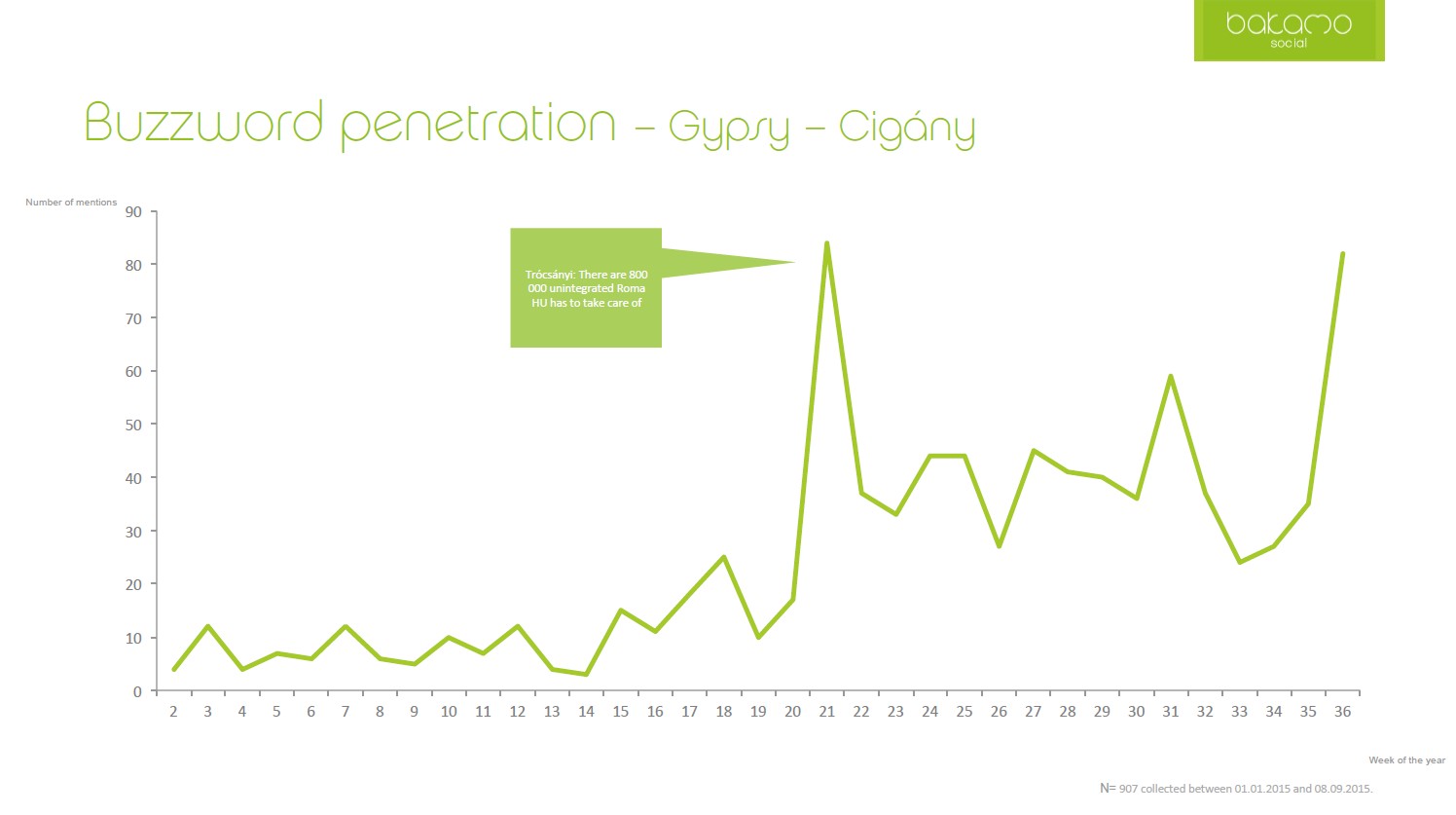
Source: Bakamo.Social
Based on the qualitative analysis, statements began to appear more frequently in the comments that treated Roma and refugees as belonging to the same category—one characterized as rejected, criminalized, or parasitic.
The government did not create a new prejudice but rather exploited an existing one
According to the research, Trócsányi’s statement marked a turning point that directly linked anti-refugee rhetoric to anti-Roma prejudices. Government communication did not create anti-refugee sentiment out of thin air, but rather consciously linked it to existing social reflexes.
Trócsányi’s statement played a key role in this: it did not introduce a new narrative, but rather incorporated refugees into a system of prejudice that had long been at work against the Roma in Hungarian public discourse. This may also explain why the reaction on social media was so swift and intense. The anti-refugee campaign was thus able to build not only on new fears but also on old enemy stereotypes.
The research notes that even at the time of the statement, there were voices warning of this danger. Béla Lakatos, the then-Fidesz mayor of Ács, told Index that Roma mayors feared the government would conflate Roma and refugees. Based on social media data, this indeed happened within a short time.
According to the research, the anti-refugee campaign was effective because it offered simple answers to a complex situation. It did not frame the issue of migration in legal, humanitarian, or international terms, but rather as a cultural, economic, and security threat.
Within this framework, rejection of refugees could easily be framed as self-defense, and exclusion as a legitimate political stance.
According to the research, it is particularly significant that the majority of users had no direct experience with refugees. Opinions were therefore largely shaped by secondhand accounts, media images, and government messages.
In this sense, the consequence of Trócsányi’s statement is twofold. One aspect is well-known: he projected anti-Roma hatred onto refugees. The other is less frequently mentioned but no less serious: he turned the Roma into migrants as well—not in a legal sense, but in a discursive one.
The phrase “descendant of earlier immigrants” implies that Roma are not citizens living here, but remnants of a previous wave of immigration, whose presence is just as temporary and burdensome as that of today’s refugees. Once someone is labeled a migrant, the logic of expulsion becomes applicable to them—even if their ethnicity has been part of the country for centuries.
Dániel Fazekas, one of the study’s authors, summarized the study’s relevance today for Átlátszó: “It is rare to see such open and transparent incitement to hatred. In my opinion, this man does not belong at the helm of a Christian university.”
There were no political consequences for László Trócsányi
The 2015 statement and the online reactions it sparked are noteworthy in part because there appear to be no significant consequences for Trócsányi’s political and institutional career: By his decision of April 17, President Tamás Sulyok appointed László Trócsányi to serve as rector of Károli Gáspár Reformed University for another five years, from February 1, 2027, to January 31, 2032.
The decision was countersigned by Balázs Hankó and was made in agreement with the university’s governing body; according to press reports, the proposal came from the Reformed Church.
One thing is certain from the fact of the appointment: neither the state, nor the countersigning minister, nor the sponsoring body considered his political past to be a disqualifying factor—a past that, according to the research materials at our disposal, measurably contributed to the intensification of anti-Roma sentiment at the height of the anti-refugee campaign.
In addition to this, Trócsányi—upon the recommendation of Prime Minister Viktor Orbán—has also received one of Hungary’s highest state honors, the Corvin Chain.
According to the citation, the former constitutional court judge, minister, and ambassador was honored for his “exceptional legal scholarship and outstanding teaching work, his activities enriching Hungarian academic life, particularly in the fields of comparative constitutional law, administrative justice, and European public law, as well as for his exemplary work on the interrelationships between national constitutional law and European integration.”
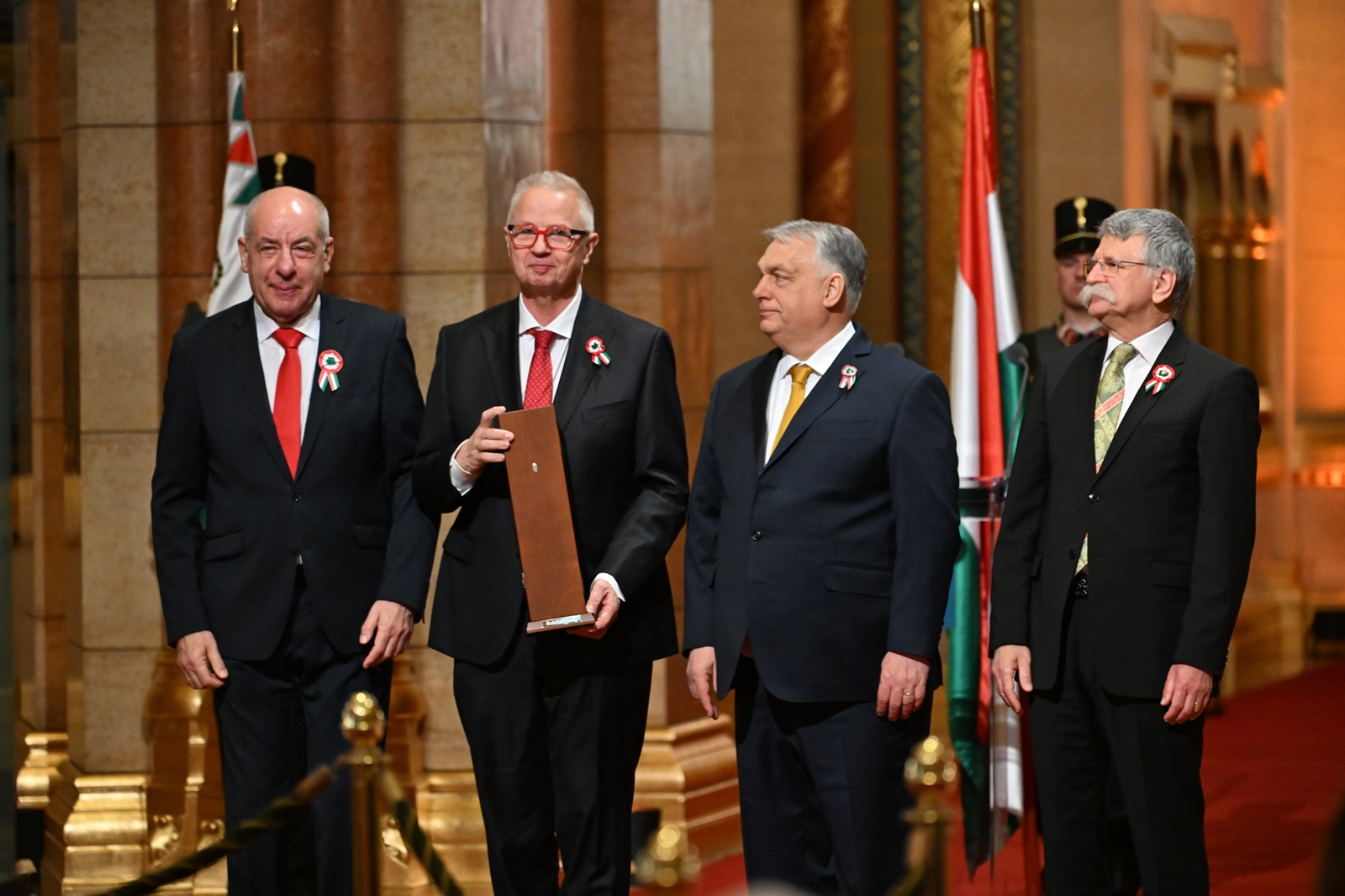
Written and translated by Tamás Bodoky. You can read the Hungarian version of the story here. Cover photo: László Trócsányi, legal scholar, university professor, rector, former constitutional court judge, minister, and ambassador, receives the Széchenyi Prize at the ceremonial presentation of the Kossuth and Széchenyi Prizes, held on the occasion of the anniversary of the 1848–49 Revolution and War of Independence in the Dome Hall of the Parliament Building on March 14, 2026. Standing next to him are President Tamás Sulyok, Prime Minister Viktor Orbán, and László Kövér, Speaker of the National Assembly. Photo: MTI/Tibor Illyés
Share:
Your support matters. Your donation helps us to uncover the truth.
- PayPal
- Bank transfer
- Patreon
- Benevity
Support our work with a PayPal donation to the Átlátszónet Foundation! Thank you.
Support our work by bank transfer to the account of the Átlátszónet Foundation. Please add in the comments: “Donation”
Beneficiary: Átlátszónet Alapítvány, bank name and address: Raiffeisen Bank, H-1054 Budapest, Akadémia utca 6.
EUR: IBAN HU36 1201 1265 0142 5189 0040 0002
USD: IBAN HU36 1201 1265 0142 5189 0050 0009
HUF: IBAN HU78 1201 1265 0142 5189 0030 0005
SWIFT: UBRTHUHB
Be a follower on Patreon
Support us on Benevity!
