

How much does the fence cost, and where are the migrants?

The government has held two referendums on illegal migration, and went on to ignore the results, while releasing human traffickers who are largely responsible for the migration crisis. One of the Orbán government’s central claims is that only their border fence is keeping migrants out, while “Brussels bureaucrats” are trying to open the floodgate to migration – however, neighbouring Croatia is receiving millions in EU funding to secure its borders, which they can achieve without a fence, or fear-mongering propaganda posters.
Are fences and constant political scaremongering really the only answer to illegal migration? We went to the Croatian-Serbian border, near Bosnia, because on the map this appears to be an exceptionally easy entry point into the Schengen Area. Here, however, we saw a completely different picture than at the Hungarian-Serbian border: there is no fence, no visible border barrier, yet migrants are not flooding in.

Based in our visit to the border, which was covered in the video report below, it has become clear that it is not asylum seekers themselves, but human traffickers who are shaping the migration route. And that, contradicting the Hungarian government’s claims, border protection can be achieved not only with a fence, but also through law enforcement and legal measures. This can be seen in Croatia, where the number of illegal entries has decreased. We have confronted Béla Mihálffy, an MP of Viktor Orbán’s Fidesz party with the fact that the government is not keeping the promises they made about border security.
When Croatia joined the Schengen Zone in 2023, many expected the country to become a new corridor for illegal migration: after all, unlike Hungary, the country has no border fence. However, when we interviewed locals, they did not report an increase in illegal border crossing, instead saying that “there are fewer illegals now” then two years ago.
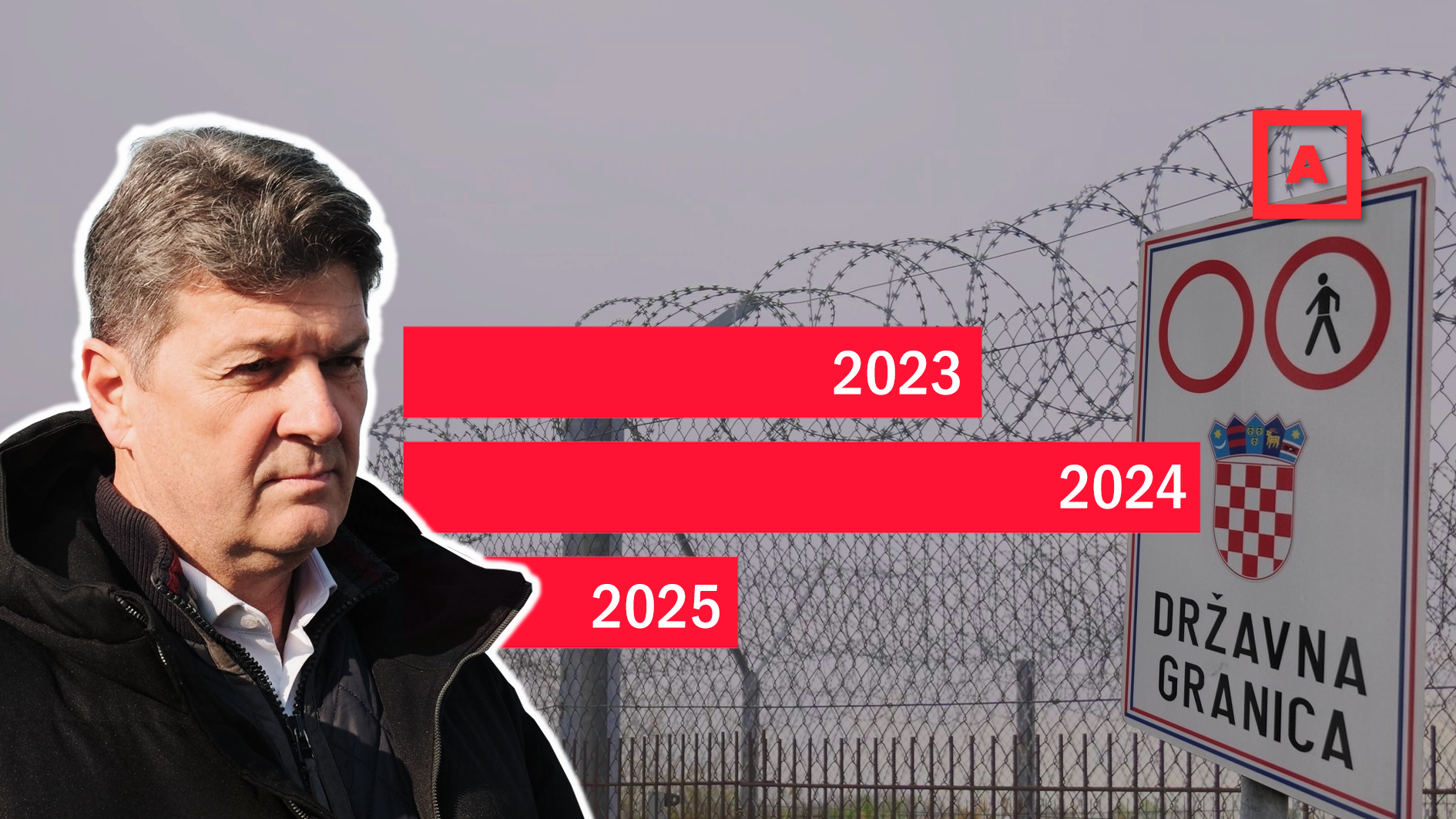
This has been confirmed by statistics received from the Croatian government, which show that
the number of illegal entries has dropped from 69,726 to 29,294 between 2023 and 2024 despite Croatia’s entry to the Schengen Treaty.
What could have caused such a drop in illegal entries? The answer may lie in a statement by the International Organization for Migration: as the organization reported, the most important factor may be a 2023 crackdown by Serbian authorities on human trafficking networks, which organized smuggling operations through Hungary.
This operation forced human trafficking networks to relocate to other countries such as Bosnia, which has become one of the new main entry points for migrants to the EU. The new route is longer and more perilous. However, migration routes are not determined by asylum seekers themselves, but human traffickers.
At the same time, the number of illegal crossings has also dropped dramatically at the Serbia-Hungary border. In 2022, more than 100,000 people attempted to cross. In 2025, the number had fallen below 10,000.
The Hungarian government bases its political messaging on migration, which they strengthened with no less than two “National Consultations” – informal, unchecked referenda where voters are asked loaded questions about the issues of the day. In two previous Consultations, voters were prompted to agree that illegal border crossers must be detained, identified, and prosecuted, but this is not what happens in practice.
Border violators are simply escorted back to Serbia without any legal sanctions. In other words, what the government previously advocated politically and promised to voters is not being implemented.
We asked the border region’s Fidesz Member of Parliament, Béla Mihálffy about this. Mihálffy said that “the government is handling the situation perfectly” and refused to address the issue of detainment and prosecution.
Another important issue is money. The Hungarian government talks about billions of euros in connection with border protection, according to data requested from the police,
operating the border fence costs roughly 3 billion HUFs (7,8 million EUR) annually.
This does not include fence repairs, vehicles, police salaries, or other related costs. In other words, the entire system could be significantly more expensive, while there is far less discussion of its actual operation and effectiveness than of the political messaging.
It seems that illegal migration is a manageable problem, but not necessarily in the way the Hungarian government has been portraying it for years. Examples from the Western Balkans show that police action, technical surveillance, and lawful, individualized procedures can be more effective than constant propaganda.
According to the Croatian Ministry of the Interior, the border is monitored through continuous patrols, thermal cameras, motion-detection surveillance, and other technical devices – largely funded by the EU, contradicting narrative about “pro-migration Brussels meddling.” And the numbers show that the number of border crossings has dropped significantly in Croatia.
Written by Csaba Segesvári and Virág Gyurkovics, video by Zsolt Józsa, translated by Zalán Zubor. Cover image by Átlátszó
Share:
Your support matters. Your donation helps us to uncover the truth.
- PayPal
- Bank transfer
- Patreon
- Benevity
Support our work with a PayPal donation to the Átlátszónet Foundation! Thank you.
Support our work by bank transfer to the account of the Átlátszónet Foundation. Please add in the comments: “Donation”
Beneficiary: Átlátszónet Alapítvány, bank name and address: Raiffeisen Bank, H-1054 Budapest, Akadémia utca 6.
EUR: IBAN HU36 1201 1265 0142 5189 0040 0002
USD: IBAN HU36 1201 1265 0142 5189 0050 0009
HUF: IBAN HU78 1201 1265 0142 5189 0030 0005
SWIFT: UBRTHUHB
Be a follower on Patreon
Support us on Benevity!
