

Written by Zsuzsa Bodnár, translated by Zalán Zubor. The original Hungarian articles can be found here and here. Cover image: photo by a reader of the Göd battery factory
The management of the Samsung factory in Göd lobbied the government to ban Átlátszó
7
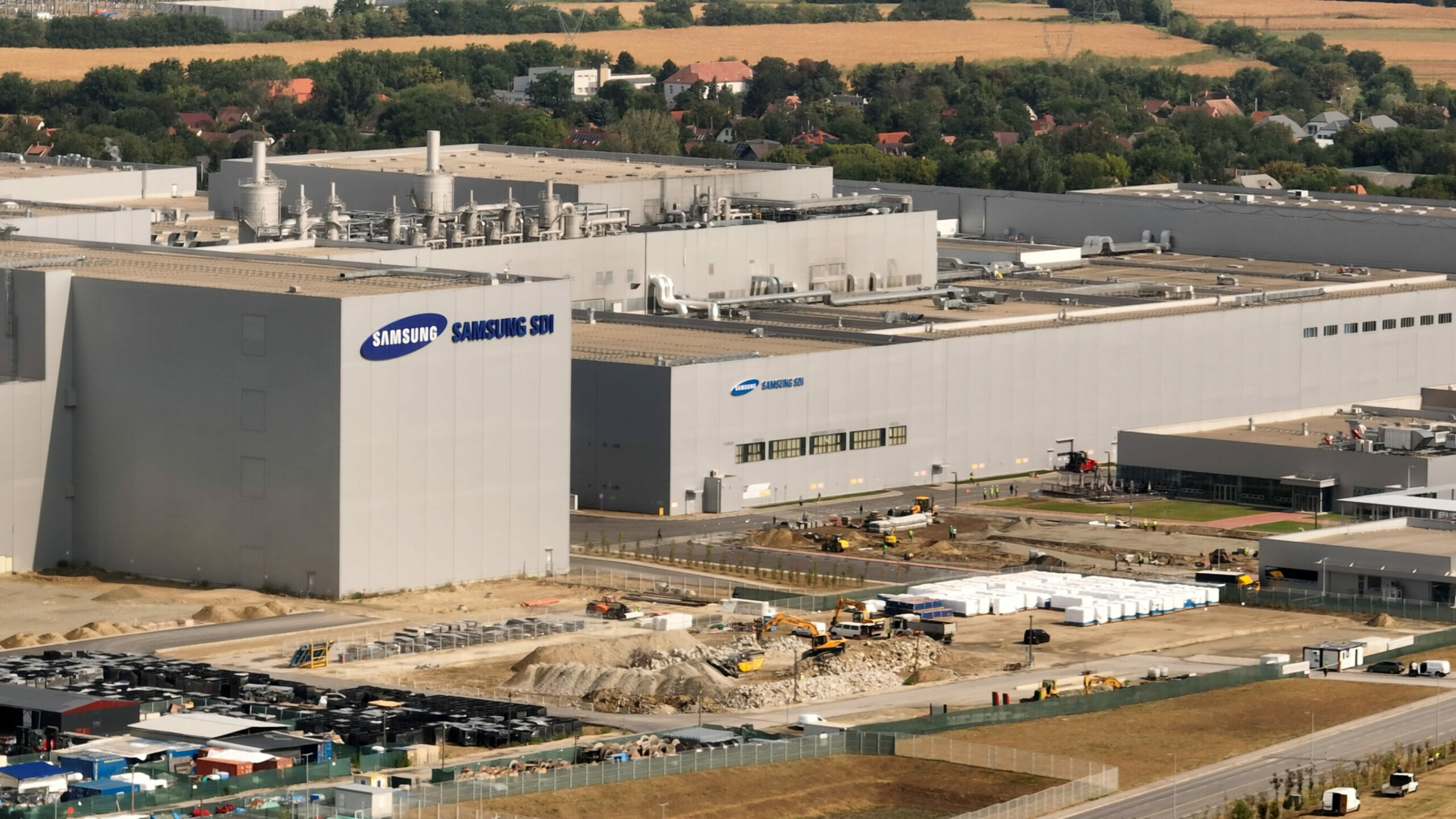
Telex cites leaked internal documents showing that in March 2024, the management of the Göd Samsung battery factory discussed lobbying the government to stop Átlátszó from investigating the factory’s pollution. Three months later, the Sovereignty Protection Office launched an investigation against Átlátszó, and a few months later against our local partner Göd-Ért Association as well. The factory has been fined numerous times for violating environmental regulations and polluting the area with poisonous and carcinogenic chemicals. However, the authorities refuse to revoke the factory’s environmental permit and disclose details about their decisions. We are suing for the release of the documents.
In recent years, we have reported on nearly 60 official rulings against the practices of Samsung SDI’s battery factory in Göd. The company has been penalized by all relevant Hungarian authorities for breaking regulations. Since they began operating, the company has been fined 378 million HUF (1 million EUR) for environmental, industrial safety, occupational safety, and other violations.
However, the authorities have been refusing to release full documents relating to the penalties. For example, documents relating to occupational safety fines were initially released with the names and quantities of carcinogenic substances redacted. It was only after we requested an investigation by the National Authority for Data Protection and Freedom of Information (NAIH) and then issued a formal request that we received the unredacted documents from the government office.
For more than a year, the Pest County Government Office and other authorities have been rejecting all requests for information with the same text. As we wrote earlier, in their rejection letters, they “recommend” submitting a request for access to documents, which is unlawful, since we do not wish to inspect procedural documents, but rather request decisions made in the course of closed proceedings as data of public interest, and then they usually refuse to comply with such requests.
We also turned to the National Data Protection Office (NAIH) for an investigation into one such case of data disclosure refusal, and the NAIH’s statement said, among other things, that “after the conclusion of the proceedings, anyone may access the final decision that does not contain personal data or protected data (…) without restriction.” The data protection authority, therefore, called on the government office to issue the decision we had requested, which the Pest County Government Office then complied with.
Nevertheless, the government office continued to refuse our subsequent requests for the data, so we are now seeking to enforce our right to access public interest data through the courts. Originally, the court hearing was set for February 11; it was postponed to February 25 “due to objective reasons arising in the operation of the court.”
Telex: Orbán was informed about graveness of the pollution
The postponement was announced shortly after the Göd factory became the center of a national controversy. The news site Telex reported on February 9 that the Hungarian domestic intelligence services investigated the factory’s pollution, and the report was presented directly to Viktor Orbán. The investigation confirmed the worst suspicions: the company exposes many of its employees to toxic, carcinogenic chemicals, and its internal measurements show much worse results than those shared with the occupational safety authority, and Samsung did virtually nothing to fix the issues, trying to cover them up instead.
Despite this, the factory continued to operate the same way, and in 2023, Samsung received 133 billion HUF (352 million EUR) government aid to expand its Göd operations.
According to documents leaked to Telex, the concentration of nickel-cobalt-manganese dust at Samsung’s factory in Göd has exceeded the permitted limits by as much as 510 times, posing a serious health risk to people who breathe the air in and outside the factory. The site reported that Samsung failed to properly extract the carcinogenic dust and did not provide proper protective equipment to all workers, who were thus likely to suffer serious health damage.
These chemicals are carcinogenic, damage the nervous system, and can lead to serious health problems with long-term exposure. Of the dust particles released at Samsung and presumably inhaled regularly by workers, nickel is the most dangerous – it is a proven carcinogen, but even in small amounts it can cause allergies, pulmonary fibrosis, cardiovascular, and kidney problems. Manganese damages the body through a completely different mechanism, primarily affecting the nervous system, and long-term exposure can lead to impaired hand movements, changes in movement and behavior, reduced coordination and balance, and milder symptoms such as forgetfulness, anxiety, or insomnia. If these symptoms are severe enough, the condition is called manganism, which can cause paralysis and serious nerve damage similar to Parkinson’s disease.
Samsung tries to shot down Átlátszó
On February 12, Telex also cited a leaked document dated March 2024, in which Samsung SDI management in Göd discussed what measures could be taken to shut down Átlátszó or prevent it from reporting about the Samsung factory in Göd in the future. The company expected the government to restrict Átlátszó’s work in some way. Three months later, the Sovereignty Protection Office launched an investigation into Átlátszó.
The document obtained by Telex was prepared on March 27, 2024, and contains the topics of one of Samsung’s management meetings. The sixth item on the agenda was: “Government target to stop or restrict Átlátszó by the end of the election campaign.” This sentence literally means that the government will shut down or restrict Átlátszó’s operations by the end of the election campaign.
According to Telex, the document contains two sub-points on this topic. One of them reads as follows:
“Closure of the prosecution office investigation is targeted for mid-May. The investigation will reveal officially that SDIHU met all legal limits and Átlátszó broke the law. Átlátszó is facing a considerable fine and prohibition from further spreading false news.” The other sub-point reads as follows:
“In addition to the prosecution office, the Integrity Authority is also investigating Átlátszó’s foreign funding. A negative decision by the authority could lead to Átlátszó ceasing operations.”
According to Telex’s source, the term “Integrity Authority” was included in the document due to a translation error, and the meeting was actually about the Sovereignty Protection Office.
The document is particularly significant because three months later, in June 2024, the Sovereignty Protection Office did indeed launch an investigation into Átlátszó.
Tamás Bodoky, editor-in-chief of Átlátszó, said that
“It is new information to us that the Göd Samsung factory may have known about or may have lobbied the government for the SPO investigation. We were notified about the investigation in June 2024. Later it was extended to our local partner, Gödért Association in early September 2024, and Átlátszónet Foundation also received a set of questions from the SPO, which suggested that our investigative work related to Samsung factory in Göd was also being targeted. Our opinion on the matter is that it has been clear for some time that Átlátszó has been targeted by the SPO because of its investigative work in the public interest, but if Telex’s information is correct, then there is now proof of this. We find it particularly ironic that the authorities are attacking the domestic press, which serves the people living here, on the grounds of protecting sovereignty in order to defend the interests of a giant foreign-owned company.”
Years of pollution and coverups
Átlátszó has been reporting regularly on the pollution caused by Samsung. In 2022, we reported that the company was given a 10 million HUF (26 500 EUR) fine for „seriously and directly endangering the health and physical integrity of 23 of its employees”. For months, the workers had to endure increased exposure to various carcinogenic air pollutants.
Later that year, we reported that the disaster management authorities had ordered an investigation following water pollution in the water wells in Göd. At the same time, the Samsung factory has also launched a “water quality monitoring” campaign in Göd, asking local residents to take samples from their wells. This was done after an independent study commissioned by the local Göd-ÉRT Association found industrial pollutants in the town’s wells.
In 2024, we published air pollution data showing that Samsung SDI’s Göd plant emitted 88 tons of toxic solvents into the air between 2019 and 2022. The Göd factory housed many times the permitted levels of carcinogenic heavy metals. Despite Samsung receiving mounting fines, workers’ exposure to toxic substances has increased steadily over the years.
In response to our investigation, the mayor of Göd announced on his social media page that he would file a police complaint against an unknown perpetrator over “pollution or scaremongering”. Nothing is known about the further fate of the complaint since then.
Share:
Your support matters. Your donation helps us to uncover the truth.
- PayPal
- Bank transfer
- Patreon
- Benevity
Support our work with a PayPal donation to the Átlátszónet Foundation! Thank you.
Support our work by bank transfer to the account of the Átlátszónet Foundation. Please add in the comments: “Donation”
Beneficiary: Átlátszónet Alapítvány, bank name and address: Raiffeisen Bank, H-1054 Budapest, Akadémia utca 6.
EUR: IBAN HU36 1201 1265 0142 5189 0040 0002
USD: IBAN HU36 1201 1265 0142 5189 0050 0009
HUF: IBAN HU78 1201 1265 0142 5189 0030 0005
SWIFT: UBRTHUHB
Be a follower on Patreon
Support us on Benevity!
