

Prostitution and Drug Abuse: How Hungary Is Failing the Children in its Care

Our investigation shows how children in Hungarian care homes are targeted by criminal networks, with pimps effectively embedding themselves within the child-protection system. Those working in the sector say they are powerless to stop the abuse.

Reni was 11 years old when a man began chatting with her and two other girls on Facebook. All three were living in a small rural children’s home in western Hungary at the time. “This man knew that we were from a children’s home. He tried to lure us to his apartment – luckily none of us went,” says Reni, now in her twenties. “We would chat at the library, and there some adult – the librarian or a caregiver, I don’t remember – saw the messages and reported it.”
Reni and the two other girls were questioned in court as witnesses. “At court I recognised the man whom we had been chatting to, and another man as well who was our patron [a kind of mentor who volunteers at the residential home] at the time,” she says. “He bought us gifts, took us places, organised programs. He probably showed our profiles to the man who wanted to lure us away.” Reni says she doesn’t know how the case against the men ended.
Reni’s experience is just one of nearly a hundred responses Atlatszo received from people who spent time involved in state care in Hungary. Atlatszo’s project was initiated after a series of high-profile child abuse and sexual exploitation scandals emerged at Hungarian state residential institutions, including the perpetration and official cover-up of child sexual abuse and beatings at the Szolo Street Reformatory in Budapest. So far, the inquiries have identified 15 underaged victims.
The stories recounted show how in Hungary, just as in other developed countries, it is primarily those in the child-protection system who become victims of child prostitution and substance abuse. Children in care are already overrepresented among the vulnerable: neglected, disadvantaged, abused – and therefore easily exploitable. They are typically in the crosshairs of criminal networks; pimps effectively “build themselves onto” the child-protection system, sometimes with the complicity of employees of the state. Beyond a certain point, those working in the system as well as the police are proving powerless to stop the phenomenon.
Men in their twenties could be patrons to 8- to 12-year-old girls with the knowledge of the institution’s director. The children went out and met these men. ‘Acquaintances’ paid for their used underwear. A 13-year-old girl did not return at night from leave. – A response submitted to Atlatszo’s anonymous questionnaire
Powerless children’s homes
Children’s homes in Hungary are not locked facilities: children attend school – often in another town – and are allowed to leave the institution in their free time. This makes them inherently easier to access for criminals. Structural problems in the child-protection system, such as insufficient training of caregivers and constant staff turnover, also contribute to institutions being unable to resist temptations or threats coming from the outside.
The image is for illustrative purposes only. Source: Motion Array.
Children’s homes are regularly approached by adults involved in prostitution. Protecting children from them is extremely difficult, because these adults offer far more positive experiences and material goods than the institutions can. Investigations have taken place on several occasions, but most end due to a lack of evidence.– A response submitted to Atlatszo’s anonymous questionnaire.
“This was more common in the past, but back then many caregivers complained that they simply couldn’t handle constantly chasing pimps away from in front of the children’s home,” says Marta Schermann, a theatre director and educational specialist who has worked with children in state care for over ten years. “A caregiver with a teaching degree arguing with pimps on a street corner?”
One girl was taken at the age of three by a wealthy businessman, who financially supported the institution, to a luxury hotel for the night and slept in the same bed with her. Anyone with enough money or good connections can gain access to the children one way or another. – A response submitted to Atlatszo’s anonymous questionnaire
“If there was any suspicion of prostitution, we did everything we could – we had a hotline to the local police station, gave license plate numbers of cars the child got into, and so on – but we couldn’t do more,” says Gergely Vaskuti, a psychologist, criminologist and child-protection expert. “There are closed institutions where children can be kept inside, but in open institutions this isn’t possible. This is a serious professional dilemma.”
According to a 2025 European Commission report, 17,248 people became victims of human trafficking in the EU in 2021-2022. One-fifth of the victims were children. In half of the registered cases, sexual exploitation took place, and 92 per cent of the victims were women.
Runaways
“I was constantly running away from the home, using drugs, and I was even wanted by the police, but they never caught me,” Reni recalls.
After some time, she entered into a relationship with a boy and lived together with him and his family. When the relationship ended, she had nowhere to go. “Family acquaintances, a married couple, took me in and said I could live with them. Then they said I should pay. I didn’t know how, and that’s when they started taking me to an Austrian guesthouse,” she recounts. Besides Reni, another six to eight young women worked at the guesthouse as prostitutes. After a few weeks, when it turned out that she was pregnant from her previous relationship, Reni ran away.
According to experts, three types of runaway behaviour are typical. One is when young people leave for a weekend for entertainment purposes, usually in a group, and reliably return by Sunday evening. The second is when children are on the run for several days. The third, and most dangerous category, consists of solitary and prolonged absences lasting weeks or even months.
In such cases, the children’s home has no information about the child. During this time, children often live with strangers, become victims of sexual abuse, or drift into criminal circles, where they are sooner or later forced to commit crimes.

The image is for illustrative purposes only. Source: Motion Array.
I worked in a special children’s home. Seven young girls were assigned to me, but in three months I only met three of them. The others were on the run. The institutional approach at the time was not to prevent escapes, because shortly before that a relative had stabbed a caregiver to death while trying to stop a runaway. Of the three girls who occasionally appeared, two were involved in prostitution and substance use. One of them was even visited by her pimp inside the institution. Another had been forced into prostitution by her stepfather from the age of 12. The institution was powerless in these cases. That is why I resigned. – A response submitted to Atlatszo’s anonymous questionnaire
According to data from the Hungarian Central Statistical Office (KSH), in 2023, 156 children ran away from foster families, while 3,131 children escaped from children’s homes. Nearly 23,000 children live in state care in Hungary; approximately 7,500 of them in children’s homes, while the rest live with foster parents. Based on these numbers, almost half of the those living in children’s homes are categorised as runaways.
At the time of writing, the police had registered 2,354 people as missing, of whom 1,306 were under the age of 18. However, the registry does not indicate whether they disappeared from their family homes or from an institution.
Girls were able to escape from a reformatory by being forced to sexually satisfy the porter, with the knowledge of the institution’s director. This happened regularly. The director and the professional leader did nothing. I no longer work there. – A response submitted to Atlatszo’s anonymous questionnaire
Full house
Attila* worked as a caregiver for more than ten years. Acting on his own initiative, he found and brought back to Hungary around 200 runaway children, mostly girls, from abroad, where they had been forced to work as prostitutes. The youngest was a 12-year-old girl addicted to heroin and suffering from hepatitis.
“Many times, I would bring a girl home from Germany and was completely exhausted. While driving, I kept talking to one constantly – she was in withdrawal and could run away at any moment. There was even a case when she tried to jump out of the car while we were driving; I barely managed to grab her by the hair,” Attila recounts. “And then we arrived home, and I couldn’t find a single institution willing to take her in. A closed institution, where her problems could be treated comprehensively, would’ve helped a lot.”
Because of repeated runaways, school absences and drug use, Reni was also placed in a special children’s home. Here, children’s movements are restricted, and schooling takes place within the institution. “This helped me,” says Reni. “That’s when I really turned things around. I attended school regularly and took part in self-awareness and other developmental programs.”
“If a child runs away many times, the process for special institutional placement is initiated. An expert committee convenes and orders placement in a special children’s home – and there is, say, a six-month waiting list. The child will likely run away again within a week, so the whole thing is absurd,” Attila says. “It was in such expert committees that I met Peter Pal Juhasz several times – this is where he met his victims, the girls,” he adds, referring to the former director of the Szolo Street Reformatory in Budapest, who is accused of sexual abuse but had allegedly long been protected by those in power. Juhasz has been in police custody since May 2025 on suspicion of human trafficking and related offences.
These are complex problems and completely overwhelm children in all types of institutions. Starting with the parents. For example, the children have weekly visits home, where, for example, twin girls were forced by their parents to masturbate their uncle at the age of nine, or a grandfather raped a three-year-old girl (proceedings were started here, nothing came of it). These children are all traumatised, but they don’t get any real help and they continue to traumatise each other or are simply used as criminals. – A response submitted to Atlatszo’s anonymous questionnaire
A study of Hungary’s National Institute of Criminology examined 248 criminal case files. It found that “young people living in children’s homes enter institutional care having already experienced numerous crises and severe trauma.” The authors established that in 95 per cent of cases, the children had already been victims of some form of abuse – psychological, physical or sexual – within their biological families.

The image is for illustrative purposes only. Source: Motion Array.
A widespread misconception in Hungarian society – including among some police officers and even caregivers – is that prostitution is an independent decision made by children or young people, driven by the “hope of easy money” or by “uncontrollable sexual desire”. However, professionals working in the system – and the law – clearly and without exception regard children involved in prostitution as exploited victims, even if they appear to consent verbally.
Drugs: at heightened risk
“A painfully large percentage of children in the child-protection system are addicted to drugs or alcohol, and often very seriously,” says the educational specialist Schermann. “From that point on, you are no longer in control of yourself: money is needed for alcohol or drugs.”
Pimps often keep victims in a state of dependency and vulnerability by inducing and maintaining drug use, says the criminologist Windt. “This ‘feeding’ is one of the typical methods.”
The adults who help girls escape bring crystal meth and marijuana into the institutions. Adult men help young girls run away and then sell them into prostitution. It depends on how ‘willing’ the girl is, but given the victims can rarely rely on adults for help, for only for a small amount of money they allow themselves to be taken. No proceedings are ever initiated; no one is interested. – A response submitted to Atlatszo’s anonymous questionnaire
“Pimps often use psychoactive substances to maintain performance, because constant readiness, long working hours, and nighttime strain place an extreme burden on the body,” says Windt. “One young girl I spoke to had her upper teeth completely blackened, because they always put the crystal [methamphetamine] there.”
Synthetic marijuana, crystal meth and designer drugs in general are the most common, as they are cheap and easily accessible. Dealers frequently appear around institutions, and sometimes the residents themselves become dealers. – A response submitted to Atlatszo’s anonymous questionnaire
“I have been working in child protection since 1997, and everything has only gotten worse,” says Attila. “Drugs were already a huge problem 10-15 years ago, but since crystal meth appeared, it has become about a hundred times worse. The situation is hellish. The police are only reacting after the fact – just like the profession and everyone else. There is no adequate response, neither professionally nor from the authorities, so now the [Hungarian] government is trying to solve it politically, by force. That is the joker card – the only thing they have left to play.”

The image is for illustrative purposes only. Source: Motion Array.
Szolo Street: the rule or the exception?
“I have never encountered anything like what happened on Szolo Street during my entire career – ten years of which I spent ‘in the field’, that is, in children’s homes – where leaders would build or participate in an organised criminal network for the purpose of prostituting the children entrusted to their care,” says Vaskuti, the psychologist, criminologist and child-protection expert. “But what I did encounter was that those in child protection are overrepresented among the victims of prostitution.”
Children who use drugs do not receive any help. Girls often obtain cigarettes and drugs through sexual work. An 11-year-old girl is placed in an open institution, but she should be in a closed institution because of her past. There are no psychologists to deal with the children. All the residents are special children and are in normal institutions. – A response submitted to Atlatszo’s anonymous questionnaire
According to Attila, “once again there is soft, ultra-liberal whitewashing on one side, and on the other a turbo-Hungarian ‘kill everyone’ mentality – and we cannot deal with the fact that there are huge numbers of children and colleagues in the system who do their work decently and with care.”
Schermann agrees. “I am not present in children’s homes 24 hours a day, or even eight, I come and go – but I have been to many places and spoken to many people over the past ten years [and] based on this, I believe that unless an institution is led by a corrupt and malicious person, as was the case on Szolo Street, it is not typical for leaders to deliberately force children or young people into prostitution for profit.”
She adds it happens that “one or two substandard – typically unqualified – caregivers can slip into an institution and commit sexual abuse or other unacceptable mistreatment. But where the leadership and staff are competent and well intentioned, abuses are picked up.”
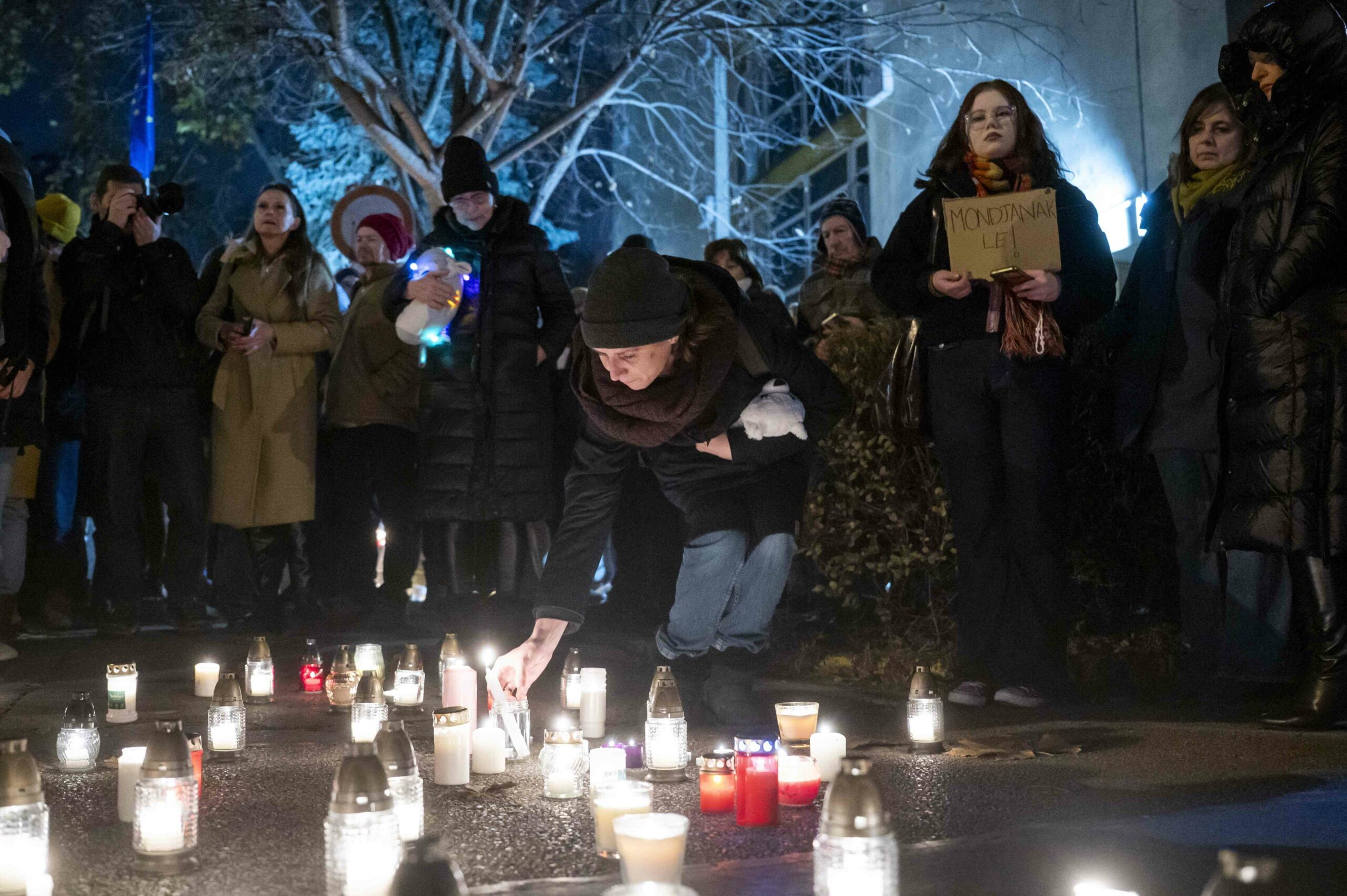
Candles lit during a “silent protest’ held on December 14, 2025 against alleged conditions and abuse at the Szőlő utca Reformatory of Budapest. MTI/Balogh Zoltán
In 2022, I worked for several months in a children’s home with ten teenagers, boys and girls. One 14-year-old girl was already living off prostitution and supporting her alcoholic mother and siblings. She drank alcohol continuously on top of her ADHD medication. Three older boys were drug addicts, two were alcoholics. While I was there, it emerged that an alcoholic porter who groped the children had recently been dismissed. There was no group leader, no professional leader, and not enough child supervisors or caregivers. When I introduced myself to the children, one 13-year-old asked: ‘Why? You’ll disappear in two weeks anyway’.” – A response submitted to Atlatszo’s anonymous questionnaire
In 2024, the Hungarian Ombudsman again examined the operation of child-protection institutions in the country and subsequent reports once more confirmed serious problems at such centres caused by constant staff turnover, lack of preparedness among applicants, and insufficient professional qualifications.
“In western Hungary there is a city where eight or nine children’s homes had to be closed because there were no staff,” says Attila. “Not because there are no special-education teachers or social workers – there is no one at all. Not even someone who used to drive a forklift in a DIY store or stock shelves in a hypermarket – anyone with two legs.”
Child prostitution is “fundamentally latent and mostly hidden in nature… therefore the number of such cases and the true scale of the problem cannot even be estimated,” according to an earlier report by the Ombudsman. This view is backed by Attila. “Out of my 200 children – who were minors, by the way – not a single case made it to court. We often reached the stage of police reports, but after that I was never summoned to testify in court.”
According to Windt, if all related crime categories are considered together – human trafficking and forced labour, pimping, and the exploitation of child prostitution – then roughly 200-300 proceedings are initiated each year. “This is certainly only the tip of the iceberg, but it is not true that no proceedings are initiated,” she points out.
“The police and the authorities have a very difficult task, because sexual exploitation and prostitution-related exploitation are extremely hard to prove,” says Vaskuti. “It is easier if there is a caught-in-the-act situation and the victim states that the other party knew they were a minor and promised compensation. But how often does that happen?”
I did a university internship in a special children’s home for a few months. Often, their pimps would be waiting for the girls when they left, making these children believe that it was a love affair. Many of them didn’t return because they were taken abroad to work as prostitutes. – A response submitted to Atlatszo’s anonymous questionnaire
Because of emotional attachment, victims usually find it extremely difficult to file reports or give incriminating testimony. These cases differ significantly from, for example, a burglary, where it is clear that the offender should be punished. The literature refers to the “loverboy method”, where the perpetrator gradually builds trust, forms an emotional relationship, and manipulates victims with kind words and unrealistic promises. Children in care are often willing to do almost anything for a single kind word.
But some break out of the cycle and move on with their lives. Reni is now married, raising two small children with her husband in a rural settlement; one attends kindergarten, the other is still at home. However, Reni’s sister hasn’t been so lucky – she continues to earn money through prostitution and is still addicted to drugs.
Written and translated by Orsolya Fülöp. *Names have been changed. The original article was first published in Hungarian language. The English version was published by Balkan Insight as well. Cover image: Motion Array.
Share:
Your support matters. Your donation helps us to uncover the truth.
- PayPal
- Bank transfer
- Patreon
- Benevity
Support our work with a PayPal donation to the Átlátszónet Foundation! Thank you.
Support our work by bank transfer to the account of the Átlátszónet Foundation. Please add in the comments: “Donation”
Beneficiary: Átlátszónet Alapítvány, bank name and address: Raiffeisen Bank, H-1054 Budapest, Akadémia utca 6.
EUR: IBAN HU36 1201 1265 0142 5189 0040 0002
USD: IBAN HU36 1201 1265 0142 5189 0050 0009
HUF: IBAN HU78 1201 1265 0142 5189 0030 0005
SWIFT: UBRTHUHB
Be a follower on Patreon
Support us on Benevity!
