

Samsung’s battery factory in Göd continues to operate despite court ruling

In October, following a lawsuit filed by the CSO Göd-ÉRT Association, the court revoked the IPPC permit for Samsung SDI’s factory in Göd and ordered the authorities to conduct a new procedure. As a result, battery production should have been suspended, but there is no sign of this: people living near the factory complain of unbearable noise, and hundreds of air pollution sources are still operating. It appears that the court’s decision has been “overruled” by the government, which has ruled that the factory can continue to operate even without a permit. However, this is not possible under current legislation.
We previously reported that on October 7, the Budapest Regional Court revoked the IPPC permit for the battery factory in Göd, which the Pest County Government Office had repeatedly amended in violation of the law due to the expansion of Samsung SDI.
The court ordered the authority to conduct a new environmental procedure: until the new permit is issued, the factory cannot continue to use the environment and must therefore suspend its activities.
The winning party, the Göd-ÉRT Association, received the written court ruling on November 10, which, according to the law, must be delivered within 15 days. The permit required for the factory to operate has therefore been invalid since the end of November, but there appears to have been no change in the plant’s operations:
The hundreds of point sources of air pollution at the two factory units continue to operate, and the noise and humming of the plant at night have become even louder in recent weeks.
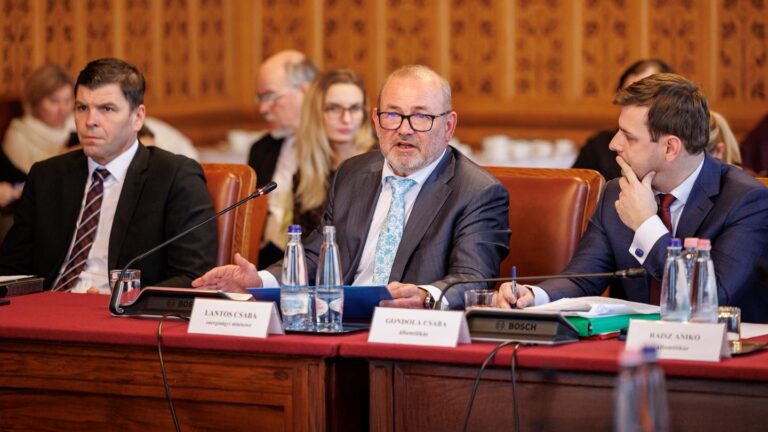
At the November 25 meeting of the National Assembly’s Sustainable Development Committee, following the annual hearing of Energy Minister Csaba Lantos, Member of Parliament Rebeka Szabó addressed a question to the minister regarding the revocation of the Göd factory’s license and the cessation of its operations. In his response, Minister Csaba Lantos stated that the plant currently does not have an environmental permit, but added that he “disagrees” with the court ruling that revoked the permit.
“Since we introduced new emission limits for battery factories, thereby also stipulating the maximum levels for NMP, for example, this has now been overturned by the Honorable Court’s decision. This means that the limit of 150 will be reinstated instead of 1… if this factory were to produce, but obviously, it cannot produce at full capacity. It is certain that the battery factory in Göd will have to submit a new permit application, which will be the most stringent environmental permit ever issued. And I have to say that it will comply with this, so it can only continue to operate at the appropriate capacity if it complies with these new permits,” said Minister Csaba Lantos.
The ministerial justification for “tightening” the limits is strange to begin with, because the authorities responsible for the factory’s operation had previously violated the applicable legal requirements when they allowed an emission limit of 150 mg/m3 for the toxic solvent NMP, as we wrote in a previous article. It is a gross misrepresentation that the court, by revoking the permit, would give free rein to this previous, unlawful situation.
We contacted the Pest County Government Office and the Ministry of Energy to clarify whether Samsung SDI Zrt. can continue its battery manufacturing activities at its Göd site in the absence of a unified environmental permit until a new permit is obtained.
The government office replied only that the authority is currently “conducting a comprehensive environmental review of the Göd plant.” However, the documents relating to this new procedure have not yet been made public.
The ministry provided a more detailed response. As they wrote, “in this case, the Budapest Regional Court revoked Samsung SDI’s IPPC permit and instructed the Pest County Government Office to conduct a new procedure. Based on the ruling, Samsung SDI may only continue to operate in activities that can be carried out without the revoked IPPC permit. Samsung SDI voluntarily reduced its heat production activity specified in the permit (115.391 MW) to below the IPPC permit threshold (50 MW heat output).”
The ministry’s statement does not mention how the “voluntary” reduction in the activity of the heat-producing boilers will be monitored.
However, in 2024, the government tightened the licensing requirements for investments in the battery industry, making it mandatory to conduct an environmental impact assessment and obtain an IPPC permit for all battery investments. Thus, according to Government Decree 314/2005 (XII. 25.), no battery factory can (or could) operate without an IPPC permit since September 2024.
According to the position of the winning Göd-ÉRT Association, battery production at the plant must be halted until the authorities issue a new permit.
The position of the civil society organization was confirmed by the association’s legal representative, Dr. Csaba Kiss, attorney-at-law:
“The factory cannot operate until the official proceedings are concluded, as this is the essence of a permit: until it is obtained, the activity cannot be carried out,”
the association’s legal representative told Átlátszó.
According to the Göd-ÉRT Association, the problem is not only that the battery factory is operating without a license, but also that the authorities and the ministry are assisting the factory in its irregular operations, which pose a threat to health and the environment.
“There was a year when the factory released 81 tons of a fetus-damaging solvent into the air. This substance, NMP, was detected by accredited laboratory tests conducted by Göd-ÉRT and Greenpeace in wells in Göd and in municipal sewage that spilled onto farmland during a pipe break, but no Hungarian authority has been willing to investigate this since then, just as they have not investigated the black dust deposits visible on satellite images on the roof of the factory. Nothing is being done about the noise from the factory’s nighttime operations, even though the noise from the plant can be heard for several kilometers at night,” emphasizes the CSO.
Written by Zsuzsa Bodnár, translated by Zalán Zubor. The original Hungarian version can be found here. Cover photo: Gábor Czepek, Deputy Minister, Parliamentary State Secretary (Ministry of Energy), Minister of Energy Csaba Lantos, State Secretary for Circular Economy and Climate Policy Csaba Gondola (Ministry of Energy) at the meeting of the National Assembly’s Sustainable Development Committee on November 25, 2025. (Photo: Facebook)
Share:
Your support matters. Your donation helps us to uncover the truth.
- PayPal
- Bank transfer
- Patreon
- Benevity
Support our work with a PayPal donation to the Átlátszónet Foundation! Thank you.
Support our work by bank transfer to the account of the Átlátszónet Foundation. Please add in the comments: “Donation”
Beneficiary: Átlátszónet Alapítvány, bank name and address: Raiffeisen Bank, H-1054 Budapest, Akadémia utca 6.
EUR: IBAN HU36 1201 1265 0142 5189 0040 0002
USD: IBAN HU36 1201 1265 0142 5189 0050 0009
HUF: IBAN HU78 1201 1265 0142 5189 0030 0005
SWIFT: UBRTHUHB
Be a follower on Patreon
Support us on Benevity!
