

Átlátszó wins first-instance lawsuit against the Sovereignty Protection Office
We won a first-instance lawsuit against the Sovereignty Protection Office in a personal rights lawsuit. According to the judge, the Sovereignty Protection Office violated the reputation of Átlátszó by accusing our newspaper of intelligence gathering and disinformation activities and the systematic misuse of public interest data. The court prohibited the Sovereignty Protection Office from further violations, and also ordered the state authority to issue an apology and pay damages for the defamation campaign launched against Átlátszó. The judgment is not final, the Office can appeal to the second-instance court.
Our newspaper filed a personal rights lawsuit against the Sovereignty Protection Office after it accused Átlátszó, in its “investigation report” last year and the video it made about it, of spying, being a member of a foreign pressure and influence network, falsifying news, or engaging in intelligence activities. Since these allegations are untrue, we took the matter to court: we asked the court to prohibit the Sovereignty Protection Office from further violations, and to oblige it to issue an apology and pay damages.
The first hearing took place in May, but the representative of the Sovereignty Protection Office did not appear because he was attending another hearing. The lawyer appeared for the second hearing at the end of June: then we finally learned that the Office did not establish facts in its report, but only drew “an investigative conclusion based on facts.”
The Office argued that intelligence gathering was not used in the criminal law sense in the report, as they interpreted the term to also apply to those who systematically collect and organize information, i.e.
even everyday journalistic activity is considered intelligence gathering.
The third day of the hearing was on November 11. The court then heard the lead analyst who prepared the report: dr. Miklós Sári. He was asked, among other things, how he could prove the claims in the Facebook video that was the subject of the lawsuit (and also the summary of the report). The analyst from the Office was unable to provide any evidence, and only repeated the claims and conspiracy theories published in the report.
In response to the judge’s question the wittness also revealed that although an entire analysis department worked on the report on Átlátszó, while compiling the 28-page document, they did not find anything that they should have reported to the prosecutor’s office or any other authority, and no suspicion of real crimes arose.
False allegations, apology, damages
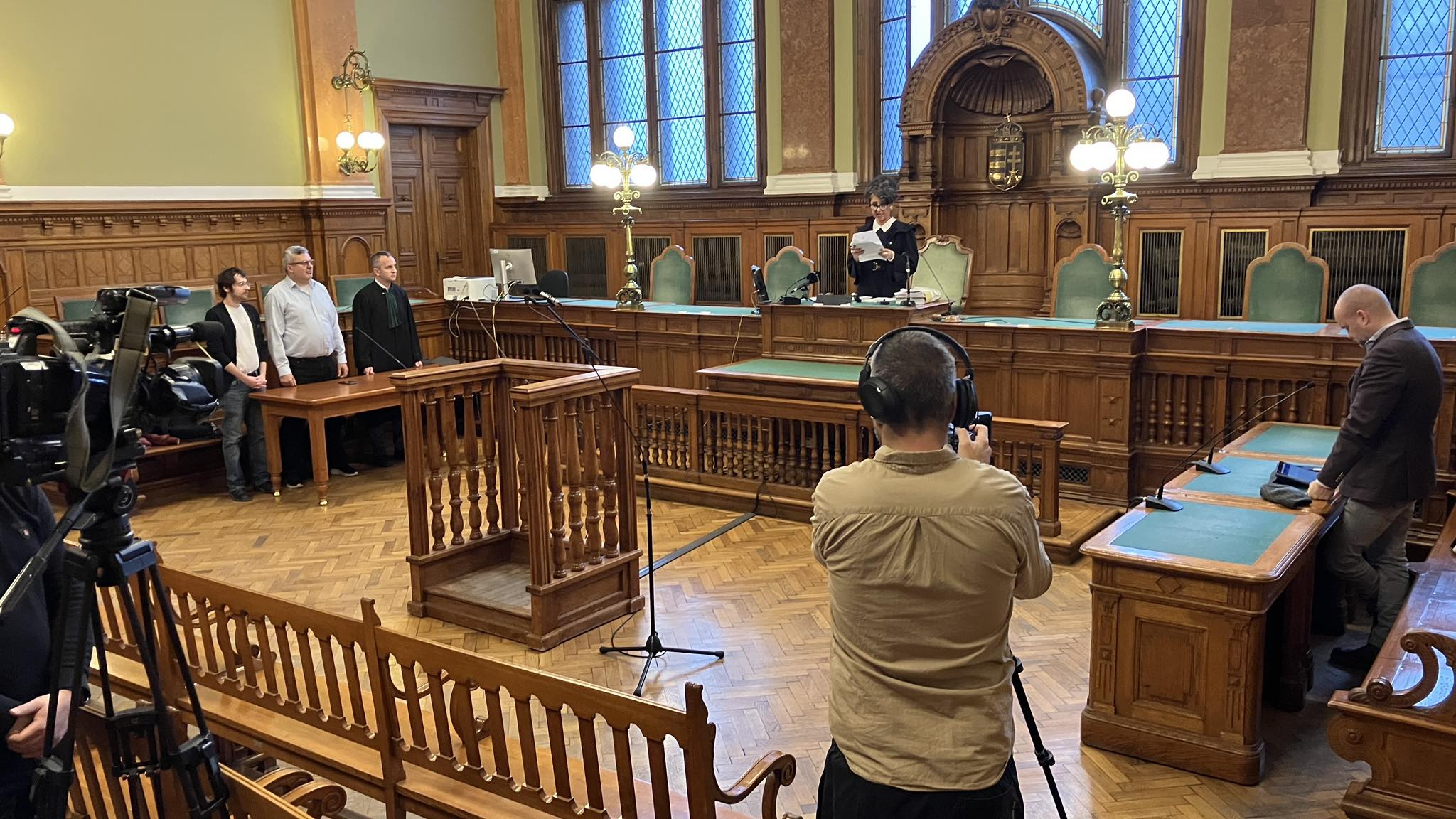
The verdict was announced at the Budapest Metropolitan Court on 4 December. According to the court ruling, the Sovereignty Protection Office violated the good reputation of Átlátszó by falsely claiming that Átlátszó was engaged in intelligence activities, created a pretext for Brussels to blackmail Hungary by withholding EU funds, submitted a partial report to the Sargentini report and concealed it, was in the employ of a foreign country, misused public interest data, and engaged in disinformation activities.
The court prohibited the defendant from further infringement, and the Office must apologize and publish a correction on its website after the judgment becomes final. They must also pay 3.8 million forints in damages and 2.4 million forints in legal costs.
According to the court’s reasoning, a state body does not have the right to express an opinion,
therefore, the Sovereignty Protection Office cannot formulate opinions either. So if it claims something, it must prove it, which in this case was not done beyond all doubt. The court also stated in its judgment that although there is no administrative remedy against the reports published by the office, there is a possibility of civil litigation (the Office also disputed this).
The case of Tamás Lánczi with the facts
Tamás Lánczi, President of the Sovereignty Protection Office, wrote the following on Facebook after the court ruling :
“The Metropolitan Court of First Instance determined that it is harmful to Átlátszó’s good reputation that it has been revealed to the public that they are engaged in intelligence and disinformation activities and are financed from abroad. However, the situation is that these are facts.”
However, there are two problems with this. One is that the court ruled in its 76-page judgment that the Sovereignty Protection Office could not prove its claims. So it is not true that anything was “revealed” about us, what was revealed was that the Office could not prove their claims in court. The other is that the legal representative of the Sovereignty Protection Office argued throughout their defense in the lawsuit that
They did not state facts, only opinions about Átlátszó.
It was even stated in the courtroom by the Office that when Tamás Lánczi, the President of the Office, spoke about facts, he – since he is not a lawyer – “did not use the term “fact” in a legal sense.” Opinions do not need to be supported by evidence as if they were factual statements.
In contrast, in his post responding to the court ruling, Lánczi repeated for the umpteenth time the claims that the court ruled were untrue and unlawful, and from which the court had banned the Office in the first instance. In response to Lánczi’s rant, we have published the operative part of the court ruling: let everyone decide for themselves what kind of ruling was actually made.
Tamás Bodoky, editor-in-chief of Átlátszó, said in response to the verdict that the court’s decision is a great satisfaction for us, as it has become clear that no state body can lie without consequences, so it is worth going to court if someone has been harmed by the Sovereignty Protection Office.
According to Balázs Tóth, legal representative of Átlátszó, the message of the lawsuit is that state bodies are still obliged to operate within the framework of the law. The essence of a state governed by the rule of law is not that there are no violations of the law, but that violations of the law have consequences.
Text: Eszer Katus — Video: Gergely Pápai
Share:
Your support matters. Your donation helps us to uncover the truth.
- PayPal
- Bank transfer
- Patreon
- Benevity
Support our work with a PayPal donation to the Átlátszónet Foundation! Thank you.
Support our work by bank transfer to the account of the Átlátszónet Foundation. Please add in the comments: “Donation”
Beneficiary: Átlátszónet Alapítvány, bank name and address: Raiffeisen Bank, H-1054 Budapest, Akadémia utca 6.
EUR: IBAN HU36 1201 1265 0142 5189 0040 0002
USD: IBAN HU36 1201 1265 0142 5189 0050 0009
HUF: IBAN HU78 1201 1265 0142 5189 0030 0005
SWIFT: UBRTHUHB
Be a follower on Patreon
Support us on Benevity!
